The decay of earth's magnetic field has been one of the strongest evidences for the Bible's recent creation doctrine. This concept, developed originally by Dr. Thomas Barnes in 1971, was updated and revised by Dr. Russell Humphreys in 1983. Here are the details.
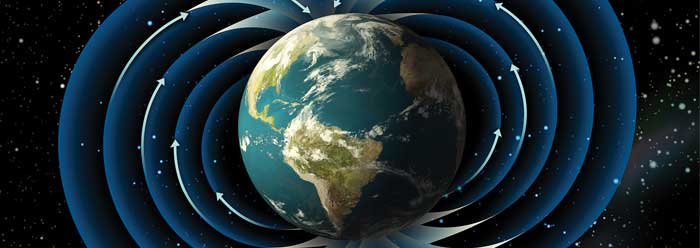
Earth is surrounded by a powerful magnetic field, generated by well-understood and well-documented electric currents in its metallic core. Incoming solar and stellar radiation continually bombards earth and does great damage to life, causing harmful mutations and likely contributing to the aging and death of living things. Indeed, if these rays were not impeded and filtered by earth's magnetic field, life here would be impossible.
The strength of the magnetic field has been reliably and continually measured since 1835. From these measurements, we can see that the field's strength has declined by about seven percent since then, giving a half-life of about 1,400 years. This means that in 1,400 years it will be one-half as strong, in 2,800 years it will be one-fourth as strong, and so on. There will be a time not many thousands of years distant when the field will be too small to perform as a viable shield for earth.
Calculating back into the past, the present measurements indicate that 1,400 years ago the field was twice as strong. It continues doubling each 1,400 years back, until about 10,000 years ago it would have been so strong the planet would have disintegrated--its metallic core would have separated from its mantle. The inescapable conclusion we can draw is that the earth must be fewer than 10,000 years old.
Compare this "clock" with others used to estimate earth's age. This method utilizes a long period of measurement, amounting to over one-tenth of a half-life, whereas radioisotope decay has been accurately measured for only about 100 years, while its half-lives are typically measured in the billions. The short half-life should be favored by uniformitarians for it minimizes the chances that something dramatic has happened to change things, since longer spans are more susceptible to out-of-the-ordinary events. Magnetic field decay also involves a whole earth measurement, and on this large scale it cannot be easily altered or "contaminated," as could any rock selected for radioisotope dating. The young-earth implications are even stronger when the energy of the field is considered rather than its strength, for the energy's half-life decays each 700 years.
Recent creation ideas are necessarily coupled with the global Flood in the days of Noah, during which all of earth's processes and systems were severely disrupted. As ferro-magnetic material rose through the existing magnetic field (when the "fountains of the great deep [were] broken open," Genesis 7:11), temporary reversals in both local and planetary fields would have been induced rapidly, as in an electromagnet. This would have been recorded as "magnetic stripes" flanking mid-ocean spreading centers. Uniformitarians propose a self-generating dynamo (itself a contradiction in terms with inferior theoretical support) of circulating core fluids that slowly decline to zero strength and start up again with reversed orientation. While all processes wane in intensity over time, if a planetary field caused by fluid movements ever went to zero, it could not restart itself.
All things considered, the magnetic field "clock" might be the very best of geochronometers, nearly all of which indicate a maximum age for earth far too short for evolution to occur. The weight of the scientific evidence is on the side of the young earth--and of biblical doctrine.1
Reference
- For more details, see Morris, J. 2007. The Young Earth, revised ed. Green Forest, AR: Master Books; and Snelling, A. A. 2009.Earth's Catastrophic Past. Dallas, TX: Institute for Creation Research, 509.
* Dr. Morris is President of the Institute for Creation Research.
Cite this article: Morris, J. 2010. Earth's Magnetic Field. Acts & Facts. 39 (8): 16.