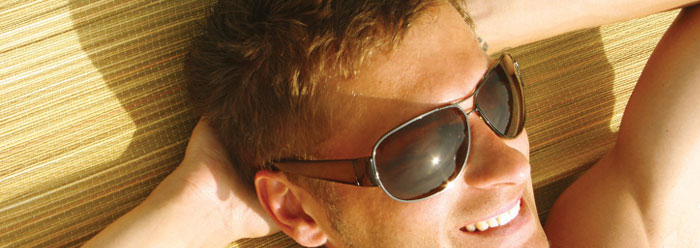
Most people north of the equator have an observable suntan by August. Ironically, a desire to be outside is often coupled with another strong desire to get out of the sun, as indicated by sales of sun umbrellas and other types of sunshades.
From a biological standpoint, energy from the sun always needs to be controlled. This means that there is complex biological machinery in place to manage sunlight in some way. The machinery itself would not exist without information in DNA prescribing its materials, manufacture, and operation. Suntans result from this special biological machinery and function like the skin's own built-in umbrella to get skin cells "out of the sun." The process is so important that if it were absent, people would have a higher probability of being killed just by the sun's raw energy.
The Sun's Energy Damages Skin
The highly vulnerable top layer of skin--the part that is tough, can callous, and eventually flakes off--is made of the protein keratin, produced by cells called keratinocytes. Sunlight--especially the ultraviolet (UV) part of the light spectrum--is naturally a photocarcinogen. It can penetrate keratinocytes, damage the DNA, and lead some cells to possibly be transformed into cancer cells, such as a deadly melanoma. The cumulative effect on the human species of sun-damaged DNA over time is not trivial. Humanity's survival is highly dependent on a mechanism to manage sunlight and repair damaged DNA. People produce a complex compound called melanin that dissipates the damaging effect of UV light as heat and helps prevent skin cancers in other ways also--but only up to a point.
Colored pigments in house paint protect the house's siding from sun damage. Melanin is a colored pigment for people, one of several compounds giving skin its coloration, generally contributing shades of red, brown, or black. Melanin is produced by melanocytes. Everyone has roughly the same number of melanocytes--regardless of skin color--but they are concentrated differently in various body parts to meet specific needs. There are over one million per square inch on the highly sun-exposed back of the hand, compared to 440,000 per square inch on the palm. Melanocytes produce different types and quantities of melanin based on inherited genetic instructions and dynamic gene regulation in response to a person's changing environment. This determines each person's skin color and allows the skin to respond to harmful UV light.
Melanin Can Control Harmful Energy
Melanin is contained in small packages called melanosomes, literally "dark bodies." The pigment melanin is not distributed randomly throughout the top layer of skin cells, the keratinocytes. Since it is particularly DNA in the skin cell nucleus that needs protection, it would make sense to place the melanosomes as a tightly packed shield, or protective sun umbrella, over the nucleus. That umbrella arrangement on the sunny side of the nucleus is exactly where the majority of melanosomes are found. With continued sunlight exposure, even more melanosomes are built and packed on the sunward side of the nucleus, sometimes several layers thick. Since a person can accumulate hundreds of millions of melanosomes per square inch protecting skin cell nuclei, the whole skin appears increasingly darkened, a condition popularly known as...a suntan.
So how does melanin protect the nucleus? There are two main steps. A fast step is produced by UV light itself, which induces melanin to undergo a chemical reaction that turns it darker. This enables it to absorb even more UV light. (Chemical engineers are working to develop paint pigments that can automatically change shades.) The second step is to stimulate melanocytes to produce more melanin. Consider this cellular relationship: one melanocyte can "serve" many skin cells by making melanin to protect their DNA and, in like manner, skin cells serve melanocytes by providing their vital protective covering.
How Melanin Is Produced
There are at least six major routes to stimulate melanin production. Melanin has other functions in the body not related to UV protection. But all routes require very strict control by several protein enzymes and if any of these enzymes in the path is missing, melanin will not be produced. Eventually these routes all stimulate a messenger (called cAMP) that is able to achieve activation of genes in the nucleus of melanocytes to make more melanin. UV light acts as one stimulus.
Another stimulus is quite amazing. Under average sun-exposure conditions for a person, the rate of skin cell DNA damage and repair (an especially complex process) varies within a narrow range. Melanocytes indirectly monitor the repair rate, and if it rises--indicating increased sun damage--melanin production is boosted to protect DNA from further damage. Managers call that solving the root cause of the problem and not just fixing the consequences.
A melanosome is actually an organelle in a cell. This means it functions inside the cell with a definite purpose just like an organ, such as a kidney, functions in a body. But melanocytes are regularly making brand-new melanosomes. A melanosome is initially constructed of a fiber-like network foundation laid down by special protein (Pmel17) unique to melanocytes. To this is added a light-sensitive pigment called L-DOPA quinone, which is manufactured through a multi-step process from the amino acids phenylalanine or tyrosine.
The transfer of melanosomes from melanocytes to skin cells is unique in human biology, requiring a whole organelle specific to one cell type to be transferred to a completely different type of cell. How? The melanocyte will form long arms that will extend up between the skin cells. Growing inside are microtubules (so small that 3,000 could fit in the diameter of a human hair), which act like railroad tracks to shuttle melanosomes. Tiny protein motors made for the microtubules pull the melanosomes outward. Under the direction of at least two more genes and controlled by four carrier proteins, the melanosome is put into a transfer vesicle at the tip of the arm. This tip fits into a special invaginated spot on a skin cell, and then the melanosome is injected into it. Skin cells will convey melanosomes to the sunward side of their nuclei.
Interestingly, the varying number of melanosomes in both melanocytes and skin cells alters, in a measured degree, their metabolism and activity. This is one way in which the body's response to the environment can be centrally monitored at the cellular level in the tissue that is most exposed to external stresses. Melanosomes also can manipulate interactions of many compounds such as electrolytes and neurotransmitters and thus regulate the activity of other cells in its local environment.
Conclusion
Naturalistic evolutionists claim that because earth is "open" to energy from the sun, life could have started and increased in complexity without a Creator. This notion is scientifically incorrect. As illustrated in human skin, raw energy from the sun must be managed by preexisting complex biological systems or else it kills life.
This fact of nature still reigns over all evolutionary speculations. In 2009 about 68,000 cases of melanoma will be diagnosed, with an estimated one million reported and unreported new cases of mostly curable basal cell and squamous cell skin cancer--predominantly in lighter-skinned Americans. Melanin certainly provides a measure of natural protection, but nobody is immune from skin cancer, regardless of skin color. When people overexpose or fail to protect their skin, or have a defect in the pigment-making process, the sun's UV energy can eventually overwhelm skin's protective and repair mechanisms with deadly results.
The Lord Jesus Christ put the human body together to function as a whole. With unsurpassed scientific genius, He designed a complex process--using many different systems--that is capable of generating the protective compound melanin. With power beyond comprehension, He spoke into existence something that requires almost a hundred genes directing hundreds of enzymatic reactions controlling events--which are not arranged in basic linear sequences but as a vast diverse multidirectional network--with layers of overlapping feedback and control, all acting in a goal-oriented fashion. What an amazing display of His love and glory!
* Dr. Guliuzza is ICR's National Representative.
Cite this article: Guliuzza, R. 2009. Made in His Image: Melanin, the Sunblock That's Just Skin Deep. Acts & Facts. 38 (8): 10-11.