Imagine a fish designed with such precision that it has thrived in deep, dark ocean waters for generations unchanged, resilient, and wonderfully suited to its world. That’s the coelacanth, a mysterious creature first known from fossils in ancient rock layers. For decades, textbooks claimed it had gone extinct 65 million years ago. But in 1938, the “extinct” fish stunned the scientific community when one was caught alive off the coast of South Africa. Since then, more have been found, looking remarkably similar to their fossilized ancestors—a striking testimony to stability and purposeful design.1,2
Recently, researchers uncovered new details about the coelacanth’s anatomy. A study in Science Advances showed that many structures in its skull, once thought to be muscles, are actually ligaments.3 This correction adds new depth to our understanding of how the coelacanth’s skull functions in its deep-sea environment. Far from being a primitive leftover, the coelacanth’s cranial design highlights engineering traits that point to intentional craftsmanship.
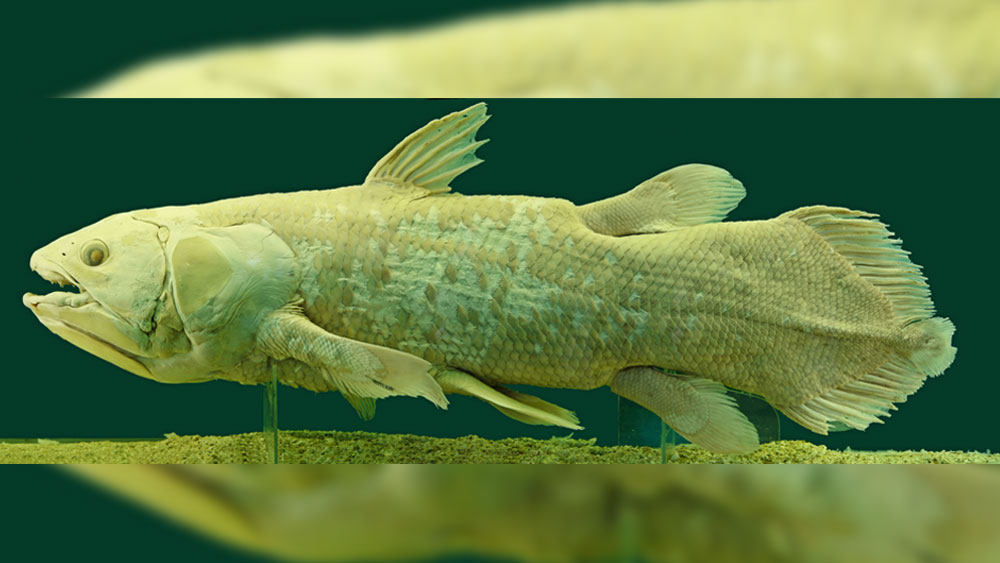
The coelacanth’s skull is unique among fish. A special joint allows the front portion to swing upward, widening its mouth and creating suction for capturing prey. Combined with powerful jaws, this design enables feeding in the low-light, high-pressure depths. Correcting the misidentification of ligaments as muscles expands our understanding of just how intricately this structure is put together—and shows how easy it is to underestimate God’s engineering.
Its lobed fins are equally remarkable. Unlike the thin, fan-shaped fins of most fish, the coelacanth’s are fleshy and jointed. Supported by sturdy bones, they give the fish precise control, almost like mechanical arms. This allows the coelacanth to “walk” along rocky sea beds hundreds of meters below the surface. Slow, deliberate movement suits its ambush hunting style, where stealth is more important than speed. These fins are not transitional stubs waiting to become legs—they are specialized tools, optimized for its environment.4
The coelacanth also possesses a remarkable sensory system. A rostral organ in its snout, filled with gel-like material, can detect electrical signals from prey. This gives it an edge in darkness, where eyesight is limited, and its large, reflective eyes gather what little light filters down. Additionally, its reproductive design—bearing live young after a long gestation—provides added survival advantages. Every feature reflects foresight, not accident.
For decades, scientists misidentified even basic aspects of this fish’s anatomy. That alone is a reminder of how much we still have to learn about God’s creation. Yet each new correction doesn’t diminish the coelacanth’s wonder—it magnifies it. From a biblical perspective, this remarkable fish is no accident of survival. Genesis tells us that God created living creatures “according to their kind” (Genesis 1:21). The coelacanth’s continuity across time reflects that truth. It hasn’t evolved from something else—it has remained steadfast, equipped from the beginning with everything it needs to flourish.5
The coelacanth is more than a living fossil; it is a living witness to the wisdom of the Creator, a reminder that God’s handiwork is not defined by chance or shifting theories but by enduring design. Its ligaments, fins, sensory organs, and reproductive strategies are not leftover parts of some evolutionary experiment. They are deliberate, integrated features—signatures of the One who spoke life into existence. When we glimpse this extraordinary fish, we see not just survival—we see divine craftsmanship and care on display.
References
- Clarey, T. and J. Tomkins. Coelacanths: Evolutionists Still Fishing in Shallow Water. Creation Science Update. Posted on ICR.org April 29, 2013.
- Denton, M. 1985. Evolution: A Theory in Crisis. Bethesda, MD: Adler & Adler.
- Dutel, H. et al. 2025. Cranial Musculoskeletal Anatomy of the Coelacanth Provides New Perspectives on the Evolution of the Vertebrate Skull. Science Advances. 11 (30): eadt1576.
- Guliuzza, R. J. 2018. Major Evolutionary Blunders: The Fatal Flaws of Living Fossils. Acts & Facts. 45 (6): 16–18.
- Morris, J. D. 2007. The Young Earth: The Real History of the Earth—Past, Present, and Future. Green Forest, AR: Master Books.
Stage image: Preserved specimen of Latimeria chalumnae (coelacanth), displayed at the Natural History Museum in Vienna. Once thought extinct for over 70 million years, this living fossil was caught near the Comoros Islands in 1974, challenging evolutionary assumptions with its remarkable anatomical stability.
Stage image credit: Alberto Fernandez Fernandez, CCA 3.0. Used in accordance with federal copyright (fair use doctrine) law. Usage by ICR does not imply endorsement of copyright holder.
* Dr. Corrado earned a Ph.D. in systems engineering from Colorado State University and a Th.M. from Liberty University. He is a freelance contributor to ICR’s Creation Science Update, works in the nuclear industry, and is a Captain in the U.S. Naval Reserve.