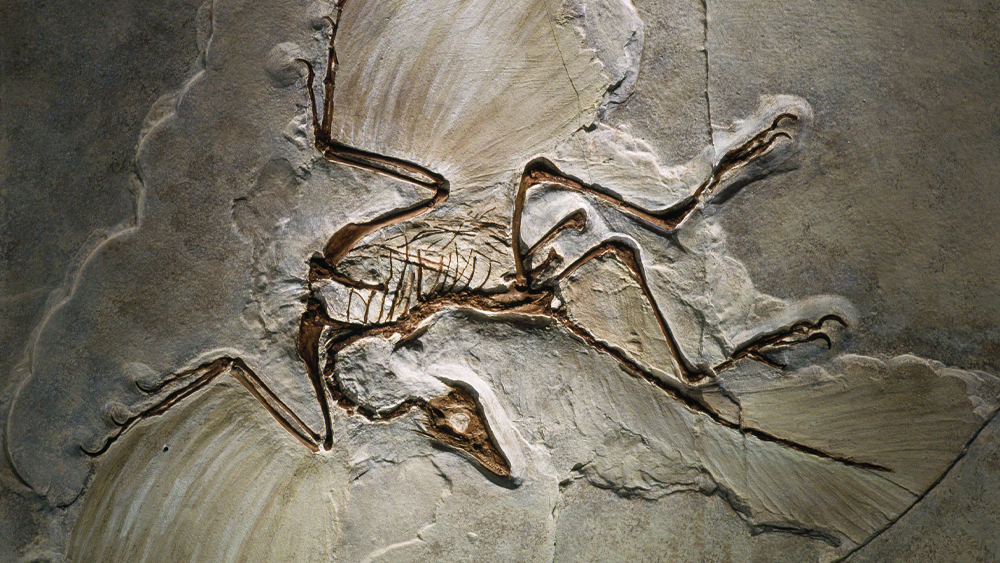
Experts and educators have long assumed Archaeopteryx represents a transition from theropod dinosaurs to modern birds. All of this speculation depends on the fossils having been deposited many millions of years ago. But a newly described Chicago specimen—the fourteenth known Archaeopteryx—seems to have preserved original body tissues that would deflate its assumed old age and thus the evolutionary tales that require all those supposed years.
Publishing in Nature, a team led by the Chicago Field Museum’s associate curator of fossil reptiles, Jiangmai O’Connor, used UV light to distinguish differences between materials, and some of them looked like original biomaterials.1
The Field Museum press release said that Archaeopteryx “lived about 150 million years ago during the Jurassic Period” and “is the fossil that proved Darwin right.”2 However, if the tissues they described could not last even one million years, then both Darwin and “150 million years” are wrong.
The study authors used the following phrases to describe the “soft tissues of the extremities:” “skin covering the right major digit of the hand is preserved,” showing a “clear outline of the skin along the major digit.”1 Further, “The plantar foot pads are partially preserved…visible under ultraviolet light.”1 This long-buried bird still has its “toe pads preserved.”1 Indeed, the images are stunning. They show clear color and texture differences between limestone matrix, bone, skin, and even the toe claws’ “keratinous sheath.”1
Like horns and fingernails, claws have always had a bone at the core with keratin wrapped around and extending from it. However, keratin is a protein. Studies on protein decay have proven that chemicals relentlessly react with them. Amino acids that comprise proteins have inherent aspects that attract reactions with many nearby chemicals like water and oxygen.3
Such biochemical decay studies show that even the toughest proteins cannot last one million years, assuming a constant and common temperature. This renders the fossil layer’s 150-million-year age assignment impossible.
Although this Nature paper did not chemically investigate what these tissues are made of—whether mineral replacement or what remains from original biochemicals—certain observations make a strong case that these are indeed the original bone, skin, and claw tissues. For one, each tissue type shows a different color. The bone looks off-white—like old bones do. The skin looks, well, skin-tone. And UV light revealed the claws’ “keratinous sheath” as slightly lighter and more yellow than the bone.
If minerals had replaced those original tissues with mere outlines of where those tissues had long before lain—as is the case with many other fossils—then how could three separate minerals each have selected its own tissue to perfectly replace?
Nor is it likely that such minerals could have replaced those tissues so completely without crystallizing at least a little bit beyond the body parts’ exact outlines. Similarly, what minerals could so perfectly mimic original tissue colors?
The study authors concluded in part, “Data from the Chicago specimen reveal new information regarding the skeletal and soft tissue transformations associated with the pivotal transition from fully terrestrial to volant.”1 In other words, they claim that the data—including bird tissues—reveal something (but they don’t say what) about how some ancient land-walker transformed over millions of years into today’s flyers. Ironically, however, the very tissue that they folded into the mandatory evolutionary story deletes that same story by refuting its required long ages.
So, was Archaeopteryx indeed the fossil that proved Darwin right? According to their own analysis, Archaeopteryx was good at both flying and walking, “similar to pigeons and doves.”1 So, no. It’s just a dead bird.
God could just as well have created it as a distinct bird kind. The Genesis Flood paints a grim picture where this bird may have fallen from the sky from exhaustion or got swept it off its feet during the Flood. Limey mud soon hardened into the Solnhofen limestone that surrounded it and so many other fossils when it was buried only 4,500 or so years ago.4,5 No wonder it refutes evolution by looking like a fully formed bird that was entombed recently enough for some of its skin to have been preserved.
References
- O’Connor, J. et al. 2025. Chicago Archaeopteryx Informs on the Early Evolution of the Avian Bauplan. Nature.
- UV Light and CT Scans Helped Scientists Unlock Hidden Details in a Perfectly-Preserved Fossil Archaeopteryx. Chicago Field Museum press release. Posted on fieldmuseum.org May 14, 2025, accessed May 15, 2025.
- See references in Thomas, B. and S. Taylor. 2019. Proteomes of the Past: The Pursuit of Proteins in Paleontology. Expert Review of Proteomics. 16 (11–12): 881–895.
- See references in Clarey, T. Bavarian Turtle Fossil Supports Marine Mixing. Creation Science Update. Posted on ICR.org August 21, 2023, accessed May 19, 2025.
- Thomas, B. 2018. Two Date Range Options for Noah’s Flood. Journal of Creation. 31 (1): 120–127.
Stage image: Archaeopteryx lithographica, found in the southern Germany.
Stage image credit: National Geographic Society, James L. Amos, public domain. Used in accordance with federal copyright (fair use doctrine) law. Usage by ICR does not imply endorsement of copyright holder.
* Dr. Brian Thomas is a research scientist at the Institute for Creation Research and earned his Ph.D. in paleobiochemistry from the University of Liverpool.