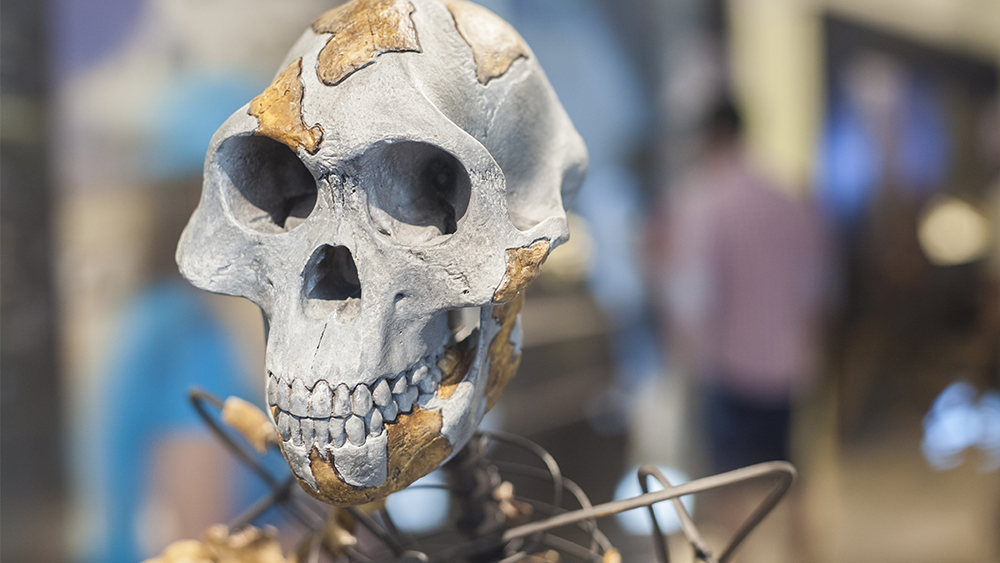
The vain attempt by evolutionists to make an evolutionary connection between people and ape-like ancestors continues. This time, it is in regard to the inner ear of a supposedly six-million-year-old ape fossil called Lufengpithecus.
To begin, scientists from New York University made a refreshingly blunt admission: "While scientists have long been intrigued by the question of how humans’ bipedal stance and movement evolved from a quadrupedal ancestor, neither past studies nor fossil records have permitted the reconstruction of a clear and definitive history of the early evolutionary stages that led to human bipedalism."1
This is certainly true, and some scientists have suggested some truly outrageous theories for how and why mankind started walking upright.2,3,4,5 So, this disclaimer is appreciated; however, as is typical with macroevolutionary stories, this report is still awash with speculation, bias, and subjectivism.
Terry Harrison, a New York University anthropologist, lists a three-step process toward human bipedalism, “First, the earliest apes moved in the trees in a style that was most similar to aspects of the way that gibbons in Asia do today.”1 This is hardly a first step toward our alleged ancestors walking upright. Apes are designed to move in trees.
He continued,
Second, the last common ancestor of apes and humans was similar in its locomotor repertoire to Lufengpithecus, using a combination of climbing and clambering, forelimb suspension, arboreal bipedalism, and terrestrial quadrupedalism. It is from this broad ancestral locomotor repertoire that human bipedalism evolved.1
Scientists do not know what the last common ancestor of humans and apes was.6 So, to say this unknown common ancestor was similar to Lufengpithecus (an extinct ape) is sheer speculation. Then, to state human bipedalism evolved “from this broad ancestral locomotor repertoire” is simply unwarranted extrapolation.
With regard to the fossilized inner ear, Professor Xijun Ni, who led the project, said, “It appears that the inner ear provides a unique record of the evolutionary history of ape locomotion that offers an invaluable alternative to the study of the postcranial skeleton [emphasis added].”1
Professor Ni also explains that people diverged from the great apes after acquiring bipedalism even though evolutionists do not know when, who, where, or how this divergence occurred. He describes Australopithecus as “an early human relative,” despite it being shown over and over again to only be an extinct ape.
“Most fossil apes and their inferred ancestors are intermediate in locomotor mode between gibbons and African apes,” adds Ni. “Later, the human lineage diverged from the great apes with the acquisition of bipedalism, as seen in Australopithecus, an early human relative from Africa.”1 (emphasis added)
But is this supposed acquisition of bipedalism in Australopithecus certain? For example, there has been some disagreement over just how “modern” the bipedalism of Lucy (Australopithecus afarensis) was.7 A study reported by John Hopkins suggested, “Even when Lucy walked upright, she may have done so less efficiently than modern humans, limiting her ability to walk long distances on the ground.”8 A group of evolutionists from Stony Brook went further. They did not agree that Lucy (Australopithecus) walked upright like modern people: “Their analysis showed that the carrying angle of the Afarensis knee joint overlaps with those of orangutans and spider monkeys, and is therefore poor evidence of bipedal locomotion.”9
To conclude, evolutionists do not know Lufengpithecus’ ultimate position in hominoid evolutionary relationships. Even with more research, creationists maintain it will remain merely an extinct ape that was killed by the Flood thousands of years ago.
Mankind was uniquely created to walk upright in the beginning.
References
- Inner ear of 6-million-year-old ape fossil reveals clues about the evolution of human movement. New York University. Posted on phys.org January 29, 2024, accessed January 29, 2024.
- Sherwin, F. Upright Walking Ancestor? Creation Science Update. Posted on ICR.org September 15, 2022.
- Sherwin, F. Man: Created to Walk Upright. Creation Science Update. Posted on ICR.org May 8, 2023.
- Sherwin, F. 2006. Walking the Walk. Acts & Facts. 35 (11).
- Thomas, B. 2015. Did Humans Evolve From Ape-Like Ancestors? Acts & Facts. 44 (4): 15.
- Tomkins, J. 2018. Separate Studies Converge on Human-Chimp DNA Dissimilarity. Acts & Facts. 47 (11): 9.
- Kimbel, W. H. and L. K. Delezene. 2009. “Lucy” Redux: A Review of Research on Australopithecus afarensis. Yearbook of Physical Anthropology. 52: 2–48.
- 3.2 million-year-old human ancestor Lucy was a tree climber, new evidence suggests. John Hopkins Medicine news release. Posted on hopkinsmedicine.org November 30, 2016.
- Rupe, C. and J. Sanford. 2017. Contested Bones. Livonia, NY: Feed My Sheep Publications, 117; See also Collard, M. and L. Aiello. 2000. Human evolution: From forelimbs to two legs. Nature
* Dr. Sherwin is a news writer at the Institute for Creation Research. He earned an M.A. in invertebrate zoology from the University of Northern Colorado and received an honorary doctorate of science from Pensacola Christian College.