The apostle Paul’s letter to the Colossian church was fundamental for its recipients. Evolutionary ideologies thrived in the city of Colossae, including Epicureanism, Stoicism, and Gnosticism. Each of these erroneous worldviews denied the Creator God, Jesus Christ.
As a prisoner, how could Paul deliver this critical warning letter? The 1,300-mile journey from Rome to Colossae was fraught with many perils and hardships. Paul needed a trusted aid. The one he chose for this important task was Tychicus, described as a “beloved brother, faithful minister, and fellow servant in the Lord” (Colossians 4:7-8).
Tychicus is mentioned five times in the New Testament—four by Paul and once by Luke. He traveled from Troas as part of Paul’s third missionary journey (Acts 20:4-6). In one of Paul’s final letters before his martyrdom, he recorded that he dispatched Tychicus to Ephesus (2 Timothy 4:12). Tychicus was no mere courier but a valued colleague and friend who knew Paul and his ministry intimately. Paul trusted Tychicus to encourage the believers with the knowledge that would help them grow in Christian maturity, sound doctrine, and spiritual discernment.
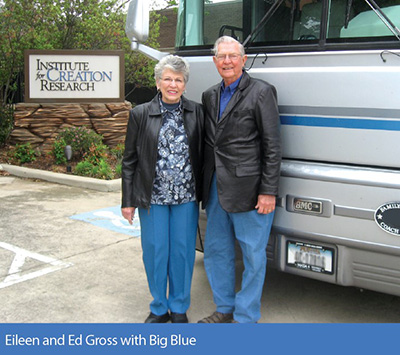 In many ways, Tychicus’ attributes were reflected by the service of one faithful couple, Ed and Eileen Gross. It all began when Jesus grabbed their hearts. “Something was stirring in our lives,” Ed said. “And one Valentine’s night, we were watching TV. There was some speaker on a program that said, ‘I feel really sorry for [those who] are trying to get to heaven by being good.’ That was a key phrase that was like a light coming on. We got down on our knees in the living room in 1972 and accepted the Lord Jesus Christ as our Savior. Intercessory prayer works. Don’t ever give up on intercessory prayer.”
From that point forward, Ed and Eileen began studying God’s Word on their own. “We had never read the Bible up to that point, so it became alive to us.” As their love for Scripture grew, so did their interest in biblical creation. Eileen began listening to a radio program by the Institute for Creation Research’s Drs. Henry Morris and Duane Gish. The Grosses subscribed to ICR publications, including Acts & Facts and Days of Praise.
In 1995, the Grosses decided they wanted to become more involved in biblical creation ministry. They sold their house and began following ICR speakers to various events across America. As volunteers, they helped sell books and explain the ministry’s purpose to others. Eventually, they assisted with ICR Loop Tours for months at a time. “Every Wednesday and Sunday, we were at a different church,” remarked Eileen.
When the tours ended, the Grosses realized that many small churches, especially in the Northwest, couldn’t afford to host speakers or travel for seminars. So, the Grosses purchased their “Big Blue” motor home in 2001 and brought ICR materials to those congregations. For over 10 years, Ed and Eileen logged thousands of miles, representing ICR to hundreds of churches across the United States.
Today, both are enjoying rest in heaven along with their brother Tychicus. Although this precious couple can’t ever be replaced, ICR remains passionate about connecting with our co-laborers. One of the ways we build these relationships is through our Meet and Greet events. These sessions allow me to meet you personally, present pertinent messages on biblical creation, answer questions about ICR’s scientific research, and share our ministry’s vision for the future. If you want more information, you can email us at ICRmeetandgreet@ICR.org.
We’re grateful for fellow coworkers like you who come alongside our ministry to faithfully steward the truth of biblical creation. Our desire is to continue the steadfast work of the brothers and sisters who came before us—like Tychicus and the Grosses—in proclaiming Jesus Christ as Creator, Savior, and coming King to the farthest reaches of the earth.
* Dr. Morse is Director of Donor Relations at the Institute for Creation Research and earned his D.Min. from The Master’s Seminary