



Eight species of dinosaurs were recently unearthed in the Prince Creek Formation of northern Alaska.1 The latest discovery, published in Current Biology, claims the bones were near the North Pole at the time of their burial in Cretaceous System rocks (about 80-85 degrees north latitude).1 This would give the region about 120 days of total darkness each year, making it difficult for dinosaurs to survive in such an extreme cold climate.1 Evolutionary theory provides no explanation for why dinosaurs would be buried in such environments—but Bible-based Flood geology does.
For 70 years now, dinosaurs found in supposedly polar climates have baffled secular paleontologists due to the cold conditions they would have faced and the long periods of darkness involved. Previously, dinosaur fossils and their egg shells were found in northeastern Russia, at a paleolatitude2 (which means their supposed latitude at the time of burial, before the shifting of tectonic plates) of about 70-75 degrees north of the equator. This latitude would have given about 45 days of total darkness per year.3
Last year, evolutionary scientists announced the discovery of dinosaurs in southeastern Australia that they claimed were deposited at a paleolatitude of 76 degrees south of the equator.4 Lead author Patrick Druckenmiller, from the University of Alaska Museum of the North told New Scientist: “We knew dinosaurs had been there, but we didn’t know if they could deal with the cold or even the darkness of winter.”5
In the past, most evolutionary paleontologists assumed that dinosaurs migrated to extreme high latitudes during the long summers and migrated away in the winter months. But the most recent discovery included many eggs, hatchlings, and juveniles in the cache of bones, indicating that these dinosaurs couldn’t have migrated.1
“There’s good evidence that these dinosaurs had incubation periods of over five months,” said Druckenmiller.5 This means that if the dinosaurs laid eggs in the spring, they wouldn’t have hatched until fall. These new hatchlings would have been too small to migrate the great distances necessary to escape the cold and darkness of winter. This implies the dinosaurs were year-round residents of these locations.
So, what gives? How could dinosaurs live so far north and south of the equator and at such high latitudes where the mean annual temperatures were about 50 degrees Fahrenheit or less? Secular science offers no adequate solution to this dilemma.
But ICR scientists have a better explanation, and one that is based on rock data. Our Column Project team has mapped out the megasequences and sedimentary rocks across multiple continents.6 We used these data to reconstruct the pre-Flood land masses and their environments. It resulted in a pre-Flood world that resembled Pangaea and was centered at the equator.6 In fact, nearly all of the land was at latitudes of less than 45 degrees north or south of the equator.
Our reconstruction places the newly discovered dinosaurs in Alaska at about 35-40 degrees north latitude in the pre-Flood world—not at 80-85 degrees where the researchers placed them.6 This provides a much more moderate climate where dinosaurs could thrive. These dinosaurs didn’t live in the far north, nor was Alaska this far north in the original Creation. It wasn’t until rapid plate motion during the Flood that these buried dinosaurs were moved to their present location in Alaska of about 70 degrees north latitude. They were never at 80-85 degrees north.
ICR’s plate reconstructions also place the other discoveries of high latitude Russian and Australian dinosaurs at similarly moderate latitudes in our pre-Flood world.4,6 Explanations of extremely high paleolatitude survival is only an evolutionary fairy tale.
Jesus had a perfect plan for His creation. Dinosaurs were placed in warm and moderate climates. It wasn’t until the wickedness of mankind brought on the judgment of a global flood that these dinosaurs were inundated and their bones moved far from their original locations. The Bible provides the answers.
References
1. Druckenmiller, P.S., et al. 2021. Nesting at extreme polar latitudes by non-avian dinosaurs. Current Biology. 31. DOI: https:// doi.org/10.1016/j.cub.2021.05.041
2. Paleolatitude refers to the supposed past location of the rock layer during its deposition and also where the animals found as fossils were assumed to have lived. Secular science places northern Alaska at extreme high latitudes in the Cretaceous. Contrary to these evolutionary reconstructions, the pre-Flood location is the actual location where the animals resided prior to their inundation. Our reconstructions place these dinosaurs at much more modest latitudes. Later plate movement during the Flood moved Alaska to its present location.
3. Godefroit, P., et al. 2009. The last polar dinosaurs: high diversity of latest Cretaceous arctic dinosaurs in Russia. Naturwissenschaften. 96:495–501. https://doi.org/10.1007/s00114-008-0499-
0.
4. Clarey, T. 2020. New Australian dinosaur surprises evolutionists. Creation Science Update. Posted on ICR.org May 27, 2020, accessed July 29, 2021.
5. Duke, C. 2021. Dinosaurs lived in the Arctic around 70 million years ago. New Scientist. 3341, published July 3, 2021, accessed July 29, 2021.
6. Clarey, T. 2020. Carved in Stone: Geological Evidence of the Worldwide Flood. Institute for Creation Research, Dallas, TX, pp. 178-179.
*Dr. Clarey is Research Scientist at the Institute for Creation Research and earned his doctorate in geology from Western Michigan University.
North Pole Dinosaurs Point to the Flood
More Fossils Show Rapid and Catastrophic Burial
New Species of Spinosaurus Supports Flood Catastrophe
Many people are fascinated with dinosaur discoveries—a new fossil, a new species, and the impressive size. But whenever we read a news article,...

100% Cicada Fossil
Cicadas are an unusual-looking insect belonging to the order Hemiptera (the true bugs, including bed bugs and aphids). If you live in the eastern United...
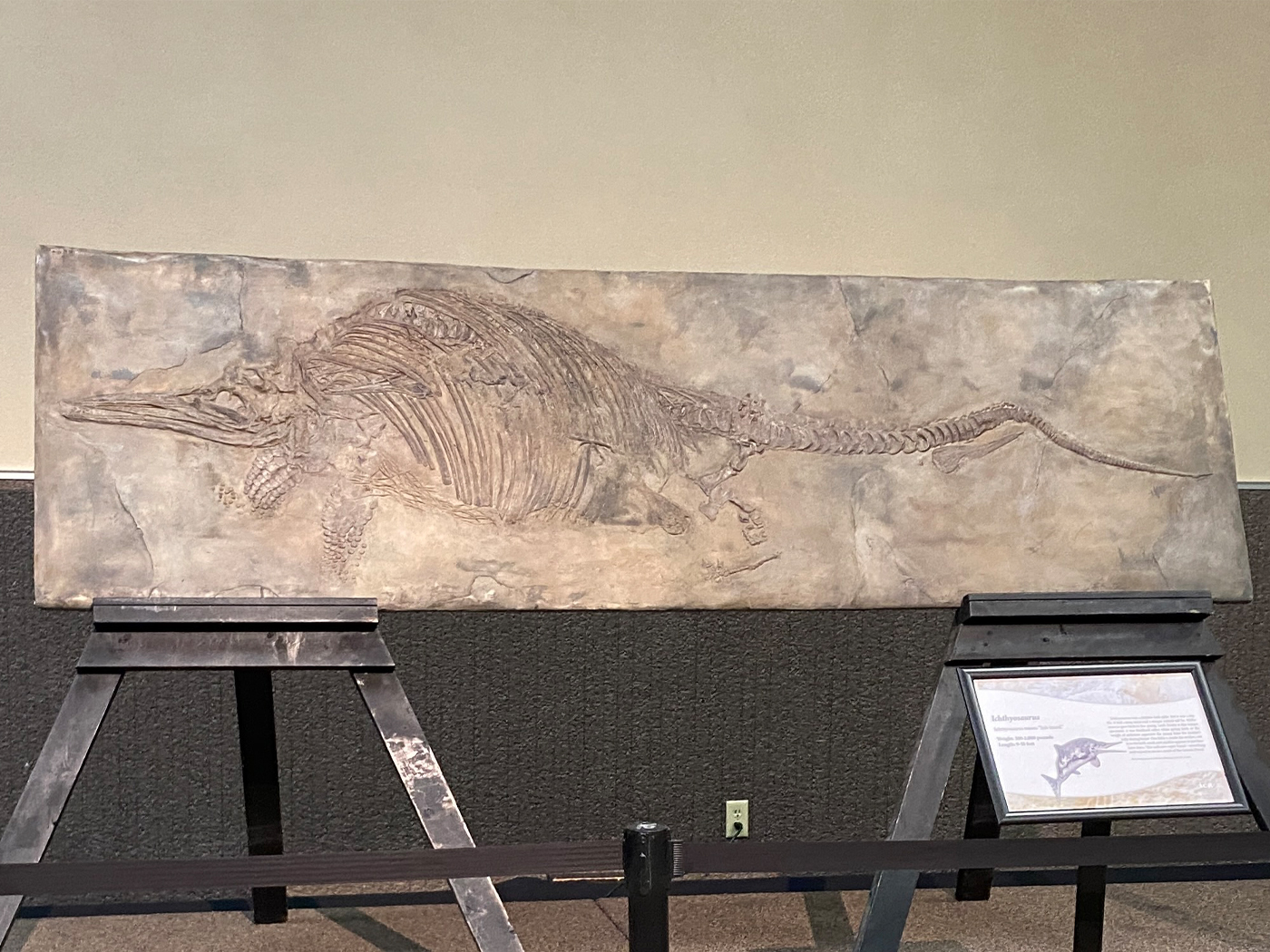
Ichthyosaur Graveyard Explained by the Flood
Ichthyosaurs are marine reptiles that occur globally in the same rock layers as dinosaurs. Specimens with babies support the idea that they gave live...
More Men and Dinosaurs Coexisted
Scientists Late to Recognize Human and Giant Mammal Coe.,.
Giant mammals roamed North America during the Ice Age, but were humans among them? A site in Vero Beach on Florida's East coast contains mammoth,...
Utah Dinosaur Petroglyph Disputed
Underneath a spectacular rock formation in Natural Bridges National Monument in Utah is a rock carving that resembles a sauropod dinosaur. The petroglyph...
We Still Can’t Determine the Sex of Dinosaurs
Recently, a new study led by Queen Mary University of London concluded that dinosaur bones tell us little about their sexes.1 In the past, secular...
More Creation Science Update
Discover the Evidence that Exists for the Bible!
For generations, the Bible has faced skepticism and challenges to its credibility. Critics have questioned whether it is merely a collection of stories...
Fire Sensory Capabilities of the Venus Flytrap
Fascinating discoveries have been made regarding the amazing Venus flytrap (Dionaea muscipula).1 For example, all parts of this amazing plant...
Another Sea Scorpion
There are few animals more nightmarish than an 8-foot sea scorpion. Although, they were not true scorpions, their fossils display a menacing and formidable...
The Latest
Jumping Genes: Engineered to Move
Scientists recently found a “jumping gene” in an odd place. An RNA molecule from a tiny predatory bacterium had entered the cells of a very...
Institute for Creation Research Partners with Louisiana Baptist...
The Institute for Creation Research (ICR) announced today a strategic handover of its School of Biblical Apologetics (SOBA) educational content to Louisiana...
A Tangled Human Tree—or One Human Family?
What if the “ghosts” in our DNA are not lost steps in human evolution? A new Science study found DNA patterns that may point to two unknown...
Mapping the Sense of Smell
Your sense of smell involves much more than enjoying a hike through an aromatic pine forest or appreciating delicious foods.1,2
Our ability...
September 11, 2001: We Will Never Forget
“Fret not thyself because of evil men, neither be thou envious at the wicked: for there shall be no reward to the evil man; the candle of the...
What Can Fossil Teeth Really Tell Us?
A few tiny fossil teeth have been asked to carry a very large story. Researchers used them to name a new order of marsupials, Keeunamorphia, and to...
Man and His Labor
“Man goeth forth unto his work and to his labour until the evening.” (Psalm 104:23)
The 104th Psalm is a beautiful psalm of creation and...
Changing Climates, Stable Primates
What do you picture when you think of the first primates? Conventional scientists have long proposed warm forests, thick vines, and tropical heat as...

September Wallpaper
"[Cast] all your care upon Him, for He cares for you." (1 Peter 5:7, NKJV)
ICR's September 2026 wallpaper is now...
Life’s Origins: The Bootstrap Problem
Could life’s instructions exist without ever being made? This question raises what is called a “bootstrap problem.”1 It...
Shop Related Products

Henry and the Ice Age
$8.99