 Tidewater-tossed seaweeds display God’s providence.1,2 Hidden in plain view, tidewater seaweeds are spectacular exhibits of Christ’s caring bioengineering. Seaweeds even serve as underwater hunting grounds for God’s hungry sea otters.
The giant brown algal seaweed called sugar kelp (Saccharina latissima) sways rhythmically in relatively cold shore waters along the rocky coasts of the Northern Hemisphere’s oceans.3 As photosynthetic plants, these yellowish-brown, floating-frond seaweeds must access and exploit sunlight for producing carbohydrates, such as mannitol sugars.3
However, if these floating seaweeds were unanchored, nothing would prevent them from being washed far from coastlines out to sea—precluding them from fully filling the providential purposes that they serve in sublittoral tidewater habitats, such as ecologically partnering with sea otters, as noted below.3,4 So, for anchoring into rocky seabed substrates, God equipped them with holdfasts that connect via long, flexible, hose-like stipe stems to floating frond leaves. Fronds, like wrinkled elephant ears, have large surface areas, optimized for capturing sunlight to power photosynthesis.3
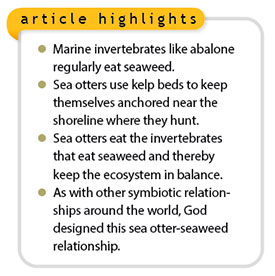
Besides benefiting marine food chains by photosynthetically producing mannitol sugars, sugar kelp illustrates nature’s post-Fall (“good yet groaning”) condition noted in Romans 8:19-22 by its interactive mutual aid (also called mutualistic symbiosis) relationship with sea otters.4
How do kelp help sea otters? Sea otters (Enhydra lutris) float in tidewaters while sleeping, so they harness themselves with kelp “seatbelts” to prevent themselves from floating out to sea too far from shore.4
Also, being carnivores, sea otters forage for sublittoral invertebrates—such as abalone snails, purple sea urchins, clams, crabs, and brittle stars—many of which are attracted to and dwell in underwater kelp forests.
[North Pacific] sea otters are voraciously hungry! Sea otters do not have blubber for insulation. To stay warm in below-freezing seawater (which stays liquid because of salinity), sea otters need warm fur and lots of food. They also have a high metabolism and eat about a quarter of their body weight every day!5
Ever-hungry sea otters, therefore, need underwater hunting grounds that house lots of edible prey—and kelp forests are like sublittoral smörgåsbords, filled with marine invertebrates that sea otters consume!
Thus, by capturing and eating marine invertebrates that eat holdfast-anchored seaweeds, sea otters continually protect kelp forests from suffering destructive overgrazing by kelp-eating gastropods and echinoderms.3-5
God designed kelp to help sea otters, who in turn help kelp. Even seaweeds glorify God, proving how He cares for His creation.
References
- Sherwin, F. 2017. The New Ocean Book. Green Forest, AR: Master Books, 14-17, 62. Regarding tidewater habitats, see Johnson, J. J. S. 2013. God Fitted Habitats for Biodiversity. Acts & Facts. 42 (3): 10-12.
- God’s providential care of His creation was disputed by irreverent deists (like James Hutton and Charles Lyell) who promoted closed-Bible “science” methodologies to evade geoscience facts reported in Genesis. See Mortenson, T. 2004. The Great Turning Point: The Church’s Catastrophic Mistake on Geology Before Darwin. Green Forest, AR: Master Books, 12-16. Deistic uniformitarianism was extended by Darwin’s animistic “natural selection” myth: “Natural selection [was marketed] as the alternative to God’s providence. This displaced the biblical understanding of creation.” Wells, D. F. 2008. The Courage to Be Protestant: Reformation Faith in Today’s World, 2nd ed. Grand Rapids, MI: Eerdmans Publishing, page 77.
- “Hard, rocky coastlines are impossible habitats for true plants to send down roots, but here—between the tides—conditions are perfect for the leafy algae popularly known as seaweeds. Instead of roots that penetrate, seaweeds have structures called holdfasts that cling to the [underwater] substrate. Some holdfasts are like suckers, but others grow dense thickets of tendrils that anchor the seaweed to the [coastal] seabed and shelter tiny invertebrates [including shellfish], while the alga’s long, trailing [emergent] fronds absorb light for photosynthesis.” Ambrose, J. et al. 2020. Oceanology: The Secrets of the Seas Revealed. London: Penguin Random House/Smithsonian Institution, 24-25.
- Psalm 104: 24-27. See Martin, J. 2018. Amazing Animals of Alaska, vol 1. DVD series. David Rives Ministries.
- Johnson, J. J. S. Sea Otters, Dungeness Crabs, and Coronavirus Politics. Creation Science Update. Posted on ICR.org March 27, 2020, accessed April 5, 2021. Besides the brown kelp’s plant-anchoring (described above), God’s providential bioengineering design and construction are needed for successive plant anchoring of vascular plants, such as trees. See Johnson, J. J. S. 2020. Delayed Post-Flood Forestation during the Early Ice Age. Creation Research Society Quarterly. 56 (3): 185-186.
* Dr. Johnson is Associate Professor of Apologetics and Chief Academic Officer at the Institute for Creation Research.
.jpg)