Researchers published the hadrosaur’s detailed description in the online journal Scientific Reports and named the fossil Kamuysaurus japonicus.1 Hadrosaurs, known popularly as duck-billed dinosaurs, had plant-eating teeth and jaws and could walk either on their hind legs or on all four legs. Subtle differences justified this dinosaur’s new name, although it looks basically the same as Edmontosaurus-types found in North America, Russia, and China.
A Hokkaido University press release via EurekAlert noted that the remains were found in “marine deposits.”2 The team suggested that it “preferred to inhabit areas near the ocean.”2 Mingled fossils included sea creatures like “ammonoids, mosasaurs and a sea turtle.”1 The hadrosaur didn’t have fins or flippers, so what was it doing there?
Figure 7 of the report includes an illustration of a dramatic scene of the Japanese hadrosaur dead and floating belly-up in a still sea with living sea creatures. Gizmodo also reported on this find, saying, “The researchers speculate that its carcass floated out to sea, eventually falling onto the seafloor, allowing it to be preserved in sediment.”3
This “floated out to sea” explanation doesn’t wash—we’ve heard this speculation before. It raises the same three unanswered questions in Japan as it does in Montana,4 the western United States5,6 including Colorado,7 Canada, (where a dinosaur “wasn’t supposed to be there”8), England,9 the rest of Europe,10 Morocco,11 (where a dinosaur discovery was “like hunting for fossil whales and finding a fossil lion,”)12,13 the Pacific coast from California to Alaska,14 Mongolia,15 and who knows where else.
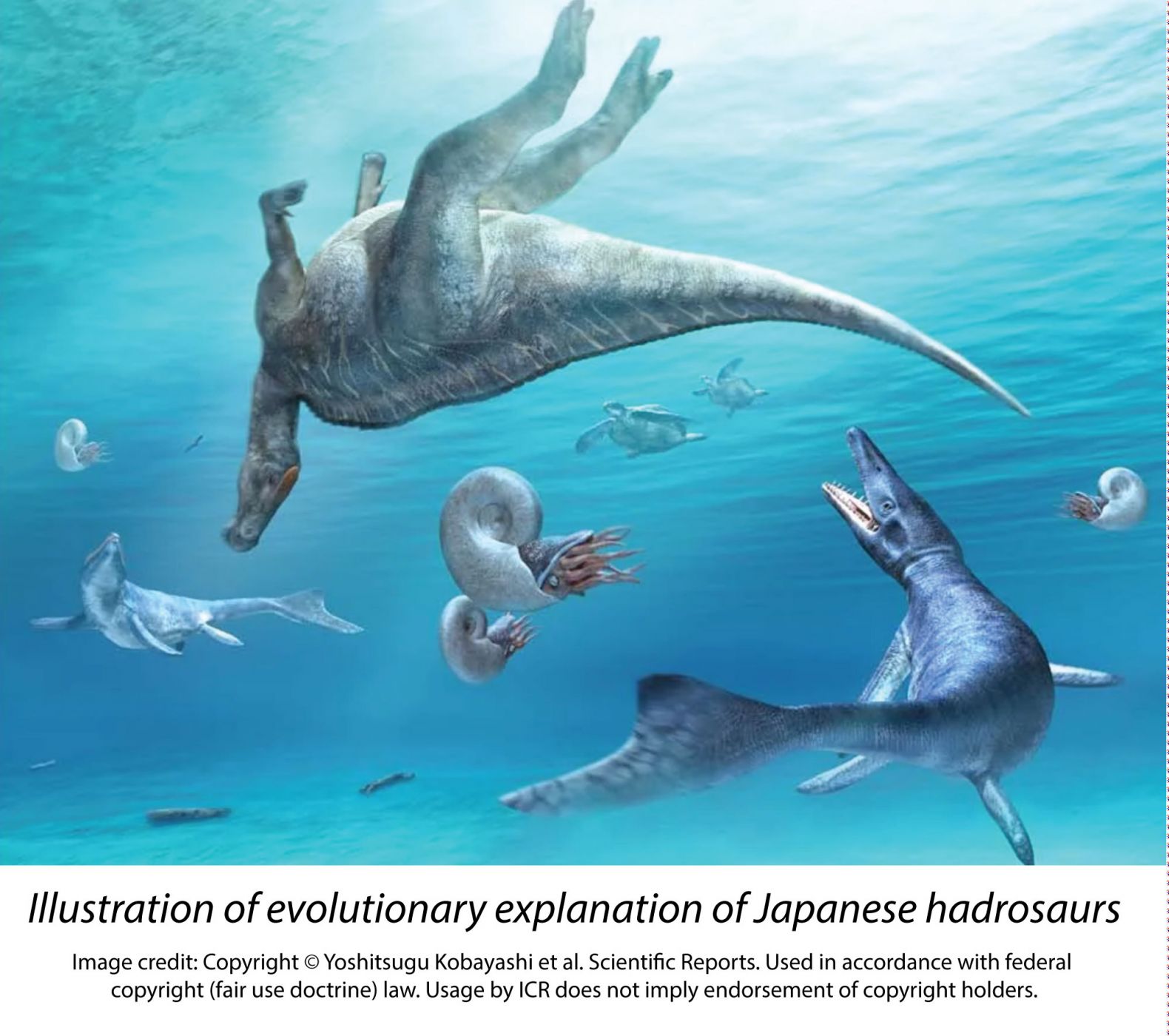
First, if these animals got washed out to sea, then what kept them from getting scavenged? Whether just bones like this hadrosaur or a mummified carcass like a nodosaur described in 2017,16 many of these fossils don’t show so much as a tooth scrape from a would-be scavenger. In any normal setting, carcass-feeders like clams and osedax worms would have recycled their bodies in days or months at most.
Next, that 2017 nodosaur weighed almost one and a half tons, but this Japanese hadrosaur “weighed upward of 5.3 tons.”3 How bad does the weather need to get to flush that much bulk out to sea? This doesn’t happen today in one location, let alone all over the place.
Last, heavy rains can wash animals to sea, such as cows flushed from Australian floods a few months ago.17 But are they getting stuck in muds with clams, fish, and turtles? Are they turning into whole-body fossils today? Clearly not. We need a much better explanation than they just “floated out to sea.”
The same evidence seen in Japan has already turned up in so many other places—wetland walking dinosaurs deeply buried beside swimming sea creatures. Why not consider one worldwide watery ruin as the most rational solution to this recurring quandary? Noah’s Flood must have entombed Kamuysaurus japonicas at about the same time it did the same thing elsewhere around the world.
References
1. Kobayashi, Y. et al. 2019. A New Hadrosaurine (Dinosauria: Hadrosauridae) from the Marine Deposits of the Late Cretaceous Hakobuchi Formation, Yezo Group, Japan. Scientific Reports. 9(1): 12389.
2. A new duck-billed dinosaur, Kamuysaurus japonicus, identified. Hokkaido University News Release, via EurekAlert. Posted on eurekalert.org September 5, 2019, accessed September 5, 2019.
3. Dvorsky, G. Newly Discovered Japanese Duck-Billed Dinosaur Was a Cretaceous Beach Bum. Gizmodo. Posted on gizmodo.com September 5, 2019, accessed September 5, 2019.
4. Horner, J. R. 1979. Upper Cretaceous dinosaurs from the Bearpaw Shale (marine) of south-central Montana with a checklist of Upper Cretaceous dinosaur remains from marine sediments in North America. Journal of Paleontology. 53(3): 566-577.
5. Gates, T. A., E. Gorscak, and P. J. 2019. Makovicky. New sharks and other chondrichthyans from the latest Maastrichtian (Late Cretaceous) of North America. Journal of Paleontology. 93(3): 512-530.
6. Hartman, J. H. and J. I. Kirkland. 2002. Brackish and marine mollusks of the Hell Creek Formation of North Dakota: Evidence for a persisting Cretaceous seaway. In The Hell Creek Formation and the Cretaceous-Tertiary Boundary in the Northern Great Plains: An Integrated Continental Record of the End of the Cretaceous. Also, Hartman, J. H., K. R. Johnson, and D. J. Nichols, eds. Geological Society of America Special Papers. 361: 271-296.
7. Hoesch, W. A., and S. A. Austin. 2004. Dinosaur National Monument: Jurassic Park or Jurassic Jumble? Acts & Facts. 33 (4).
8. Gordon, J. Rare dinosaur found in Canada’s oil sands. Reuters. March 25, 2011.
9. Thomas, B. Marine Reptile Fossil Rewrites Evolution. Creation Science Update. Posted on ICR.org January 18, 2012, accessed September 6, 2019.
10. Csiki-Sava, Z. et al. 2015. Island life in the Cretaceous-faunal composition, biogeography, evolution, and extinction of land-living vertebrates on the Late Cretaceous European archipelago. ZooKeys. 469: 1-161.
11. Ibrahim, N. et al. 2014. Semiaquatic adaptations in a giant predatory dinosaur. Science. 345 (6204): 1613-1616.
12. New Scientist staff. African T. Rex was one of last dinosaurs alive before extinction. New Scientist. Posted on newscientist.com May 7, 2017, accessed September 6, 2019.
13. Johnson, J. J. S., and T. Clarey. 2019. Deep-Sea Dinosaur Fossil Buries Evolution. Acts & Facts. 48 (8): 10-13.
14. Peecook, B. R., and C. A. Sidor. 2015. The First Dinosaur from Washington State and a Review of Pacific Coast Dinosaurs from North America. PLOS ONE. 10(5): e0127792.
15. Thomas, B. 2019. Mongolia, Montana, and My Bible. Acts & Facts. 48 (5):13.
16. Thomas, B. Secrets from the World’s Best-Preserved Nodosaur. Creation Science Update. Posted on ICR.org May 15, 2017, accessed September 6, 2019.
17. Quested, V. ‘Oh My God She’s Alive’: Family’s Beloved Cow ‘Sparkle’ Swept Out To Sea. 10 daily News. Posted on 10daily.com.au Jan 30, 2019, accessed September 6, 2019.
Stage image: hadrosaurs
Stage image credit: Copyright © Yoshitsugu Kobayashi et al. Scientific Reports. Used in accordance with federal copyright (fair use doctrine) law. Usage by ICR does not imply endorsement of copyright holders.
Dr. Brian Thomas is Research Associate at the Institute for Creation Research.