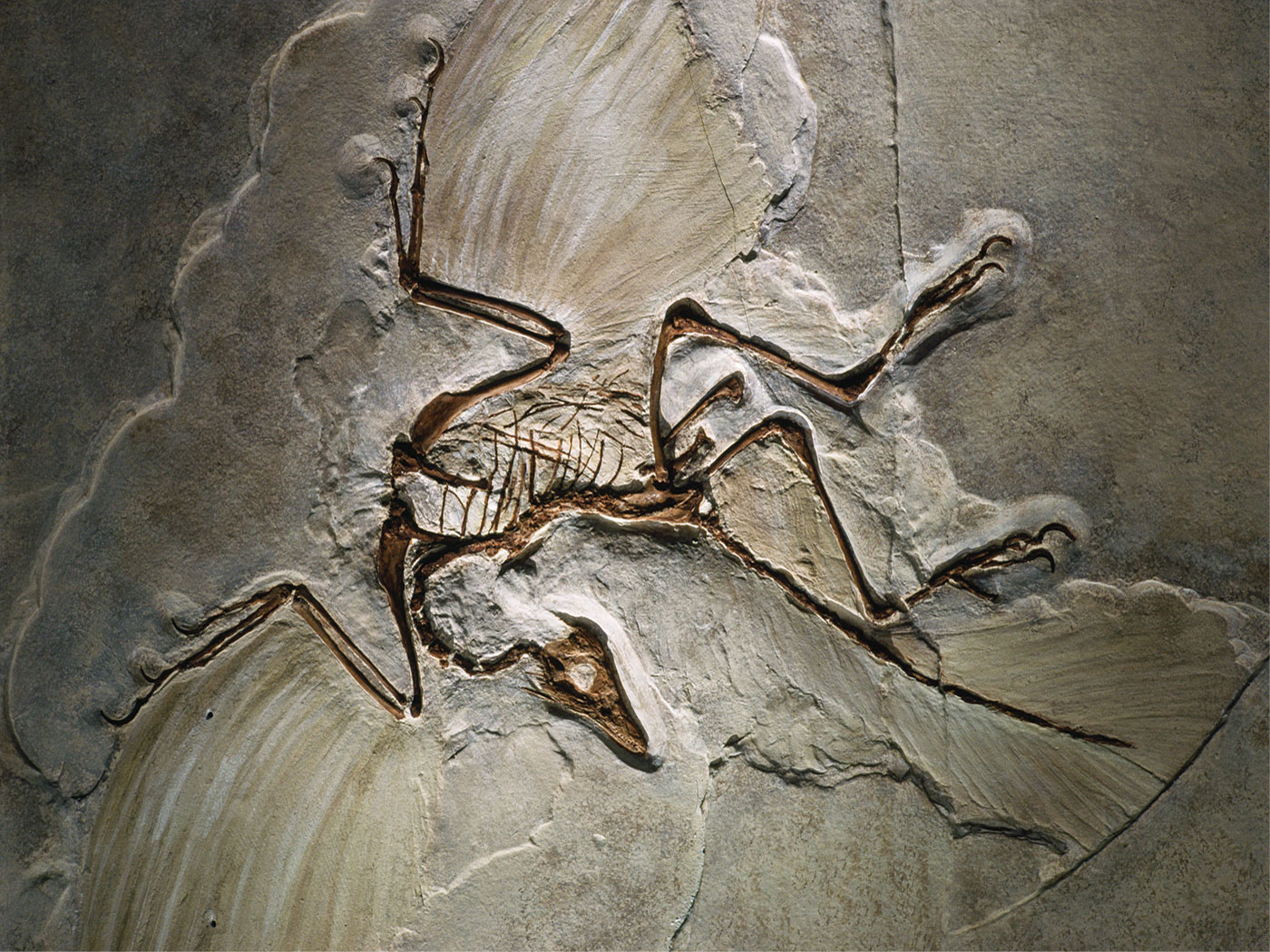
In the last few decades, there has been a lot of discussion by prominent paleontologists who imply that dinosaurs and birds are closely related. Many of these paleontologists go even further, suggesting that dinosaurs didn’t actually go extinct, but evolved directly into birds. Much of the supposed evidence that supports this argument comes from comparative anatomy. In the middle of this controversy is the so-called “transitional fossil” often cited as the link between birds and dinosaurs entitled Archaeopteryx.
Archaeopteryx is the iconic “first bird” because it is arguably the bird fossil found deepest in the sedimentary record; although there is some debate whether other true birds have been found even deeper. Regardless, it has been at the center of the evolution debate since the first specimen was discovered in Germany in 1860. Actually, this first specimen was a single feather from Archaeopteryx. But the feather told a story—the story of a bird.
The feather was about 2.5 inches long and nearly identical to the secondary flight feathers of modern birds, possessing airfoil qualities one would expect in a flying bird.1 A few months after the feather fossil was described, the first articulated Archaeopteryx specimen was unearthed.
To date, 12 specimens and one feather have been discovered from this amazing creature. All have been found in a remarkable, fine-grained unit in Germany called the Solnhofen Limestone within Upper Jurassic strata, dated by evolutionary geologists as 150 million years before present. Pat Shipman states that, “These few, special fossils have served as the basis for brilliant deductions, wild speculations, penetrating analyses, and amazing insights.”2
And paleontologists are still debating whether Archaeopteryx could fly, glide, or even take off from the ground.1

The latest research, published in Nature Communications, appears to settle the issue once and for all by studying the geometry of the wing bones from three specimens of Archaeopteryx.3
The authors, who hail from several universities across Europe, conclude,
Our analyses reveal that the architecture of Archaeopteryx’s wing bones consistently exhibits a combination of cross-sectional geometric properties uniquely shared with volant birds, particularly those occasionally utilising short-distance flapping. In effect, Archaeopteryx appears to have flown by flapping its wings in short bursts.
Lead researcher, Dennis Voeten of the European Synchrotron facility in France said, “We imagine something like pheasants and quails. If they have to fly to evade a predator they will make a very quick ascent, typically followed by a very short horizontal flight and then they will make a running escape afterwards.”4
Steve Brusatte, of the University of Edinburgh, who was not part of the study team, added, “I think it’s a case closed now. Archaeopteryx was capable of at least short bursts of powered flight.”4
It’s quite clear Archaeopteryx was a fully designed bird that could fly directly from the ground. It possessed some unusual features for a bird, and possibly used its wings a bit differently from more modern birds, but it was a bird nonetheless.3
In Genesis, God tells us He created birds, like Archaeopteryx, on Day 5 of Creation Week, birds that would reproduce only after their kind. The fossil record confirms this account. Birds, like Archaeopteryx, appear suddenly in the Flood sediments, fully formed and without any ancestors. There are no fossils of any type of transitions between dinosaurs and birds.
Flight feathers also appear in the rock record, fully formed. The first feather and the subsequent 12 articulated specimens of Archaeopteryx confirm that birds have always been birds by design.
References
- Feduccia, A. 2012. Riddle of the Feathered Dragons: Hidden Birds of China. New Haven, CT: Yale University Press.
- Shipman, P. 1998. Taking Wing: Archaeopteryx and the Evolution of Bird Flight. New York, NY: Simon & Schuster, 13.
- Voeten, D. F. A. E. et al. 2018. Wing bone geometry reveals active flight in Archaeopteryx. Nature Communications 9: 923. DOI: 1038/s41467-018-03296-8.
- Briggs, H. 2018. Archaeopteryx flew like a pheasant, say scientists.
*Dr. Timothy Clarey is Research Associate at ICR and earned his doctorate in geology from Western Michigan University.