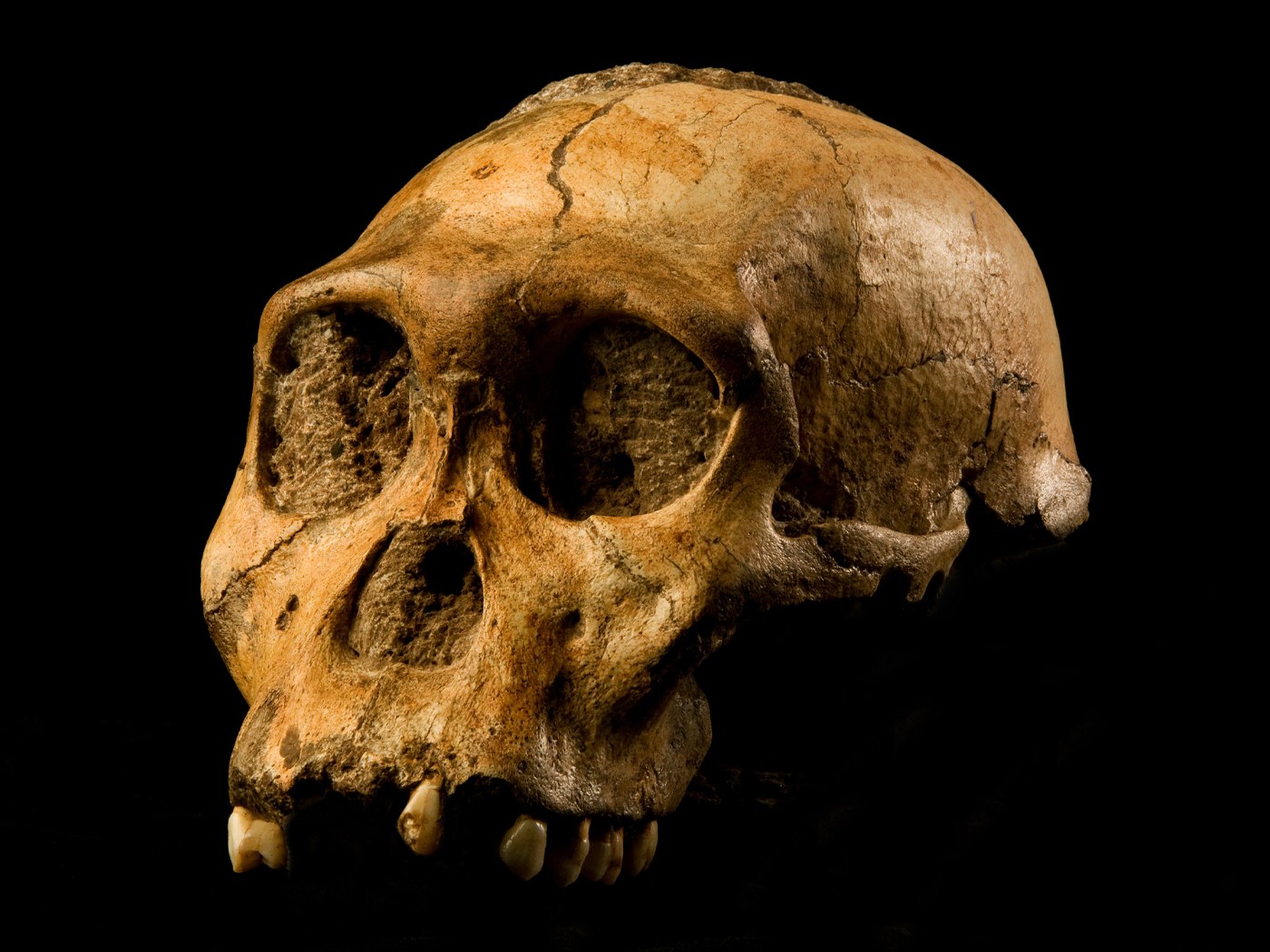
Nearly 20 years ago, a team of anthropologists presented the finding of a fossil skull that was very chimp-like in many respects.1 However, the skull had several unusual features that led to the claim that the ape-like creature was an early bipedal ancestor from the early stages of human evolution. Now, a new study has presented a very chimp-like fossil femur that supposedly belongs to the creature and indicates that it habitually walked on all four feet and was therefore not trundling down the path to humanness at all.2
In 2002, a team led by a French researcher published the description of a new fossil skull deemed Sahelanthropus tchadensis.1 The skull was discovered in Central Africa in the country of Chad in the southern Sahara. It was originally highly fragmented and distorted, but after the researchers reconstructed its pieces, its face was flatter than a chimp’s and it had the foramen magnum (opening for the spinal cord) positioned more forward than is typically found in chimps. Based on the deduced position of the spine to the skull, the researchers claimed the ape-like creature habitually walked on two legs. And because the evolutionary age dates obtained for the creature are about six to seven million years, it was believed that this fossil could represent one of the oldest (if not the oldest) known human-ape ancestor.
Like many alleged hominid fossils, Sahelanthropus has been heavily criticized and debated over the years since its discovery. But adding to the controversy is the question of why the recently published fossil femur was never included in the original analysis to begin with. The femur is a large leg bone that connects the knee to the thigh, and its design and structure are very important for the purposes of posture and locomotion.
In this new paper in the Journal of Human Evolution, visual data from photographs provide a detailed look at the fossil femur.2 Strangely, the authors claim they do not know the current whereabouts of the fossil but have worked with the fossil firsthand and created detailed photographs for their later research. In this report, the researchers state, “The results of our preliminary functional analysis suggest the TM 266 femoral shaft belongs to an individual that was not habitually bipedal, something that should be taken into account when considering the relationships of S. tchadensis.”
A New Scientist report also describes the research and claims that “the shape of the femur from Sahelanthropus tchadensis is typical of apes like chimps” and that the creature “didn’t walk on two legs, and therefore may not have been a hominin at all, but rather was more closely related to other apes like chimps.”3 When we add this new data to the original reconstructions done of the skull, which showed it to be very chimp-like in appearance (even the same size as chimp skulls), the conclusion is that Sahelanthropus likely represents a type of extinct chimp and is not an evolutionary human ancestor.
Once again we are left with a huge chasm between humans and apes in the fossil record. The missing link is still missing.
Stage image: Sahelanthropus tchadensis femur.
Stage image credit: Franck Guy/Université de Poitie. Copyright © 2020. Adapted for use in accordance with federal copyright (fair use doctrine) law. Usage by ICR does not imply endorsement of copyright holders.
References
1. Brunet, M. et al. 2002. A new hominid from the Upper Miocene of Chad, Central Africa. Nature. 418 (6894): 145–151.
2. Macchiarelli, R. et al. 2020. Nature and relationships of Sahelanthropus tchadensis. Journal of Human Evolution. 149 (102898): ISSN 0047-2484.
3. Marshall, M. 2020. Our supposed earliest human relative may have walked on four legs. New Scientist. Posted on NewScientist.com November 18, 2020, accessed December 1, 2020.
*Dr. Tomkins is Director of Research at the Institute for Creation Research and earned his doctorate in genetics from Clemson University.
Sahelanthropus Femur Likely Makes It a Chimp
More Fossils Reflect Life's Original Diversity
We Still Can’t Determine the Sex of Dinosaurs
Recently, a new study led by Queen Mary University of London concluded that dinosaur bones tell us little about their sexes.1 In the past, secular...
Chicago Fossil Trips Up Conventional Origin Story
According to the evolutionary narrative, life supposedly began as single-celled creatures that slowly became multicellular animals and plants. Through...
Spinosaurus Swam! How a Swimming Spinosaurus Fits Scripture
Spinosaurus aegyptiacus had a longer body than the enormous T. rex. In Nature journal, researchers published a new reconstruction of the extinct reptile’s...
More Fossil Record
First Tapejarid Pterosaur Found In Great Britain
The very first tapejarid pterosaur identified in the United Kingdom was recently found on the Isle of Wight along the southern coast of England.1...
Rapid Burial in the Flood Explains Strange "Squid" Attack
A new study published in Proceedings of the Geologists’ Association has found what is claimed to be the oldest recorded attack by a squid-like creature.1...
Frog Fossils Found in Antarctica!
Can you imagine frogs in snow-covered, frigid Antarctica? A recent fossil discovery has significant implications for Earth’s climate history as well...
More Problems with Evolution
DNA in Sheep and Dinosaurs
About 1,600 years ago, salt miners in Iran apparently left their lamb lunch down the shaft. Their loss became scientists' gain. The now-mummified sheep...
Cretaceous Bird Beak Pecks Holes in Evolution
Rock layers in China have yielded yet another strange bird. Two features in its partial skull—the only parts found—make it both a unique discovery...
Was a Fossil "Fish-Hand" Discovered?
In order for the bizarre theory of evolution to be validated, evolutionists must show how inorganic non-life organized itself into carbon-based (organic)...
More Contrasting Worldviews
Getting Carbon into the First Cell
Today’s secular mindset replaces “In the beginning God…” with “In the beginning, hydrogen….” The extreme specificity...
Physics Today Article Ignores Monster Milankovitch Problem
An overview of the Milankovitch (or astronomical) ice age theory appears in the May 2020 issue of Physics Today.1 This theory (hypothesis, really)...
Cretaceous Bird Beak Pecks Holes in Evolution
Rock layers in China have yielded yet another strange bird. Two features in its partial skull—the only parts found—make it both a unique discovery...
More Man Was Created Distinct from Apes
Fossil Confusion in Ethiopia: Are Evolutionary Trees Bu.,.
A new study published in Nature describes the discovery of 13 fossilized teeth from the Ledi-Geraru site in Ethiopia. They have been dated to between...
First Human Chromosome Fully Sequenced
Most people might be surprised to learn that the human genome has not been fully sequenced. Gaps still remain that have not yet been bridged because of...
Tooth Study Takes Bite Out of Evolution
Secular scientists have told incredible stories for over a century about how fossil teeth supposedly support the idea that humans evolved from primates....
More Creation Science Update
Spider Silk Properties Ideal for Nerve Repairs
Big doesn’t always mean strong. Most of the time, strength comes from what something is made of. The proteins forming spider silk make that silk...
March 2023 ICR Wallpaper
"Sing to the Lord with thanksgiving;
Sing praises on the harp to our God,
Who covers the heavens with clouds,
Who prepares rain for the earth,
Who...
Earliest Fossil Brain Is Still a Brain
Over a century ago, a fossil fish was extracted from an English coal mine. Evolutionists assigned an age of “319 million years” to the extinct...
The Latest
Can Metals Explain the Origin of Life?
A spark plug can make a spark, but no one would say a spark plug can build a car. In much the same way, a chemical reaction can do one useful job without...
Jumping Genes: Engineered to Move
Scientists recently found a “jumping gene” in an odd place. An RNA molecule from a tiny predatory bacterium had entered the cells of a very...
Institute for Creation Research Partners with Louisiana Baptist...
The Institute for Creation Research (ICR) announced today a strategic handover of its School of Biblical Apologetics (SOBA) educational content to Louisiana...
A Tangled Human Tree—or One Human Family?
What if the “ghosts” in our DNA are not lost steps in human evolution? A new Science study found DNA patterns that may point to two unknown...
Mapping the Sense of Smell
Your sense of smell involves much more than enjoying a hike through an aromatic pine forest or appreciating delicious foods.1,2
Our ability...
September 11, 2001: We Will Never Forget
“Fret not thyself because of evil men, neither be thou envious at the wicked: for there shall be no reward to the evil man; the candle of the...
What Can Fossil Teeth Really Tell Us?
A few tiny fossil teeth have been asked to carry a very large story. Researchers used them to name a new order of marsupials, Keeunamorphia, and to...
Man and His Labor
“Man goeth forth unto his work and to his labour until the evening.” (Psalm 104:23)
The 104th Psalm is a beautiful psalm of creation and...
Changing Climates, Stable Primates
What do you picture when you think of the first primates? Conventional scientists have long proposed warm forests, thick vines, and tropical heat as...

September Wallpaper
"[Cast] all your care upon Him, for He cares for you." (1 Peter 5:7, NKJV)
ICR's September 2026 wallpaper is now...
Shop Related Products
The Fossils Still Say No
$29.99