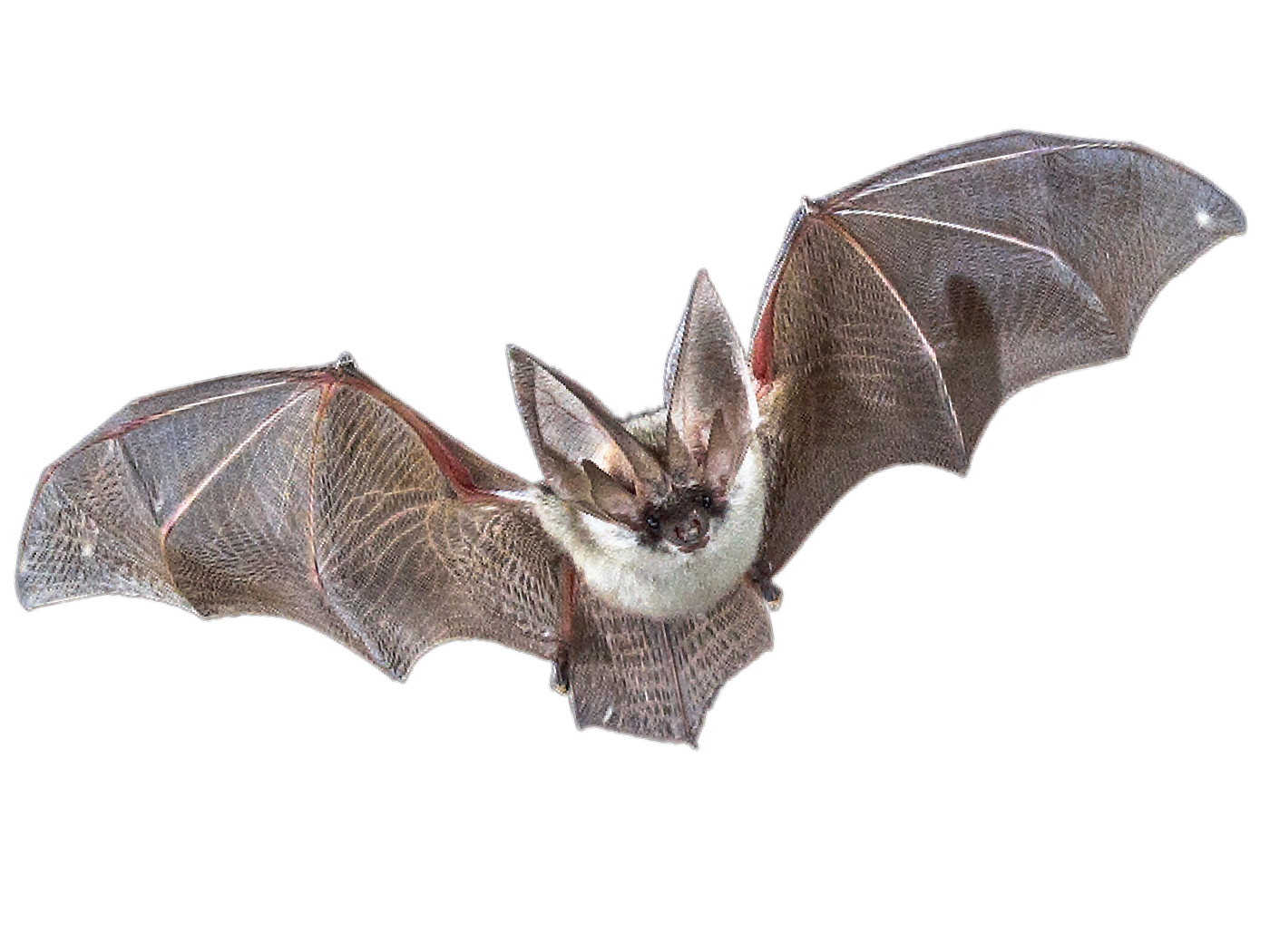
Picture a calm summer evening. Most people are only dimly aware of the aerial creatures that may dart and dive nearby. Indeed, many would think these animals are birds unless their activity is closely observed. They would be surprised to discover these flying creatures are actually bats using their designed sonar to detect and track insects as small as mosquitos—prey these bats pick up and devour on the wing and in the dark.
Looking at the amazing design features of a typical bat, Douglas Futuyma assumes “the only scientific explanation of adaptations is the theory of evolution by natural selection.”1
Yet, there is another, more logical explanation of bat origins found in Genesis. Looking at the fossil record, we find, unsurprisingly, that bats have always been bats. There are no evolutionary intermediates between any four-legged rodent and today’s two-legged, two-winged bat; there are no fossils of non-flying bats. Supposedly, the oldest fossil bats are from Wyoming (e.g., Icaronycteris and Onychonycteris) and Europe dated by evolutionists to the early Eocene. Neither can evolutionists explain the exquisitely designed bat biosonar that uses sound waves rather than radio waves. Michael Benton states, “The evolution of echolocation in bats has been hard to resolve.”2
Hard to resolve or not, zoologists have discovered bats use this amazing biosonar echolocation system to determine the texture, size, density, and shape of an object. “A bat builds a mental image of its surroundings from echo scanning that approaches the visual resolution of a diurnal animal's eyes.”3
Research has documented this amazing claim. Scientists at the Universities of Munich and Bristol discovered a unique mechanism bats use to perceive object size.4 Bats are able to detect tiny timing differences between when a sound reaches each ear. Sounds arrive from diverse directions, and bats use this mechanism to build a virtual image with remarkably detailed features. A press release reporting on these studies states this gives the “bats access to comparable information about objects as we obtain with our eyes.”5
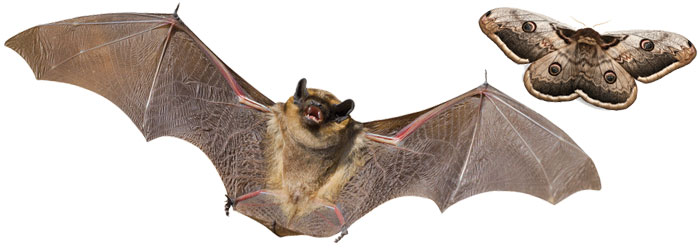
One of the more fascinating relationships in the animal world is the ultrasonic war between moths and bats. The Creator designed in some moths (e.g., the hawk moth) and a host of other insects the ability to pick up specific phases of bat sonar by way of unique cells imbedded in the insect’s body. When sonar impulses strike the moth’s body, these receptor cells send a message (action potential) up to the moth’s brain alerting it to bat activity nearby. The moth knows it’s in danger and takes evasive action.
Recently, it was discovered that when some types of bats encounter these evasive moth maneuvers, the bats engage in countermeasures. Specifically, in the last phase of their pursuit, the bats widen their beam of echolocation to keep their supper within the “acoustic field of view.” Jakobsen et al state, “Thus, beam broadening is not a general property of echolocation, but we hypothesize that maintaining a broad acoustic field of view is crucial for all echolocators hunting moving prey.”6
Future research into this amazing bat biosonar promises to further verify God’s “clearly seen” creative hand (Romans 1:20).
References
- Futuyma, D. J. 2013. Evolution, 3rd ed. Sunderland, MA: Sinauer Associates, Inc., 1.
- Benton, M. J. 2015. Vertebrate Palaeontology, 4th ed. Malden, MA: Wiley Blackwell Publishing, 376.
- Hickman, C. et al. 2020. Integrated Principles of Zoology, 18th ed. New York: McGraw-Hill, 633.
- Goerlitz, H. R., D. Genzel and L. Wiegrebe. 2012. Bats’ avoidance of real and virtual objects: implications for the sonar coding of object size. Behavioural Processes. 89 (1): 62-67; Heinrich, M. et al. 2011. The sonar aperture and its neural representation in bats. Journal of Neuroscience. 31 (43): 15618-15627.
- How bats ‘hear’ objects in their path. University of Bristol press release. Posted on bristol.ac.uk November 24, 2011 accessed June 26, 2015.
- Jakobsen, L., M. N. Olsen, and A. Surlykke. 2015. Dynamics of the echolocation beam during prey pursuit in aerial hawking bats. Proceedings of the National Academy of Sciences. 112 (26): 8118-8123.
* Mr. Sherwin is Research Associate, Senior Lecturer, and Science Writer at the Institute for Creation Research.