Introduction
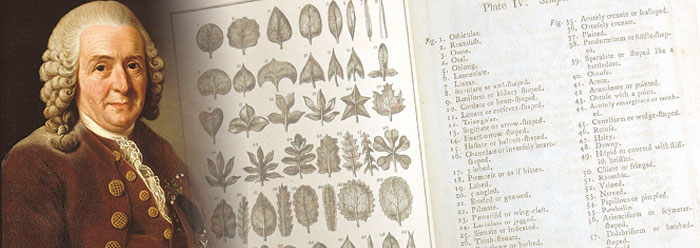
Carolus Linnaeus (1707–1778), Swedish botanist and zoologist, laid the foundations for the biological binomial nomenclature system still used today.1 As the father of modern taxonomy and ecology, he is known as the “most famous botanist of all time.”2 He was also “a creationist and thus an enemy of evolution.”3 Dr. Henry Morris wrote:
[Linnaeus] was a man of great piety and respect for the Scriptures. One of his main goals in systematizing the tremendous varieties of living creatures was to attempt to delineate the original Genesis “kinds.” He…[believed] that variation could occur within the kind, but not from one kind to another kind.4
His Life
Born in southern Sweden, Linnaeus spent much of his spare time searching for new plant specimens and collecting flowers.5 First educated at Lund University, he later transferred to Uppsala University to study botany.6 There he soon realized the current taxonomy system used to name plants was severely lacking.
Before Linnaeus’ generation, most people lived in a simple and geographically small world and were exposed to so few organisms that it was fairly easy to achieve a taxonomic order that made good sense.7 In Linnaeus’ day these simple times had rapidly come to an end. At the start of the eighteenth century, hundreds of European ships left port with adventurers and missionaries eager to explore the world opening up to them. Cartographers, mineralogists, and naturalists scoured the globe for new life forms to sell to European exotica collectors.8
Scientists “in different countries, speaking different languages, reading different texts, quickly began to find it difficult to know, in any particular case, whether any two naturalists were even talking about the same animal or plant or something entirely different.”8 For example, the many names for buffalo included bubalus, buffle, urus, catoblepas, bubalas, theur, and the Scottish bison.
This abundance of names caused a major confusion for scholars—a problem Linnaeus set out to solve.9 Linnaeus was actually said to be “obsessed with order in general, a quality that helped him keep his head in the growing botanical and zoological chaos. He…and any who followed his mandates” would be able to achieve order in the natural world.10
At only 23, Linnaeus began to develop a new system to reorganize the entire plant kingdom.11 In the end, it was his “organization, his spit and polish rules, that have been among Linnaeus’s most lasting gifts to science and part of what helped to rescue natural history from disarray.”12 Writing in his autobiography that Almighty God gave him insight “into His myriad forms [of life] unchanged since the day of creation,” Linnaeus believed “he did indeed have a special ability that set him apart…his talents and powers [are] a clue to that difference.”13 His entire taxonomy system was based on his belief “that God could be approached through the study of Nature,” and he felt it was his Christian obligation to learn about God by studying “the wonders of the created universe.”14
Over the next several years Linnaeus originated the two-word binomial classification system that uses the genus and species designation.15 He published the first edition of the taxonomy bible Systema Naturae (The System of Nature) in 1735 at the age of 28. Linnaeus achieved this feat by “laying out not only a vast compendium of rules for the ordering and naming of life, but an ordering of the entire living world.”16 This book eventually grew to multiple volumes, naming some 7,700 species of plants and 4,400 species of animals “for the glory of God.”17
This elegant work far surpassed other existing schemes due to its all-encompassing nature, clarity, and “simple good sense—seeming so inexplicably right to so many—that they and he would take the world by storm.”18 This and his other books were very popular and sold well.19
In the 1740s, he made several journeys throughout Sweden to discover and classify new plants and animals. He continued to collect and classify animals, plants, and even minerals for his entire life, continually publishing new volumes of his Systema Naturae.1 His tenth edition is now “recognized by scientists around the world as the official starting point for all zoological nomenclature, the ordering and naming of all animals,” and his work Species Plantarum (The Species of Plants) would be internationally recognized as the basis for all botanical nomenclature.20
His Worldwide Influence
Philosopher Jean-Jacques Rousseau wrote of Linnaeus, “I know no greater man on earth.”21 German writer Johann Wolfgang von Goethe opined, “With the exception of Shakespeare and Spinoza, I know no one among the no longer living who has influenced me more strongly.”21 Professor Å. Gustafsson of the University of Lund concluded that “Linnaeus is regarded in the history of biology as the brilliant classifier of nature’s diversity. ‘God created the world, Linnaeus put it in order.’”22
Linnaeus was knighted in 1753 by the king of Sweden. Today he is revered “as a national hero in Sweden, depicted in countless biographies, [and] spoken of with glowing admiration in textbook after textbook. He captured and validated our world.”23 Linnaeus eventually became professor of medicine and botany at Uppsala.
Although a dedicated and popular professor, he found time to write many books, such as Flowers of Lapland, and he even penned a manual on classifying minerals.24 From 1749 to 1769 he published 170 papers and several books on topics ranging from woodpeckers to the cause of epilepsy.25 His life documents what a man of God can attain by applying Genesis to science.
References
- Silverstein, A. and V. Silverstein. 1969. Carl Linnaeus: The Man Who Put the World of Life in Order. New York: John Day Co.
- Anderson, M. J. 1997. Carl Linnaeus: Father of Classification. Berkeley Heights, NJ: Enslow Publishers, 8.
- Winsor, M. P. 2006. Linnaeus’s Biology Was Not Essentialist. Annals of the Missouri Botanical Garden. 93 (1): 2.
- Morris, H. 1988. Men of Science, Men of God. Green Forrest, AR: Master Books, 27.
- Yoon, C. K. 2009. Naming Nature: The Clash Between Instinct and Science. New York: W. W. Norton, 26.
- Blunt, W. 1984. The Compleat Naturalist: A Life of Linnaeus. London: Collins Publishers, Ltd.
- Yoon, Naming Nature, 27.
- Ibid, 29.
- Anderson, Carl Linnaeus, 13-15.
- Yoon, Naming Nature, 42.
- Anderson, Carl Linnaeus, 39.
- Yoon, Naming Nature, 43.
- Ibid, 45.
- Appleby, J. O. 2013. Shores of Knowledge: New World Discoveries and the Scientific Imagination. New York: W. W. Norton, 146-147.
- Anderson, Carl Linnaeus, 12.
- Yoon, Naming Nature, 26.
- Ibid, 49.
- Ibid, 26-27.
- Silverstein and Silverstein, Carl Linnaeus, 68.
- Yoon, Naming Nature, 50.
- What people have said about Linnaeus. Uppsala Universitet fact sheet. Posted on www.linnaeus.uu.se, accessed September 10, 2014.
- Gustafsson, Å. 1979. Linnaeus’ Peloria: The History of a Monster. Theoretical and Applied Genetics. 54 (6): 241.
- Yoon, Naming Nature, 51.
- Anderson, Carl Linnaeus, 55.
- Ibid, 99.
* Dr. Bergman is Adjunct Associate Professor at the University of Toledo Medical College in Ohio.