The New Covenant | The Institute for Creation Research

The New Covenant

"Likewise also the cup after supper, saying, This cup is the new testament in my blood, which is shed for you." (Luke 22:20)

The Greek word diatheke, translated as both "testament" and "covenant," occurs thirty-three times in the New Testament, seventeen of which are in the book of Hebrews. The Hebrew word for "covenant" (berith) comes from a word meaning to "cut, or divide," referring to the fact that blood had to be shed to bind the parties involved to the covenant. (See Genesis 15:10; Jeremiah 34:18-19.) God had made covenants with Abraham and Moses on the part of the people of Israel. He had kept His part of the agreement; but in each case the others involved "continued not in my covenant" (Hebrews 8:9). But God, in His grace, has issued a new covenant.

This covenant or testament is not unlike a human "last will and testament," but there are some differences. He did not merely die, thereby enabling His children to inherit His fortune, but He is now "the mediator of a better covenant" (Hebrews 8:6). He is the sacrifice whose death was necessary to make the covenant binding, and yet He is the "surety of a better testament" (Hebrews 7:22).

He cannot fail, and hence the new covenant cannot be done away with. Through His death, He not only has removed the penalty for our previous failures, but qualified us to receive the inheritance. "For this cause he is the mediator of the new testament, that by means of death, for the redemption of the transgressions that were under the first testament, they which are called might receive the promise of eternal inheritance. For where a testament is, there must also of necessity be the death of the testator" (Hebrews 9:15-16). "Wherefore he is able also to save them to the uttermost that come unto God by him, seeing he ever liveth to make intercession for them" (Hebrews 7:25). JDM

The Latest
NEWS
September 11, 2001: We Will Never Forget
“Fret not thyself because of evil men, neither be thou envious at the wicked: for there shall be no reward to the evil man; the candle of the...

NEWS
What Can Fossil Teeth Really Tell Us?
A few tiny fossil teeth have been asked to carry a very large story. Researchers used them to name a new order of marsupials, Keeunamorphia, and to...

NEWS
Man and His Labor
“Man goeth forth unto his work and to his labour until the evening.” (Psalm 104:23) The 104th Psalm is a beautiful psalm of creation and...

NEWS
Changing Climates, Stable Primates
What do you picture when you think of the first primates? Conventional scientists have long proposed warm forests, thick vines, and tropical heat as...

NEWS
September Wallpaper
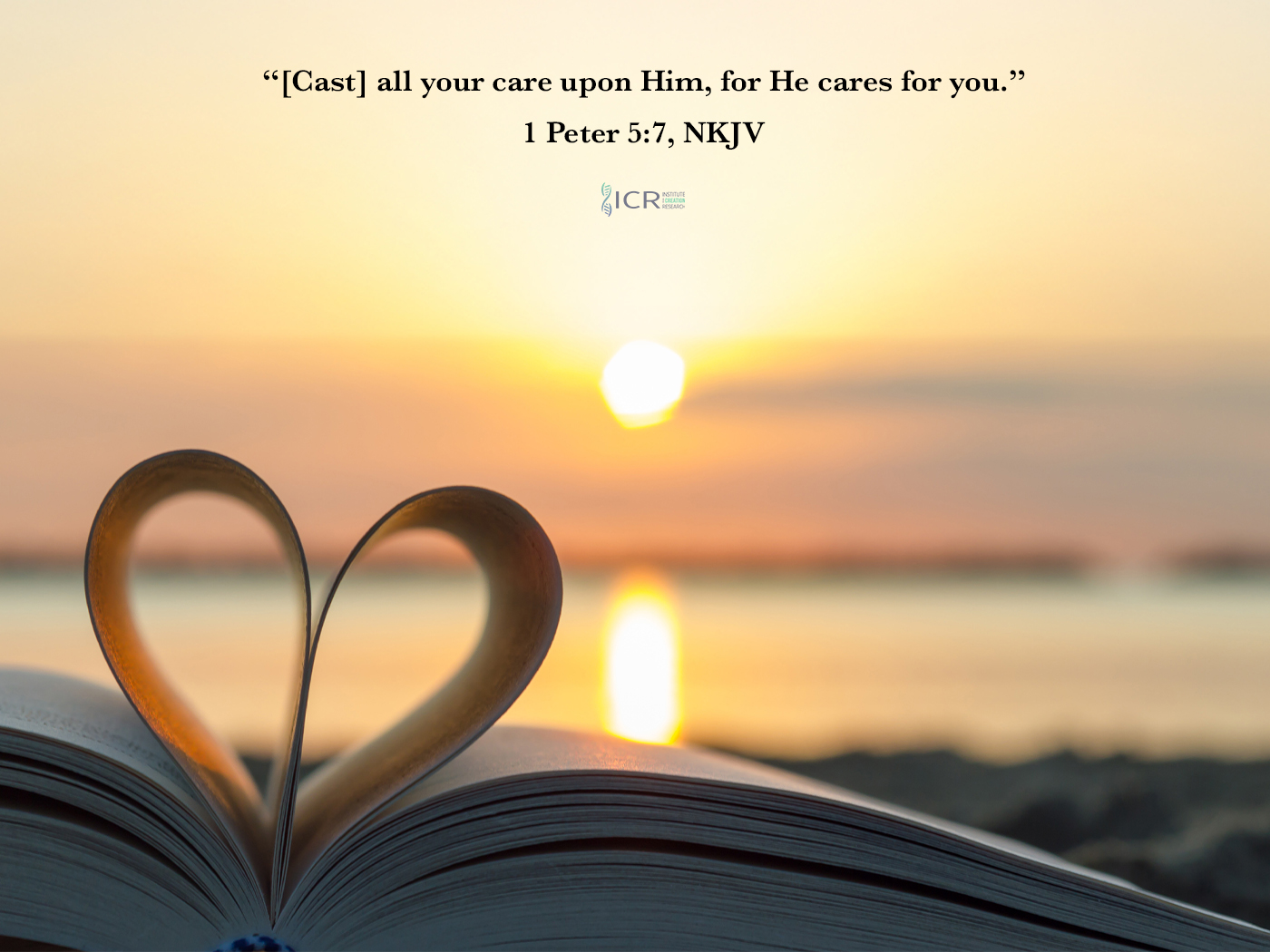
"[Cast] all your care upon Him, for He cares for you."  (1 Peter 5:7, NKJV) ICR's September 2026 wallpaper is now...

NEWS
Life’s Origins: The Bootstrap Problem
Could life’s instructions exist without ever being made? This question raises what is called a “bootstrap problem.”1 It...

ACTS & FACTS
The Power of a Meek Life
One of the clearest voices calling believers to surrender to Jesus was George Whitefield, who said, “I have just put my soul as a blank into the...

ACTS & FACTS
Extent of the Curse and the Hope of Redemption
“For we know that the whole creation groaneth and travaileth in pain together until now.” Romans 8:22* At the end of the sixth day of...

ACTS & FACTS
Modern Idolatry: Crediting Natural Selection as the Creator
“Have no other gods before Me.” Exodus 20:3 In the beginning God created the heavens and the earth” (Genesis 1:1). The Creator...

ACTS & FACTS
Is Death a Curse or Life’s Change Agent?
“The last enemy that will be destroyed is death.” 1 Corinthians 15:26 Without a doubt, there is a sting to death that is felt by Christians...