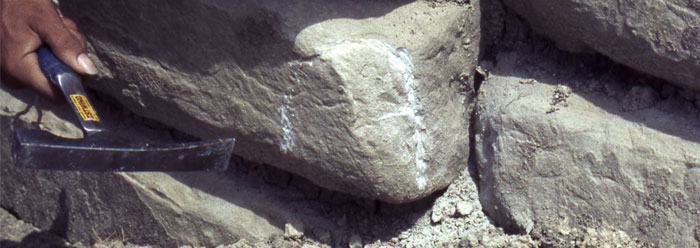
Situated just to the northeast of Dallas County is the county of Rockwall, with its capital city Rockwall, both derived from the frequent occurrence of underground rock "walls" that crop up around the area. On occasion, intrepid Texans have dug down beside a wall to see how far it goes, but they’ve never reached the bottom.
Often the walls are thin, just an inch or so thick. Others are several inches thick. When exposed, they really do look something like a manmade brick wall consisting of beveled "bricks" with mortar in between them. In recent decades, the city of Rockwall has witnessed rapid growth and the walls have been destroyed or covered, so that now none can be seen. Local folklore has arisen that a race of prehistoric giants built the walls.
Geologists have occasionally studied the walls and have each concluded that they are a natural phenomenon, much to the dismay of local romantics. In the mid-1970s, several local historians contacted the Institute for Creation Research for a creationist’s opinion. They may have thought that if anyone would acknowledge prehistoric giants, creationists would. I was a member of the geological engineering faculty of Oklahoma University at the time and was asked to investigate.
First, I reviewed all the scant scientific literature on the subject. All the geologists had concluded that the walls were sandstone dikes, cracks filled in with sand squeezed up from below like toothpaste, followed by hardening of the sand into sandstone over millions of years. Next, I collected field observations of the dikes and concluded that they had indeed come up from below and couldn’t have simply been cracks filled in from above.
My uniformitarian colleagues may have correctly identified the dikes and their source, but they completely misunderstood the dikes’ significance. The sand seems to come from a deeply buried sand stratum that was squeezed up at some point after its deposition. Several other layers had been deposited on top of the sand layer. Regional torsion of the area had applied the squeezing pressure, perhaps associated with the uplift of the Rocky Mountains.
At any rate, the timing of the squeezing was, according to uniformitarian thinking, many millions of years after the mother sand bed had been deposited. Yet the sand had not yet hardened into sandstone, for it was still able to flow. But how long does it take for sand to harden? Not long at all, if the conditions are right, and particularly if a cement is present to bind the grains together.
Let’s put this sequence of events together.
| Event | Creationist View | Uniformitarian View |
| Deposition of mother sand bed | Mid-Flood | 160 million years ago (my) |
| Deposition of overlying beds | Mid- to late-Flood | Surface rock < 100 my |
| Squeezing | Late-Flood | 65 my |
| Hardening | Post-Flood | < 65 my |
The sandy material had to be soft when emplaced in the dikes, but according to uniformity it was already millions of years old and should have been hard. What’s wrong with this picture? Evidently, it is the millions and millions of years timeline that is wrong.
The evidence supports a shorter chronology.
Image credit: Dr. John Morris
* Dr. Morris is President of the Institute for Creation Research.
Cite this article: Morris, J. 2011. The Rock Walls of Rockwall County. Acts & Facts. 40 (9): 16.