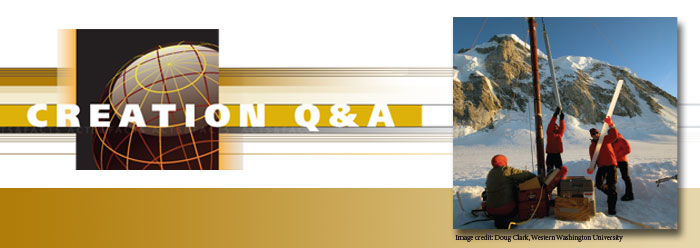
Scientists found a mummified forest in 2010 on northern Canada's Ellesmere Island. It had apparently been buried by a landslide long ago and was exposed by receding ice and glaciers. How those trees were able to grow in a place that is now too cold for them is uncertain. But several clues from the find fit with a biblical timeline and setting, and conflict with evolutionary assumptions.
For example, the logs, leaves, needles, and seedpods were not replaced by minerals, but were found as "exquisitely preserved" original organic materials. An age range of 2 to 8 million years was assigned, based on comparing the biodiversity of recovered pollen to that of other sites of already "known" age.1 Plant pathologist Robert Blanchette, who is familiar with the area but is not involved in the ongoing study of the materials, told National Geographic News, "Finding wood that is millions of years old in such good condition—almost as if you just picked it up from the forest floor—will provide an exceptional opportunity [for research]."2
Melting ice and glaciers during the late 20th century's warmer climate revealed the mummified forest.3 National Geographic News suggested that "the mummified trees were likely preserved so long because they were buried quickly by landslides and thus protected from air and water, which hastens decomposition."2 But the absence of factors that hasten decomposition does not address the question of what special factors could have miraculously prolonged the remains' integrity.
Joel Barker of Ohio State University is the lead researcher in the study. A university press release reported that he plans to conduct DNA testing.1 Can DNA, even if frozen, last for millions of years?
Lab tests of DNA have shown that identifiable sections (of at least 500 base pairs long) would have decayed into tiny, unreadable fragments after 100,000 years if constantly held below
Thus, the man-made "millions of years" age assignment for the mummified forest conflicts with both science and the Bible. If it is not millions of years old, then when did this forest exist?
Barker observed that the tree rings were very narrow, indicating that the forest survived in very stressful conditions:
These trees lived at a particularly rough time in the Arctic. Ellesmere Island was quickly changing from a warm deciduous forest environment to an evergreen environment, on its way to the barren scrub we see today.1
The tree trunks from the mummified forest "were at least 75 years old when they died."1 Why did they only live this long? What dramatic climate changes must have marked the beginning and end of this forest? Why are the mummified remains so pristinely preserved?
These questions can be answered by adopting the conceptual framework of biblical history. When ocean water was still warm from mantle material that had risen during the violent year of the Flood, it dramatically affected weather patterns, triggering a post-Flood Ice Age. While ice built up in certain places during this time, temperate corridors in the Arctic also existed, caused by air warmed by the ocean.6
After the Flood, the forest began to grow in an Arctic corridor that was just barely warm and wet enough to support it. After the ocean cooled, the temperature rapidly changed to a perpetual cold. The hillsides, having been recently sculpted by late and post-Flood waters, were still somewhat unstable. Years later, earth movements then caused this material to collapse in a landslide, burying the forest.
And all this happened within the last 4,500 years, accounting for the quality of the preserved leaves and forest material found on Ellesmere Island today. The Bible's timeline can explain it all with relative ease, whereas evolution leaves too many questions unanswered.
References
- Gorder, P. F. Ancient Forest Emerges Mummified from the Arctic. The Ohio State University press release, December 16, 2010, regarding research presented December 17, 2010, at the American Geophysical Union 2010 Fall Meeting in San Francisco.
- Inman, M. Mummified Forest Found on Treeless Arctic Island. National Geographic Daily News. Posted on news.nationalgeographic.com December 17, 2010, accessed January 3, 2011.
- Vardiman, L. 2009. A New Theory of Climate Change. Acts & Facts. 37 (11): 10.
- Criswell, D. 2006. How Soon Will Jurassic Park Open? Acts & Facts. 35 (6).
- Climate Data Almanac, Alert, Nunavut. National Climate Data and Information Archive, Environment Canada. Posted on climate.weatheroffice.gc.ca, accessed January 5, 2010.
- Vardiman, L. 2010. An Ice Age in Yellowstone National Park. Acts & Facts. 39 (12): 12-14.
* Mr. Thomas is Science Writer at the Institute for Creation Research.
Article posted on January 11, 2011.