Who Shall Let It? | The Institute for Creation Research

Who Shall Let It?

"Yea, before the day was I am he; and there is none that can deliver out of my hand: I will work, and who shall let it?" (Isaiah 43:13)

This is one of the classic "archaisms" of the King James Version, where the English word "let" does not mean "allow" (as we now use the word), but almost the exact opposite. This particular English word was originally written and pronounced "lat" and was from the same Teutonic root as the word "late." Thus, to our Old English ancestors, it meant essentially "make late," or "hinder." Note its similar use in the King James in Romans 1:13 and 2 Thessalonians 2:7.

However, the Hebrew word (shub) from which it is translated in the verse of our text is extremely flexible, being rendered no less than 115 different ways in the Old Testament, occurring about 1,150 times altogether, with the context controlling its meaning in any given case.

In this context, the great theme is that of God as omnipotent Creator and only Savior. The first occurrence of shub, however, is at the time of the primeval curse on the creation, implanted in the very dust of the earth because of Adam's sin. To Adam, God had said: "In the sweat of thy face shalt thou eat bread, till thou return unto the ground; for out of it wast thou taken: for dust thou art, and unto dust shalt thou return" (Genesis 3:19). Here, shub is twice rendered "return," and this is the way it is most often translated in its later occurrences.

God therefore challenges every man: "When I work, who can return anything |or anyone| to its |or his| prior condition?" Though none can deliver out of His hand, or "make late" His work, He has promised to be our Savior, "and will not remember thy sins" (Isaiah 43:11, 25). When it is time for God to do His work--whether of creation or judgment or salvation--there is no one in all His creation who can "make it late!" HMM

The Latest
NEWS
What Can Fossil Teeth Really Tell Us?
A few tiny fossil teeth have been asked to carry a very large story. Researchers used them to name a new order of marsupials, Keeunamorphia, and to...

NEWS
Man and His Labor
“Man goeth forth unto his work and to his labour until the evening.” (Psalm 104:23) The 104th Psalm is a beautiful psalm of creation and...

NEWS
Changing Climates, Stable Primates
What do you picture when you think of the first primates? Conventional scientists have long proposed warm forests, thick vines, and tropical heat as...

NEWS
September Wallpaper
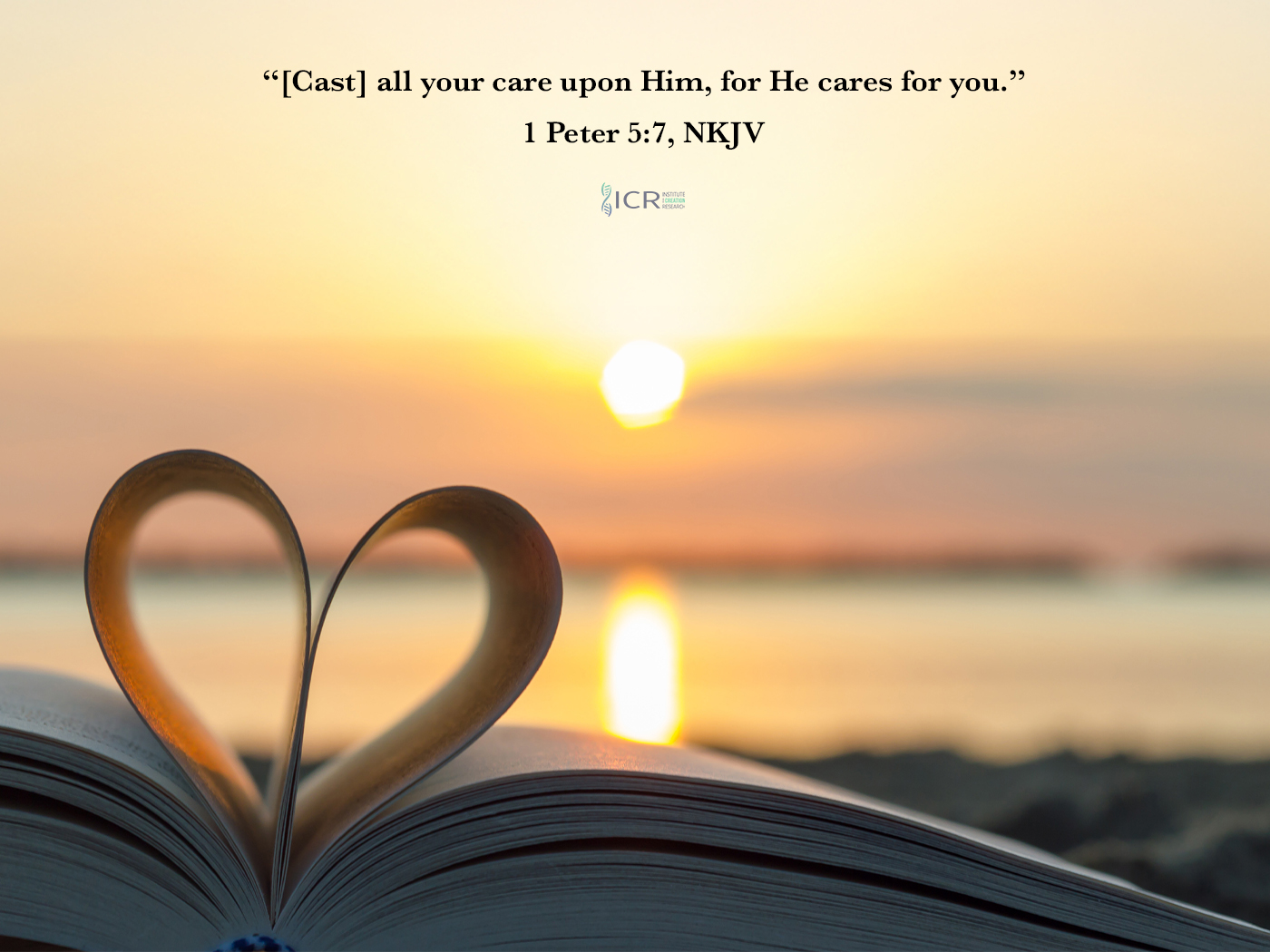
"[Cast] all your care upon Him, for He cares for you."  (1 Peter 5:7, NKJV) ICR's September 2026 wallpaper is now...

NEWS
Life’s Origins: The Bootstrap Problem
Could life’s instructions exist without ever being made? This question raises what is called a “bootstrap problem.”1 It...

ACTS & FACTS
The Power of a Meek Life
One of the clearest voices calling believers to surrender to Jesus was George Whitefield, who said, “I have just put my soul as a blank into the...

ACTS & FACTS
Extent of the Curse and the Hope of Redemption
“For we know that the whole creation groaneth and travaileth in pain together until now.” Romans 8:22* At the end of the sixth day of...

ACTS & FACTS
Modern Idolatry: Crediting Natural Selection as the Creator
“Have no other gods before Me.” Exodus 20:3 In the beginning God created the heavens and the earth” (Genesis 1:1). The Creator...

ACTS & FACTS
Is Death a Curse or Life’s Change Agent?
“The last enemy that will be destroyed is death.” 1 Corinthians 15:26 Without a doubt, there is a sting to death that is felt by Christians...

ACTS & FACTS
A Literal First Adam and Redemption in Christ
“ . . . the son of Enosh, the son of Seth, the son of Adam, the son of God.” Luke 3:38 Was there a literal Adam created along with his...