With the continued invalidation of the corrupt theory of neo-Darwinism in the eyes of many, and school boards nation-wide taking a favorable look at intelligent design, it is not surprising that evolutionists are scrambling to enact damage control. Enter an alleged “missing link” that some are saying reveals one of the greatest chan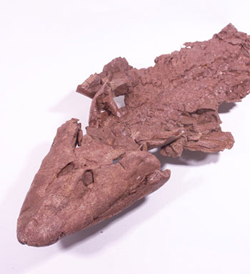 ges in the field of zoology.
The New York Times (NYT) reports that the recent discovery of a large scaly creature in Canada is “a predecessor of amphibians, reptiles and dinosaurs, mammals and eventually humans” (Wilford 2006). National Geographic News (NGN) crows that “fossil hunters may have discovered the fish that made humans possible.” (Owen 2006). But before evolutionists start celebrating, they should keep in mind that Tiktaalik roseae is incomplete. Scientists as of yet unable to determine what the hind fins and tail might have looked like. Paleontologist Neil Shubin states, “We’ve really only begun to sort of crack that spot [the small rocky outcropping 600 miles from the North Pole where Tiktaalik was found]” (AP 2006).
Also noteworthy, is the use of diffident language by the secular reporters and scientists when discussing Tiktaalik. For example, NGN says this creature “may” be a missing link. While the NYT states that changes in this creature “anticipate” the emergence of land animals. One may anticipate leaving the house, but he is still in the house.
What will the Creationists say now?
It is significant that most of the news stories immediately mention creationists and the problem this discovery presents for their model. NYT author, J. N. Wilford takes a swipe at “religious creationists” by stating that the Tiktaalik discovery is a “powerful rebuttal” to creationists’ insistence that the transitional forms that would otherwise validate Darwin’s strange theory remain undiscovered. He continues to marginalize the debate by referring only to “conservative Christians” while ignoring a sizable portion of the population who are not Christians or “religious” but nonetheless remain skeptical of Darwin’s fish-to-philosopher idea. Furthermore, Wilford quotes evolutionary paleontologist M.J. Novacek as gleefully stating that “creationists are flatly wrong” (Wilford 2006). Wilford continues to quote Novacek who makes the mistake of listing only two alleged transitional forms! If macroevolution has been taking place for 4.6 billion years, the sedimentary rock units should have billions of undeniable transitions. Novacek only mentions Archaeopteryx (it had wings, feathers, and it evidently flew quite well based on the robust wishbone), and a suspiciously vague reference to “an early whale that lived on land.” If this whale were a true missing link, paleontologist Novacek wouldn’t hesitate to list its name plus other specifics to make his case.
Is Tiktaalik really 375 million years old? These long ages have always been suspect, especially in the light of the discovery of living fossils (e.g. ICR Impact #394), the ICR RATE project, and recently, soft dinosaur tissue discovered in eastern Montana allegedly 70 million years old (Yeoman 2006).
A lobe-finned fish
We are reminded of the history of a lobed-finned fish called the coelacanth considered by evolutionists to be an index fossil that would date sedimentary strata to millions of years (the Devonian, a period in the Paleozoic Era). However, in 1938 a coelacanth was discovered alive off the coast of South Africa. Since then, others have been filmed and coelacanths have recently appeared in the South Pacific. Tiktaalik had lobed fins like the coelacanth and it “would have breathed like a lungfish”, says senior assistant curator Jennifer Clack of Cambridge's University Museum of Zoology (Owen 2006).
Evolutionist Michael Denton states
If the case of the coelacanth illustrates anything, it shows how difficult it is to draw conclusions about the overall biology of organisms from their skeletal remains alone. Because the soft biology of extinct groups can never be known with any certainty then obviously the status of even the most convincing intermediates is bound to be insecure. The coelacanth represents yet another instance where a newly discovered species, which might have provided the elusive evidence of intermediacy so long sought by evolutionary biology, ultimately proved to be only another peripheral twig on the presumed tree of life (Denton 1985).
In his description of this fossil, evolutionist Shubin states the front fins look basically “like a scale-covered arm” with “bones that correspond to a shoulder, upper arm, elbow, forearm and a primitive version of a wrist” (AP 2006). Shubin is speaking of an unstable macroevolutionary cornerstone called homology. The Concise Oxford Dictionary of Zoology defines homology as, “the fundamental similarity of a particular structure in different organisms, which is assumed to be due to descent from a common ancestor" [my emphasis] (Allaby 1992). The word assumed means supposed or taken for granted. The whole theory of homology assumes macroevolution to be a fact.
One should note that the bones in Tiktaalik’s fins have no axial skeleton connections. This is significant because without this direct connection, no true walking could be done by Tiktaalik. Furthermore, the fins of this creature enclose rays, not digits such as toes or fingers.
Conclusion
Evolutionist Jennifer Clack of Cambridge University, who was not involved in the study, said it’s impossible to tell if Tiltaalik was a direct ancestor of land vertebrates (AP 2006), and the NYT states Tiktaalik is still a fish (Wilford 2006).
As always, creationists adopt a cautious wait-and-see attitude. The scientific jury is still out. As yet, many zoologists—creationists and evolutionists—have been unable to examine the fossils or their cast impressions first-hand. Stories that shout “one of the greatest transformations in the history of animals” (AP 2006) have traditionally been a flash in the evolutionary pan.
References
1. Wilford, J.N. 2006. Fossil called missing link from sea to land animals. New York Times, April 6, 2006. http://www.nytimes.com/2006/04/06/scienc
e/06fossil.html ?r=1&oref=slogin.
2. Owen, James 2006. Fossil fish with "limbs" is missing link, study says. National Geographic News, April 5, 2006. http://news.nationalgeographic.com/news/
2006/ 04/0405_060405_fish.html.
3. Associated Press. 2006. Fossil shows how fish made the leap to land. MSNBC.com, April 5, 2006. http://www.msnbc.msn.com/id/12168265.
4. Yeoman, Barry. 2006. Schweitzer's dangerous discovery. Discover, April.
5. Denton, Michael. 1985. Evolution: A theory in crisis. Bethesda, MD: Adler & Adler.
6. Allaby, Michael, ed. 1992. Concise Oxford Dictionary of Zoology, s.v. “homology.” Oxford: Oxford University Press.
Article posted on April 11, 2006.