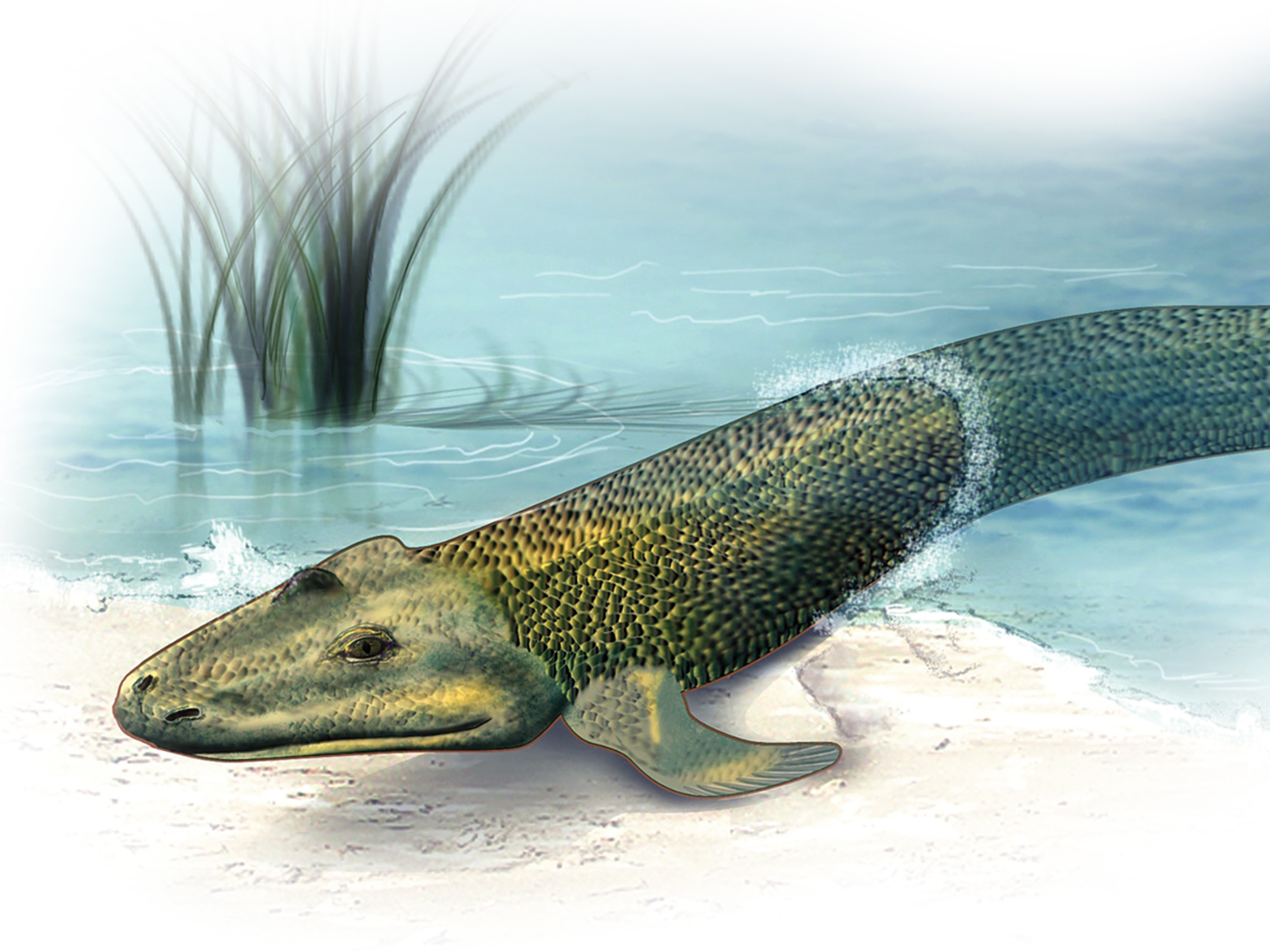
According to evolutionary theory, fish went through a variety of forms until they evolved into the fish we see swimming today. Recently, what conventional scientists would ordinarily consider as a primitive fish was discovered in a fossil deposit in Cleveland.1 But the uniqueness of the fish has left them scratching their heads about its origins and its actual place in history.
Dunkleosteus terrelli was an armored fish, or placoderm, that lived in the pre-Flood world. Evolutionists consider placoderms to be pivotal in the evolutionary history of vertebrates, including people, even though placoderm evolution is unknown.
However, that doesn’t stop conventional scientists from speculating about it. Although they appeal to convergent evolution in The Anatomical Record, that’s not an explanation at all.2,3 The scientists state, “Many features of D. terrelli appear to reflect broader evolutionary trends characterizing dunkleosteoids, and some appear to be convergent specializations for macropredation shared with some aspinothoracidans.”2 Convergence states only that similar traits allegedly evolved independently within unrelated lineages across the so-called tree of life, but it doesn’t say how this is accomplished. It doesn’t scientifically explain anything.
The fossil record appears to set the matter straight. ICR’s Dr. Jeffrey Tomkins describes “primitive” placoderms being found with modern fish.4 There is no evidence of step-by-step evolution of these unusual fish from some other creature.5 Instead, they appear suddenly, complete, and fully formed in the fossil record, which suggests that armored fish have always been armored fish—no in-between forms or different ancestors.
Russell Engelman, lead author of the study, believed the team wasn’t dealing with primordial fish: “These discoveries highlight that arthrodires cannot be thought of as primitive, homogeneous animals, but instead a highly diverse group of fishes that flourished and occupied many different ecological roles during their history.”1 Engelman came close to the creationist interpretation of these fish. God designed them with incredible diversity, which gave them the ability to move in, fill, and even flourish within a variety of ecological niches.6
To conclude, D. terrelli was 100% an armored fish, created with other fish on Day 5 of the creation week. This unique fish is found buried in Flood sediments along with other fish of all types, none of which show any evolutionary progression. They reproduced after their kind, just like Genesis says.
References
- Case Western Reserve University. Cleveland’s Famous Sea Monster Gets a Scientific Update. Phys.org. Posted on phys.org November 20, 2025.
- Engelman, R. K. et al. 2025. Functional Anatomy, Jaw Mechanisms, and Feeding Behavior of Dunkleosteus terrelli (Placodermi, Arthrodira). The Anatomical Record. Published online November 2025 before print. 309 (7).
- Guliuzza, R. J. 2017. Convergent Evolution Is a Seductive Intellectual Swindle. Acts & Facts. 46 (3): 17–19.
- Tomkins, J. P. The Fossils Still Say No: The Mystery of Jawed Vertebrates. Acts & Facts. 50 (2): 12–14.
- Sherwin, F. Alleged 380-Million-Year-Old Fish Heart. Creation Science Update. Posted on ICR.org October 24, 2022.
- Guliuzza, R. J. and P. Gaskill. 2018. Continuous Environmental Tracking: An Engineering Framework to Understand Adaptation and Diversification. Proceedings of the International Conference on Creationism. 8 (1): 158–184.
* Dr. Sherwin is a science news writer at the Institute for Creation Research. He earned an M.A. in invertebrate zoology from the University of Northern Colorado and received an honorary doctorate of science from Pensacola Christian College.