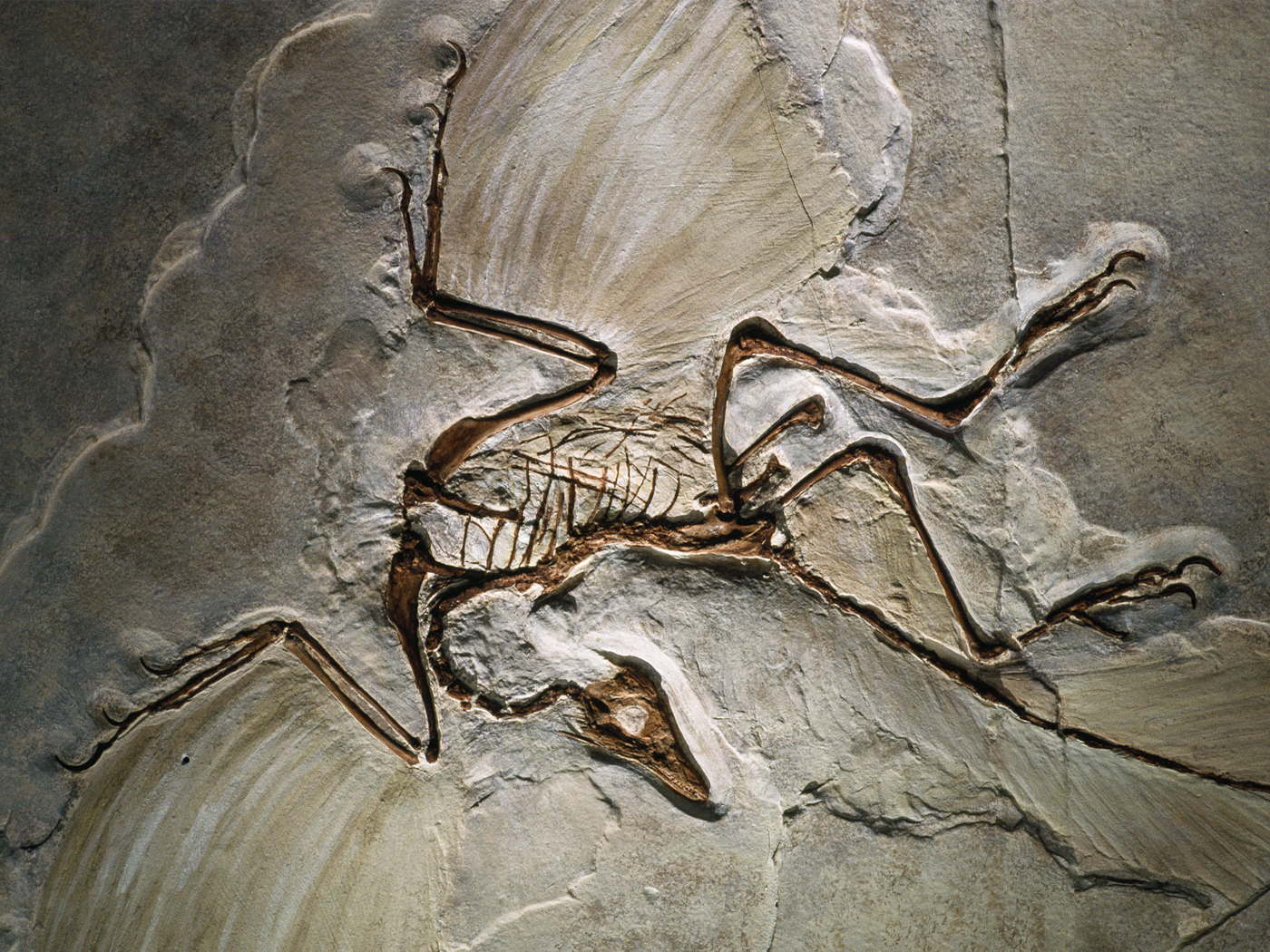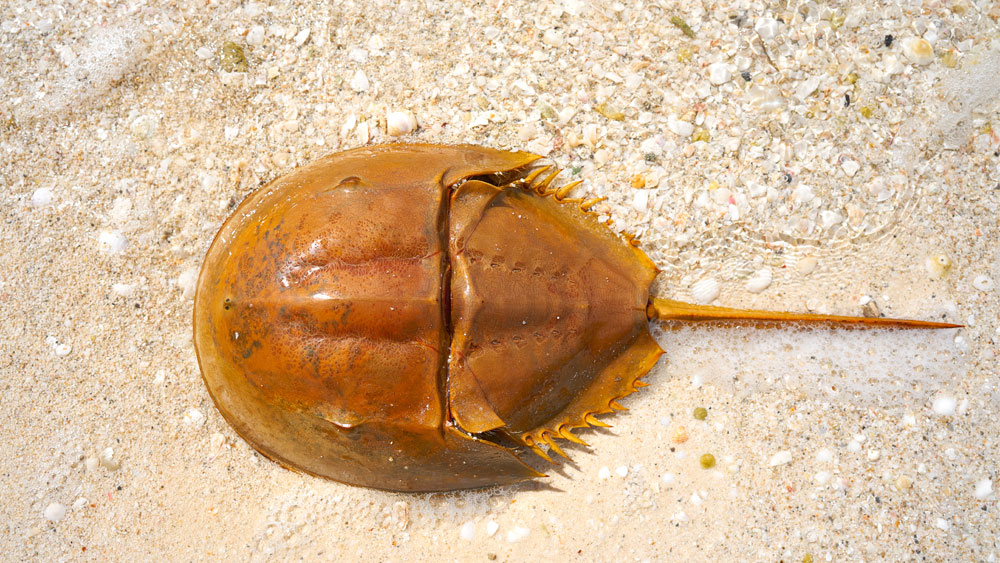
Supposedly, throughout the past hypothetical millions of years, sub-human primates became man, dinosaurs evolved into birds, and a group of mammals even returned to the oceans to become whales. But also according to evolution theory, the amazing horseshoe crab (order Xiphosura) “goes back practically unchanged to the Triassic period.”1 Natural selection2 and random mutations have not affected these chelicerates at all.3 This is hardly surprising to creation scientists because the Bible indicates that horseshoe crabs have always been horseshoe crabs since their creation thousands of years ago—that’s why the fossils match the living creatures.
Horseshoe crabs are arthropods, but they are not true crabs (crustaceans). They are instead classified as chelicerates belonging to the family Limulidae. Although horseshoe crabs are an alleged ancient lineage with an evolutionary history stretching back almost a half-billion years (Ordovician period), evolutionists generally consider them to be examples of living fossils.4 In fact, evolutionist James Lamsdell said, “The group [Xiphosura] is famous as an example of an evolutionary conservative lineage [i.e., no change] and is considered to comprise archetypal [standard] ‘living fossils.’”5
Recently, science writer Sergio Prostak stated,
A paleontologist from West Virginia University has described a new genus and species of true horseshoe crab from a Silurian-age specimen unearthed in Indiana, the United States. The species bridges the 80-million-year gap in the horseshoe crab fossil record and has an overall morphology similar to that of the Ordovician species.6
But this supposed 80-million-year gap does not exist except in the mind of the evolutionist. There’s no evidence for such missing time. It was a 100% horseshoe crab extracted from Genesis Flood sediments. As ICR’s Jeff Tomkins states,
While evolutionists have no good explanation why such creatures [such as horseshoe crabs] would abruptly appear hundreds of millions of years ago and then disappear for millions of years only to reappear and now be happily alive, a biblical Flood-based interpretation perfectly explains the data. Creationists know from both the rock record and the Scriptures that the Genesis Flood was a progressive year-long global event. The succession of fossils in the rock strata largely represents the progressive burial of ecological zones [such as the “Silurian-age” specimen of horseshoe crab] characterized by the plants and animals they contained.”7
But despite this better alternative explanation for these living fossils, conventional scientists maintain that this single horseshoe crab fossil—Ciurcalimulus discobolus—found in the Wabash Formation of sedimentary rock in Indiana is 424 million years old.
The greatly inflated age is based on “finely laminated dark dolostones [a sedimentary carbonate rock] and is considered to be Silurian in age based on conodont [extinct marine jawless vertebrates] data [emphasis added].”6 In other words, the sedimentary strata that Ciurcalimulus was found in also had conodonts—index fossils of the Silurian (i.e. the Kokomo Member of the Wabash Formation).
An index fossil, or zonal fossil, is the fossilized remains of a creature that is found in a particular unit of sedimentary rock and is used by evolutionists to correlate and date the age of rock layers. So Ciurcalimulus is dated by strata it was found in and the same sedimentary strata is dated to be Silurian because the conodonts were found there, which were themselves dated by other index fossils or uncertain radiometric dating. Clearly, it’s not exactly a precise dating system.
The minor change seen in these creatures from the Ordovician to the Late Devonian is just that, variation within the created kind such as what we also see in dandelions (over 250 species), dinosaurs, or dogs. There is no real horseshoe crab evolution documented in the sedimentary rocks. Nor are they definitively millions of years old. To conclude, “The origins and early evolution of horseshoe crabs are poorly known.”6 When fossil horseshoe crabs are found, they only vary within the kind as predicted by the creation model.8 Horseshoe crabs have always been horseshoe crabs since the beginning of creation.
References
- Hickman, C. et al. 2024. Integrated Principles of Zoology. Columbus, OH: McGraw Hill, 418.
- Thomas, B. Lizard Study Questions Natural Selection. Creation Science Update. Posted on ICR.org June 4, 2010.
- Sherwin, F. Arachnid Origin—WGD (What God Did). Creation Science Update. Posted on ICR.org March 10, 2025.
- Thomas, B. Should We Drop the Term ‘Living Fossil’? Creation Science Update. Posted on ICR.org, July 18, 2016.
- Lamsdell, J. 2025. The First Silurian Horseshoe Crab Reveals Details of the Xiphosuran Ground Plan. Proceedings of the Royal Society B. 292 (2049).
- Prostak, S. Paleontologist Discovers First Known Silurian Horseshoe Crab. Sci.News. Posted on sci.news August 29, 2025.
- Tomkins, J. 2020. The Fossils Still Say No: The Cambrian Explosion. Acts & Facts. 49 (12): 10–13.
- Morris, J. 2003. Do Creationists Really Believe in Evolution? Acts & Facts. 32 (3).
* Dr. Sherwin is a science news writer at the Institute for Creation Research. He earned an M.A. in invertebrate zoology from the University of Northern Colorado and received an honorary doctorate of science from Pensacola Christian College.