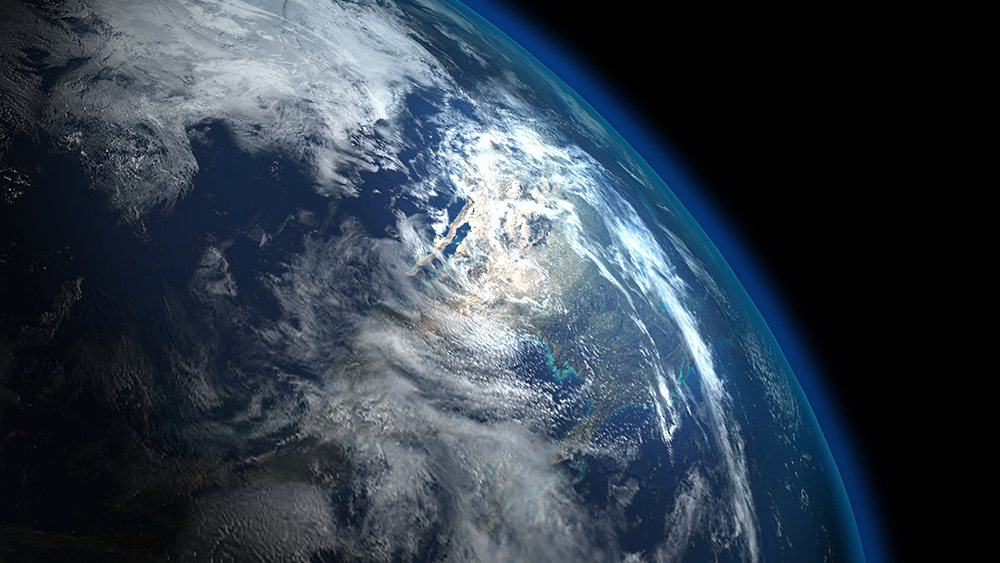
Earth’s oceans contain 321 million cubic miles (1.335 billion cubic kilometers) of water. The moon causes ebb and flow of tides twice in a 24-hour period, while the wind, density variations, and tides contribute to the massive ocean currents. These currents prevent oceanic stagnation and help circulate vital moisture and heat around the globe. But where did all this water come from?
Because some scientists reject the biblical model of creation, Earth’s water origins have been an enigma for them for many decades: “The source of Earth’s water has been a long-standing mystery.”1
Indeed, an evolutionist wrote in Science, “According to secular models of Solar System formation, Earth, as an inner Solar System planet, should have little to no water.”2 And yet 71% of Earth is covered with water!
For decades, a popular, attempted explanation for Earth’s water has been that Earth was peppered with untold millions of water-containing comets and asteroids over many millions of years. But scientific research has not supported this highly questionable theory. In fact, this idea has long had problems. In 2014, ICR’s Brian Thomas reported that Comet 67P/Churyumov-Gerasimenko, investigated by the Rosetta spacecraft, had water that differed significantly from Earth’s water.
A research team published details of their discovery in Science, noting that the comet's water molecules have about three times more deuterium than hydrogen. Deuterium is a heavy but stable isotope of hydrogen. It carries a proton and neutron in its nucleus, whereas the more abundant version of hydrogen carries just one proton.
If comets supplied the water to form Earth's oceans, then the ratio of deuterium to common hydrogen should be about the same, not three times higher in comets. Perhaps this comet's water does not represent water found in other comets—but that would throw a new kink in the secular notion that comets and Earth all formed from the same material.4
Recently, meteorite research suggests that Earth may not have obtained its water in this manner.3 A Live Science article stated,
Researchers found signs of hydrogen sulfide in a type of meteorite similar to those that made up the early Earth. If these rocky bodies contain abundant hydrogen when out in space, it's possible that Earth could have formed with the materials to make water, rather than getting most of its water from chance collisions with asteroids and meteoroids throughout the planet’s early history.3
In other words, the hydrogen in the hydrogen sulfide contained within these very early meteorites somehow became the hydrogen in Earth’s water (H2O) molecules. But other evolutionists have pointed out that such meteorites are likely to be contaminated by hydrogen from Earth.3
In 2024, Live Science reported that ancient zircon crystals show that Earth might have had fresh water and continents soon after forming, and some evolutionary scientists have suggested water “may have been part of the planet’s original composition.”5
Other than the greatly inflated age, this is getting closer to the biblical model.
Some scientists have suggested that Earth may have been mostly covered by water as early as 4.4 billion years ago — aligning with the oldest zircons ever discovered. However, it is unclear how water arrived. It may have been part of the planet’s original composition or may have been the result of bombardment by water-bearing asteroids soon after its formation.5
In 2021, Sci.News reported that water may have been here all along, “‘All our data suggest that water was part of Earth’s building blocks, right from the beginning,’ said Professor Anders Johansen, Centre for Star & Planet Formation, University of Copenhagen and Lund Observatory” [emphasis added].6
So uniformitarian scientists are being forced to acknowledge that Earth’s water was here from the beginning, like Scripture claims. But they still don’t know how the water got here. Perhaps this is because the presence of water on Earth is not something that can be explained naturally, but supernaturally.
And the earth was without form, and void; and darkness was upon the face of the deep. And the Spirit of God moved upon the face of the waters. (Genesis 1:2)
References
- Redd, N. T. Where Did Earth’s Water Come From? Astronomy.com. Posted on astronomy.com April 1, 2019.
- Peslier, A. 2020. The Origins of Water. Science. 369 (6507): 1058.
- Ware, S. Earth May Not Have Gotten Its Water How We Thought, Controversial Meteorite Study Suggests. Live Science. Posted on livescience.com May 5, 2025.
- Thomas, B. Study: Comets Did Not Supply Earth’s Water. Creation Science Update. Posted on ICR.org December 29, 2014.
- Pallardy, R. Earth May Have Had Freshwater and Continents Soon after Forming, Ancient Crystals Reveal. Live Science. Posted on livescience.com May 13, 2024.
- Aquatic Planets are Common in Our Milky Way Galaxy, Study Suggests. Sci.news. Posted on sci.news February 23, 2021. (The leading title of this article is nothing more than wishful thinking on the part of evolutionists.)
* Dr. Sherwin is a science news writer at the Institute for Creation Research. He earned an M.A. in invertebrate zoology from the University of Northern Colorado and received an honorary doctorate of science from Pensacola Christian College.