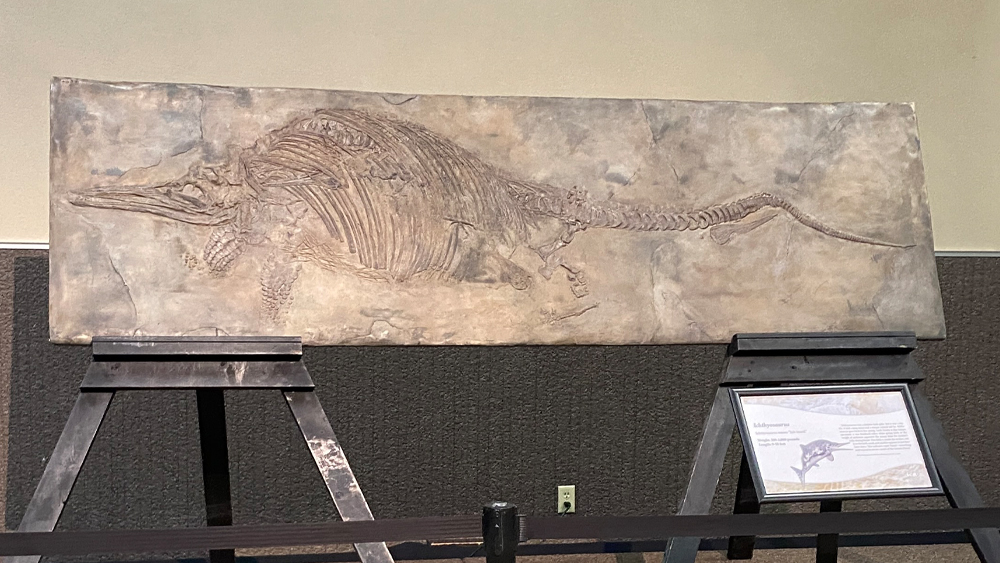
Ichthyosaurs are marine reptiles that occur globally in the same rock layers as dinosaurs. Specimens with babies support the idea that they gave live birth, unlike most of today’s reptiles.
A pregnant ichthyosaur fossil named Fiona offers new information about the lifestyles of these marine predators.1 Originally discovered in 2009 and excavated in 2022 near the Tyndall Glacier in Torres Del Paine National Park, southernmost Chile, it is the first complete ichthyosaur found in Chile.2 The same site has produced an additional 86 ichthyosaur specimens to date, qualifying the locality as a Lagerstätte deposit, or a fossil graveyard.2 All seem to have been buried rapidly in wet sand that has since turned to sandstone.
Fiona was taken out of the ground in five pieces and flown by helicopter to a nearby ranger station before being shipped to the research laboratory at the Natural History Museum Río Seco in Punta Arenas, Chile.2
One of the most fascinating aspects of Fiona is that her snout was found to have been pushed about four inches into the sand during burial, causing the skeleton to twist and exposing its right side.2 Science writer Jordan Joseph further described the specimen.
Inside her body were fossilized fish vertebrae, which indicate that her last meal had not yet been digested. The fetus was also mostly intact and appeared ready for birth, with its tail oriented toward what would have been the exit path from the mother.1
Joseph added this about Fiona’s rapid burial,
The fossil reveals a story of sudden burial. Scientists suspect an underwater landslide pushed down a heavy flow of sand that covered Fiona almost instantly, and led to excellent conditions for the preservation of both mother and unborn baby.1
To explain the other 86 ichthyosaur fossils at the site, the science team postulated that repeated underwater landslides catastrophically buried each of them.1 But where are marine animals being buried completely, so perfectly, and in such numbers today? In addition, these fossils are found on the continent, not in the deep ocean.
A better explanation is that Fiona and the other ichthyosaurs were buried in the catastrophe of the global Flood described in Genesis. The forces behind her sudden burial are best explained by super-sized, tsunami waves generated by tectonic activity during the Flood year. Earthquakes can generally create a series of tsunamis. Each wave could have carried in several living ichthyosaurs from the ocean depths, rapidly burying them in sand and mud. Catastrophic plate motion, as modeled by creation scientists, could have easily generated hundreds of tsunamis a day, resulting in wave after wave of water that spread marine creatures, sand, and mud across the land.3 This most likely created the stacked graveyard of ichthyosaur fossils in Chile.
While it’s impossible to tell if Fiona was giving birth at the time of her burial or if the baby was simply pushed out by the compaction process, it’s clear that ichthyosaurs gave life birth. Fiona is a reminder of the judgement of the Flood. Her unfortunate burial while pregnant is a consequence of Adam’s sin and rebellion against Jesus Christ, our Creator. With the rest of creation, Christians look forward to the day when God will “make all things new” (Revelation 21:5).
References
- Joseph, J. 2025. ‘Fiona’ the Ichthyosaur Was Preserved for Millions of Years after a Landslide. Earth.com. Posted on earth.com April 14, 2025, accessed April 16, 2025.
- Pardo-Pérez, J. M. et al. 2025. The First Gravid Ichthyosaur from the Hauterivian (Early Cretaceous): A Complete Myobradypterygius hauthali von Huene, 1927 Excavated from the Border of the Tyndall Glacier, Torres Del Paine National Park, Southernmost Chile. Journal of Vertebrate Paleontology. e2445705.
- Clarey, T. 2020. Carved in Stone: Geological Evidence of the Worldwide Flood. Dallas, TX: Institute for Creation Research.
Stage image: Ichthyosaur fossil replica showing several babies, supporting that these marine reptiles gave live birth.
Stage image credit: Joel Kautt
*Dr. Clarey is the director of research at the Institute for Creation Research and earned his doctorate in geology from Western Michigan University.