Evolutionists theorize that the universe came into being through random means. Fundamentally, randomness lacks symmetry since the very concept of symmetry implies order. Randomness also lacks periodicity, such as events occurring in a cycle or objects in a repeating sequence. Quite simply, randomness lacks any evidence of design. Nature, however, does not display randomness.1 In fact, it exhibits quite the opposite.
In the twelfth century, Italian mathematician Leonardo Fibonacci discovered a fascinating number sequence in which each number is the sum of the previous two numbers (1, 1, 2, 3, 5, 8, 13, 21, 34…). This sequence is revealed in many profound ways across the natural realm.
For instance, in geometry a “golden rectangle” is a rectangle whose side lengths are represented by the “golden ratio,” which is derived from the Fibonacci sequence.2 Needless to say, this rectangle has some interesting mathematical properties that are also pleasing to the human eye. As such, it can be seen in historical structures like the Parthenon, the Great Pyramid of Giza, and the United Nations building. It’s also used for credit cards, playing cards, and even the light switch in your bedroom. Additionally, many artists utilize the golden rectangle to give their art a quality called dynamic symmetry, which adds elements of growth, movement, power, animation, and life.
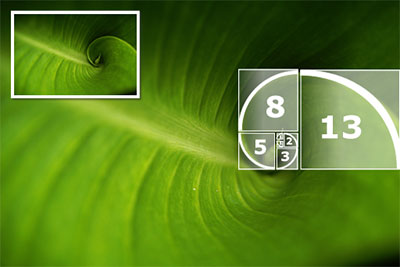
The golden rectangle taken one step further produces the “golden spiral,” a logarithmic spiral whose growth component reflects the golden ratio.2 It’s the only spiral that does not change shape as it grows. This spiral is well-represented in nature via the chambered nautilus shell, a hurricane spiral, a ram’s horn, the tail of a seahorse, the DNA molecule, galaxies, and the cochlea of the human ear, to name a few examples.
In botany, phyllotaxis is the arrangement of leaves on a plant stem. The rotational angle from leaf to leaf represents a fraction of a full rotation around the stem. Alternating elm leaves, for instance, have an angle of 1/2 of a full rotation. In beech and hazel, the angle is 1/3; in oak and apricot, 2/5; in sunflower, poplar, and pear, 3/8; and in willow and almond, 5/13.3,4 As demonstrated, each numerator and denominator consists of a Fibonacci number and its successor.5 In fact, you’ll never find a leaf arrangement that does not reflect the Fibonacci sequence—this specific configuration maximizes the leaves’ exposure to sunlight and air without shading from the others.
So, why is the Fibonacci sequence exhibited in phyllotaxis, the rotation of our galaxy, the DNA in our cells, and countless other places? It’s because the same Designer created them all in perfect unison and harmony. As Jeremiah 32:17 proclaims, “Ah, Lord GOD! Behold, You have made the heavens and the earth by Your great power and outstretched arm. There is nothing too hard for You.”
References
- See Corrado, J. 2023. Non-Repeatable Repeatability: Finding Order in Disorder. Creation Science Update. Posted to ICR.org October 23, 2023, accessed March 3, 2024.
- Livio, M. 2002. The Golden Ratio: The Story of Phi, the World’s Most Astonishing Number. New York: Broadway Books.
- Coxeter, H. S. M. 1961. Introduction to Geometry. New York: John Wiley & Sons.
- Willson, F. 2002. Shapes, Numbers, Patterns, And The Divine Proportion In God's Creation. Acts & Facts. 31 (12).
- Pennybacker, M. and A. C. Newell. 2013. Phyllotaxis, Pushed Pattern-Forming Fronts, and Optimal Packing. Physical Review Letters. 110 (24).
Stage image: Cross section of a chambered nautilus shell displaying the golden spiral
Stage image credit: Copyright © Philippe Alès. Used in accordance with federal copyright (fair use doctrine) law. Usage by ICR does not imply endorsement of copyright holder.
* Dr. Corrado earned a Ph.D. in Systems Engineering from Colorado State University and a Th.M. from Liberty University. He is a freelance contributor to ICR’s Creation Science Update, works in the defense and nuclear industries, and is a senior officer in the U.S. Naval Reserve.