



Life requires many parameters in order to survive and thrive. The more data that are uncovered, the more evidence there is that Earth and its environs were specifically designed with the exact conditions needed for life. Remote sensing has unearthed data suggestive of just such design.
Remote sensing is the process of detecting and monitoring the characteristics of an area by measuring its reflected and emitted radiation at a distance, typically from a satellite or aircraft.1 Practically speaking, this process enables people to look beyond the range of human vision.2 Data gathered by remote sensing provide powerful insights and give researchers much more information than human senses can directly detect. The extraction and analysis of this data not only reveal valuable information with many different applications, but they also imply specific design characteristics that only a Designer could produce.
One such design element is a phenomenon called the IR Ledge, or Red Edge. The IR Ledge is an important, dramatic spectral feature found in remote sensing. Image analysts use it to highlight vegetation in satellite imagery. It refers to the region of dramatic change in vegetation reflectance in the near-infrared range. This striking wavelength reflectance rise makes vegetation appear bright in the infrared.3
Live green plants absorb solar radiation in the visible wavelengths, and they use it as a source of energy in the process of photosynthesis. But leaf cells reflect solar radiation in the near-infrared spectral region because the energy at these wavelengths is insufficient to synthesize organic molecules. Absorption at these wavelengths would only result in overheating the plant and possibly damaging the tissues.4
The question, then, is how does the IR Ledge correspond to the light emitted by the sun? When an object is heated to a high temperature, it emits light that’s more representative of the object’s temperature than of its composition. When an object has this characteristic, it’s called a blackbody radiator. The sun is one such object.5
Interestingly, the sun’s blackbody curve corresponds to a surface temperature of 5,600°C, and its peak centers in the visible spectrum so that the greatest amount of energy is emitted within this visual band. This means that the sun’s temperature is just right to ensure that plants receive the maximum amount of energy for photosynthesis. Also, under daylight conditions, the human eye is most sensitive to yellow-green light near the center of the visible band.6 Are these merely coincidences or hints of design?
This means the sun’s surface temperature must remain at 5,600°C to ensure optimal “tuning” for human daylight vision and plant photosynthesis. Of course, the sun must also maintain a constant temperature, given the distance from the sun to Earth, to prevent Earth from freezing or overheating. In that case, life of any kind on Earth would be impossible.7
Understanding that the sun’s temperature and blackbody spectrum must remain relatively constant for life on Earth to remain viable, it can be inferred that the placement of the IR Ledge should be tied to the sun’s blackbody spectrum. As displayed in the figure below, an overlay of the sun’s blackbody radiation profile on top of a vegetation reflectance curve clearly shows this tie.
The figure indicates that most of the sun’s energy is emitted within the wavelength range of the visible spectrum, which is precisely the energy that plant life absorbs for photosynthesis. Outside the visual spectrum, the sun’s blackbody energy declines rapidly as the plant’s reflectance profile increases, repelling the energy at wavelengths that would harm the plant. This phenomenon indicates complexity, sophistication, and purpose—as if it were designed by a Designer.
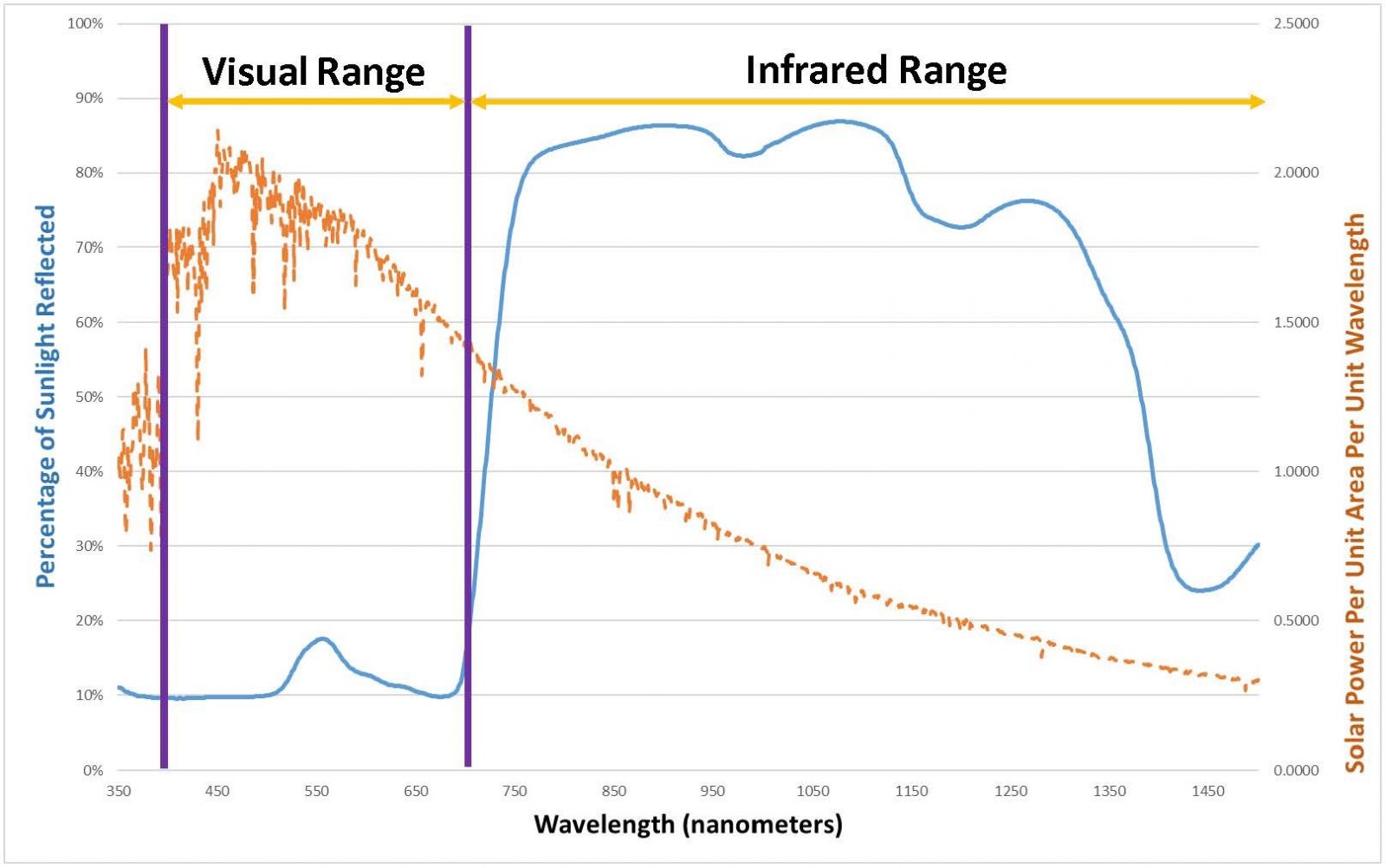
An interesting yet critical design element is therefore discernible in the IR Ledge via remote sensing. This element, combined with the unique and specially tuned blackbody radiation profile of the sun centered on the visual spectrum, displays characteristics that transcend coincidence and thus radiates the evidence of design.
The marvel of the IR Ledge supports the observation that “His invisible attributes are clearly seen, being understood by the things that are made, even His eternal power and Godhead, so that they are without excuse” (Romans 1:20).9
References
- Chuvieco, E. 2020. Fundamentals of Satellite Remote Sensing: An Environmental Approach, 3rd ed. Boca Raton, FL: CRC Press/Taylor & Francis Group.
- Olsen, R. 2016. Remote Sensing from Air and Space, 2nd ed. Bellingham, WA: Spie Press.
- Carter, G. A. 1991. Primary and secondary effects of water content on the spectral reflectance of leaves. American Journal of Botany. 78 (7): 916-924.
- Gates, D. M. 1980. Biophysical Ecology. New York: Springer-Verlag.
- Stewart, S. and R. Johnson. 2017. Blackbody Radiation: A History of Thermal Radiation Computational Aids and Numerical Methods. Boca Raton, FL: CRC Press/Taylor & Francis Group.
- Hewitt, P. G. Conceptual Physics, 10th ed. San Francisco: Pearson: Addison-Wesley.
- Borrow, J. and F. Tipler. 1988. The Anthropic Cosmological Principle. New York: Oxford University Press.
- Kokaly, R. F. et al. 2017. USGS Spectral Library Version 7: U.S. Geological Survey Data Series 1035.
- Coddington, O. et al. 2015. NOAA Climate Data Record (CDR) of Solar Spectral Irradiance (SSI), NRLSSI Version 2. NOAA National Centers for Environmental Information. doi:10.7289/V51J97P6, accessed April 15, 2021
For the full research paper, see J. K. Corrado. 2022. The design of the spectral “IR Ledge.” Creation Research Society Quarterly. 59 (1).
Image Credit: NASA
*Dr. Corrado earned a Ph.D. in Systems Engineering from Colorado State University and a Th.M. from Liberty University. He is a freelance contributor to ICR’s Creation Science Update, works in the nuclear industry, and is a senior officer in the U.S. Naval Reserve.
