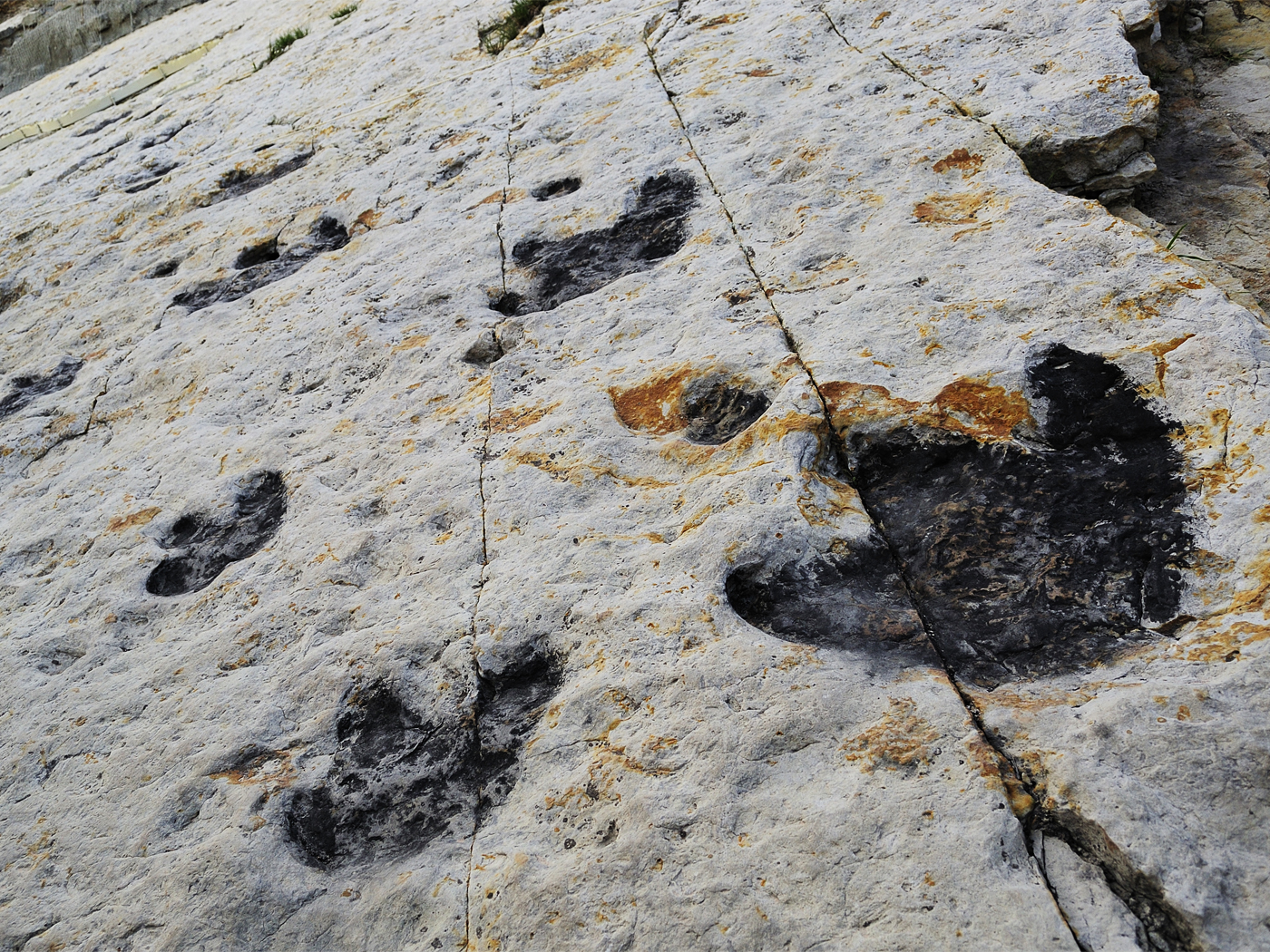
A group of evolutionary scientists from the United Kingdom and France recently unearthed a large track-bearing surface in southern Wales.1 They speculate that these prints are from a bipedal prosauropod2 dinosaur, similar to Plateosaurus, common across Europe. But their interpretation has one major issue. It appears that the prints were made across freshly deposited ocean sediments. Were these dinosaurs walking in the ocean?
Examination of the tracks shows that the footprint outlines are poorly preserved. Although, some indentations do reveal possible digits and claw marks. There also appear to be two sizes of prints at the site, with the larger tracks extending about 20 inches.1
“We believed the impressions we saw at Penarth were consistently spaced to suggest an animal walking,” said co-author Professor Paul Barrett, a paleontologist in the Department of Earth Sciences at the Natural History Museum, London.3 He added, “We also saw displacement rims where mud had been pushed up. These structures are characteristic of active movement through the soft ground.”3
The tracks extend across an area that measures 160 feet long by 6 feet wide, along the shoreline near Penarth in south Wales.1 The scientists discounted a nonbiologic origin for the tracks, concluding that the tracks represent a type of “trample ground” with multiple tracks stepping on one another.1
In their report published in Geological Magazine, the science team noted that the tracks were discovered on a single surface at the top of a 6-inch-thick, gray, dolomitic siltstone.1 The track bed is sandwiched between numerous thin sandy layers filled with wave ripple marks, mudstones, and limestones. In fact, they noted a cyclic pattern of dolomitic mudstones, siltstones, and limestones.1
They also found small gypsum nodules near the top of the bed and more gypsum in a layer about a foot below the track bed.1
Most telling is the presence of dolomite in the track layer and in layers above and below the print bed. Dolomite is a mineral that is deposited almost exclusively in the ocean. And gypsum is a mineral that is commonly derived from ocean water also. And limestone beds form most commonly in a marine environment too. These minerals strongly indicate a marine source for these sediments.
But why would dinosaurs be trampling across fresh ocean sediments? The uniformitarian authors tried to explain, “The tracks were thus formed under predominantly semi-arid conditions [to explain the gypsum] on a low-lying mudflat alongside a marine-influenced lake that was prone to periodic shoreline retreat and sub-aerial exposure [exposed above the water level].”1
Their long, rather convoluted sentence is an attempt by the authors to cover all their bases. They clearly recognize the presence of marine minerals, like dolomite and gypsum. But, rather surprisingly, they claim that it was a lake that was merely influenced by the ocean. They don’t even consider it could all be part of the global Flood.
The mineral dolomite in the track bed itself, and in the layers above and below, clearly indicate these beds were deposited in a marine environment. Secular scientists only claim there was a lake because the tracks are from non-marine animals, like dinosaurs. But we observe ample evidence of mixing of land and marine fossils in the rock record.5 This is nothing new. Just last year, dinosaur bones were found in marine rocks in Ireland.6 Six species of sharks have been found in the same layers as T. rex bones in Montana.7 Even marine fossils have been found in amber (tree resin).8
But at ICR we have a better interpretation. We recognize that dinosaurs were not swept away in the earliest stages of the Flood, but later as the water continued to rise.5 We also expect tsunami-like ocean waves to wash in and out during the Flood’s advance, leaving some areas above water for brief moments. The dinosaurs who made these tracks probably were walking across freshly deposited Flood sediments during a short respite between the waves. They were merely trying to find any available land surface just to survive, explaining the trampling across the same small area. But as the Flood waters rose higher, even these dinosaur track-makers were overcome and buried elsewhere by the progressing water.
And not only are these tracks found within a sediment package most likely deposited by ocean waves, they had to be buried extremely quickly to preserve the prints. Footprints and tracks don’t last long in and near the ocean. Again, the rising Flood waters provides the best conditions to accomplish this.
The global Flood explains why these tracks are found in ocean-derived sediments and are sandwiched between even more ocean-influenced sediments. Furthermore, it explains the mixing of land animals with marine rocks that is so common globally. Finally, it justifies why the tracks were buried so rapidly and preserved. The evidence continues to stack up in support of the global Flood. The rocks don’t lie!
References
1. Falkingham, P., et al. 2021. Late Triassic dinosaur tracks from Penarth, south Wales. Geological Magazine. 1-12. doi:10.1017/S0016756821001308.
2. A prosauropod is a type of long-necked, plant-eating dinosaur. They were generally shorter than the more massive sauropods, like Diplodocus, and some walked on their hind legs.
3. De Lazaro, E. 2022. Triassic Dinosaur Footprints Discovered in Wales. Sci News. Posted on sci-news.com January 3, 2022, accessed January 14, 2022.
4. Clarey, T. 2015. Dinosaur Fossils in Late-Flood Rocks. Acts & Facts. 44 (2).
5. Clarey, T. 2020. Carved in Stone: Geological Evidence of the Worldwide Flood. Dallas, TX: Institute for Creation Research, 301-304.
6. Clarey, T. Ireland’s First Dinosaur Bones Found in Flood Rocks. Creation Science Update. Posted on ICR.org May 13, 2021, accessed January 15, 2022.
7. Clarey, T. 2015. Dinosaurs in Marine Sediments: A Worldwide Phenomenon. Acts & Facts. 44 (6).
8. Clarey, T. Mind-Blowing Marine Ammonite in Tree Resin. Creation Science Update. Posted on ICR.org May 30, 2019, accessed January 15, 2022.
Image Credit: Peter Falkingham, Natural History Museum, London.
*Dr. Clarey is Research Scientist at the Institute for Creation Research and earned his doctorate in geology from Western Michigan University.
Welsh Dinosaur Tracks Found in Flood Rocks
More Much Evidence Exists for a Worldwide Flood

Dinosaur National Monument: Fossil Graveyard of the Flood
Straddling the border of Utah and Colorado, Dinosaur National Monument (DNM) is one of the richest exposures of dinosaur fossils in the world.1...

Early Fish Evolution?
The discovery of a new species of a plant or animal would probably not spark much excitement to the non-scientist. But in this case, the conditions...
Dino Footprints Down Under
Dinosaur trackways1 are once again making the news. Australia is the setting of a remarkable series of dinosaur tracks attributed to ornithischian...
More Creation Science Update
Tiny Worms with an Ability to Suspend Life
God has designed some creatures with an amazing ability to stop or slow down their metabolism (life processes) when encountering challenging conditions.
This...
Salty Sweat in a Desert Plant
Although plants aren’t alive in the biblical sense,1 they are most certainly complex in their physiology and anatomy.2,3...
Human Neurons with 'Tricks Up Their Sleeves'
Who isn’t curious, at some level at least, about how human brains process all the complicated inputs and outputs that our daily lives require?...
The Latest
The Engineering Behind Every Heartbeat
The human heart does not beat like a perfect clock. The time between beats changes as the body breathes, moves, rests, and reacts to the world around...
Blood Vessels: Built to Sense and Respond to Force
Blood vessels do more than carry blood. As tissue grows or heals, new vessels must form in the right place and direction, through a process called angiogenesis....
Hummingbird Hawkmoth Exhibits Astonishing Abilities
The incredible hummingbird hawkmoth (Macroglossum stellatarum), and other insects of the Lepidoptera order, continue to amaze entomologists.1,2...
More Than Just Parts: The Networking of Cells
An engineer can list every part in a system and still miss how it works. Think of a radio. Its parts matter, but so does the wiring that joins them....
Living Centenarian Sturgeon: Extreme Genesis Longevity Is Plausible
Native American oral tradition contains stories of sturgeon living for centuries. While this was largely seen as folklore among conventional scientists,...
Brainy Bees Solve Pollen Problem
The uncanny abilities of the honeybee cause entomologists to shake their heads in wonder.1,2
Scientists have long known that honeybees...

October Wallpaper
"Be anxious for nothing, but in everything by prayer and supplication, with thanksgiving, let your requests be made known to God; and the peace...
Possible Ark Site Has Mainstream Media Hopping
An organization named Noah’s Ark Scans is investigating a site called Durupinar, almost 20 miles from Mount Ararat in Turkey. Could it contain...
ANNOUNCEMENTS
Heroes of Creation Science: Henry M. Morris
“The creation/evolution issue is, in a very real sense, the most fundamental issue of all.” —Henry M. Morris
Many people believe the...

Creation Kids: Fungi
Hi, kids! We created a special Acts & Facts page just for you! Have fun doing the activities while learning about the wonderful world...
Shop Related Products