Nowadays, many folks experience “cabin fever,” but are banned from ordinary travel and social activities.1 However, some get out of the house—yet stay home—by investing time and labor outdoors, doing yardwork and gardening.
For many Americans, it is enough of a challenge at this time of year to trim tree branches, remove weeds (hopefully by the roots), add weed-and-feed to lawn grass, mow the grass, and weed-whack wherever needed. Since tending to one’s own yardwork is a permissible outdoor activity, many are using their extra time at home to maintain their lawns.
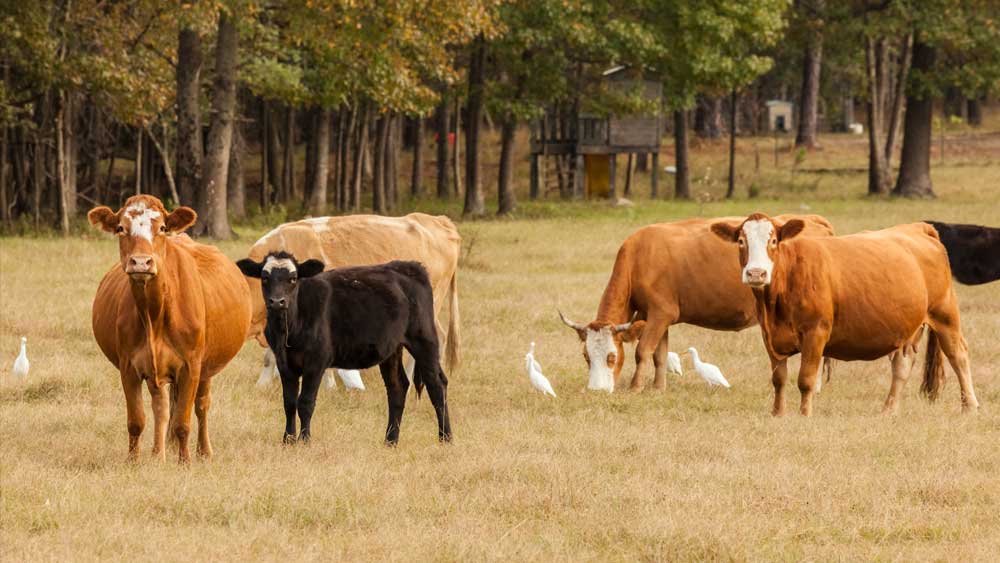
Yet, in other places where large grassy areas abound—such as ranchlands of America’s Great Plains—wild grasses constitute “all-you-can-eat” pastures for domestic cattle.2 And where you find cattle herds and pastures, you often also find their small white heron-like neighbor Bubulcus ibis, the cattle egret.3 Actually, providential partnering between grass-munching bovines and cattle egrets is an example of neighborly mutualism.
Being a good neighbor is a good standard to live by. Good neighbors help one another. In fact, as the New Testament indicates, it’s the biblical norm for how to treat one’s neighbors.4
To some extent, this type of win-win situation often occurs with cattle egrets over most of the world. They ecologically partner with domesticated bovines (cattle) and other large mammal herbivores such as bison, water buffalo, bison, horses, zebras, donkeys, camels, giraffes, antelope, rhinoceroses, etc.
In short, large mammals graze in tall grasses where bothersome insects (like grasshoppers and crickets) and parasitic ticks abound, stirring up the bugs wherever they walk. As the bugs move, reactively, their own motions betray them as moving targets—and often as fast-food—for the cattle egrets who “chaperone” the pasturing cattle.5 Likewise, cattle egrets are not shy about perching atop cattle to eat whatever insects, ticks, or insect larvae may be trespassing on beleaguered bovine bodies.5
The benefit to the birds is obvious—convenient meals, either on the bovine skin or in the stirred grasses that bovine feet brush against, causing bugs to show themselves as moving targets. The egrets just need to watch out for the bovine hooves.
The cattle benefit as well. They have no hands to dislodge the pestering bugs (many of which are noxious parasites) off their backs or to shoo away bugs that initially flit about near their feet and might soon land on the bovine’s legs or back.
The bugs really bug the bovines! So, the insectivorous habits of the bug-munching birds are a welcome relief, providing blessing to the cattle—assuming egrets live nearby.
Actually, the cattle egret is an African emigrant. Cattle egrets migrated from Africa to South America more than a century ago.5,6 After migrating northward more than 70 years ago, cattle egrets quickly colonized the southern regions of North America, and then expand their ranges further north.5,6 In some parts of America, they are established as seasonal migrants. In other parts, they reside year-round.3
And they are easy to recognize, especially during breeding season. Although the plumage of these egrets is mostly white, accented by yellow bills and yellow legs, during breeding season these egrets have golden “mustard” markings (resembling buff-colored blotches) on their breasts, backs, and crowns. The breeding season begins about around April and lasts until November.3
So, if you live near a pasture where cows are grazing, look at the grass near the cattle’s hooves. You might see a few cattle egrets satisfying their hunger and being a good neighbor.
This helpful association exhibits mutualistic neighborliness, not cutthroat competition. Thus, this mutually beneficial pasture-land partnership clashes with the Darwin’s overly pessimistic portrayal of nature as dominated by “kill-or-be-killed” selfishness.7
So, do the cattle egrets have a lesson for us?
Opportunities abound to be helpful to someone who is (or who is like) a neighbor. In disruptive times—as America eagerly anticipates returning to post-coronavirus normal—it’s good to be reminded that neighborly helpfulness is actually a blessing to both the helpful giver and the recipient.8
References
1. Johnson, J. J. S. When Travel is Restricted, Be Honest and Trust God. Creation Science Update. Posted on ICR.org April 4, 2020, accessed April 7, 2020.
2. Johnson, J. J. S. 2017. Dung Beetles: Promoters of Prairie Preservation. Acts & Facts. 46(1):21.
3. Peterson, R. T. 1980. Peterson Field Guides: A Completely New Guide to All the Birds of Eastern and Central North America, Volume 1. Boston, MA: Houghton Mifflin, pages 102-103, and Map # 94.
4. Romans 13:9.
5. Staff writer. 2020. All About Birds: Cattle Egret. The Cornell Lab. Posted on allaboutbirds.org, accessed April 7, 2020.
6. Alerstam, T. 1993. Bird Migration. Cambridge, UK: Cambridge University Press, 45.
7. Neighborly “mutual aid” is actually quite common, ecologically speaking, even in this fallen world. Johnson, J. J. S. 2018. Grand Canyon Neighbors: Pines, Truffles, and Squirrels. Acts & Facts. 47(10): 21.
8. Acts 20:35.
*Dr. Johnson is Associate Professor of Apologetics and Chief Academic Officer at the Institute for Creation Research.
Cabin Fever, Cattle Egrets, and Pasture-land Partnerships
The Latest
Alive with Christ
“Now if we be dead with Christ, we believe that we shall also live with him: knowing that Christ being raised from the dead dieth no more; death...

April 2026 Wallpaper
"Ask the Lord for rain in the time of the latter rain. The Lord will make flashing clouds; He will give them showers of rain, Grass in the field...
Does Earth Have a Twin?
A possible Earth-like planet 146 light-years away has recently been discovered by citizen scientists.1 The evolutionary community is cautiously...
Giant Virus, Big Claims: Does Ushikuvirus Explain Complex Life?
A newly discovered giant virus called ushikuvirus has been described by conventional scientists as a possible clue to how complex cells evolved. But...
Conventional Science Still Struggling to Exhume the Great Unconformity
The book of Genesis tells us about a global flood that occurred about 4,500 years ago, an event that began with the bursting of the fountains of the...

Designed to Handle Oxygen: Lessons from Asgard Archaea
Oxygen gives cells energy. But oxygen can also harm cells. Any organism that uses oxygen must both harness the power and protect itself against being...
New Species of Spinosaurus Supports Flood Catastrophe
Many people are fascinated with dinosaur discoveries—a new fossil, a new species, and the impressive size. But whenever we read a news article,...
Adaptation Without Innovation: Rethinking Mutations and Design
What if mutations that seem helpful today become harmful tomorrow? That question sits at the center of a new genetics study published in Nature Ecology...
More Soft Tissue in Archaeopteryx
Was the famous extinct fossil named Archaeopteryx a bird or an evolutionary link that led to birds? And how confident should scientists and others feel...
The Lipstick Vine: Evidence of Designed Adaption
In their desire to validate the questionable case for evolution, conventional biologists will appeal to local adaptation, variation, and ecological...
Shop Related Products


The New Ocean Book
$16.99