



by Jake Hebert, Ph.D., and Frank Sherwin, D.Sc. (Hon.)*
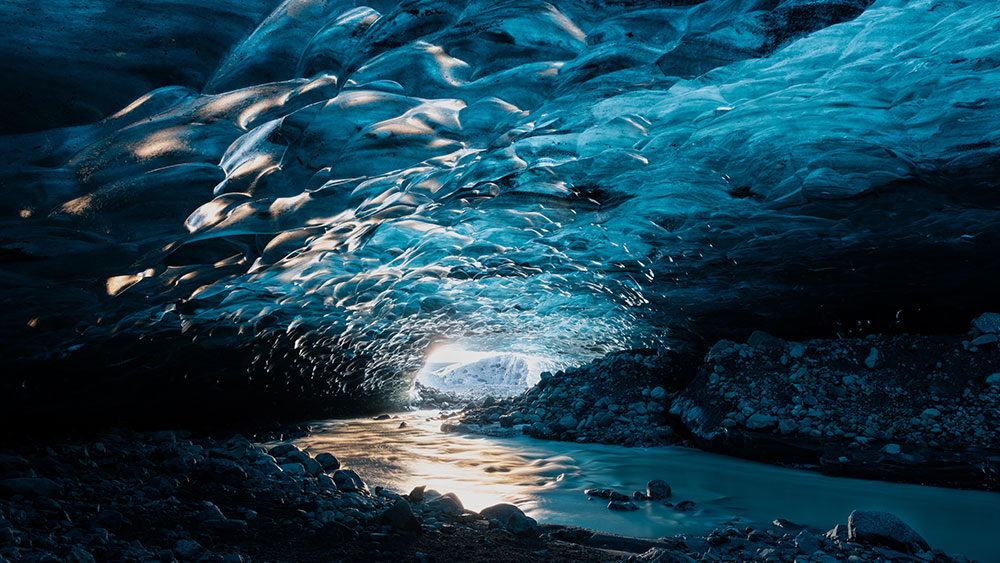
A small portion of surface ice in Antarctica is called blue-ice areas (BIAs), and for good reason. Air bubbles were squeezed out of the ice, giving it a clear, bluish tinge. The ice is beautiful, but is it as old as evolutionists claim?
In 2025, scientists discovered supposed “6-million-year-old ice” in blue ice from the Allan Hills coastal region of southeast Antarctica, bordering the Ross Sea.1 Was this ice dated by simply counting the supposed annual layers?
In such blue ice areas—just 1% of the continent’s surface—the ice flows across rocky ridges, tipping the record on its side. Deep, old layers are driven up, while wind strips away snow and younger ice, revealing the lustrous blue of compressed ice below. But these contortions also confound the neat ordering of the annual layers—making it impossible to date the ice by counting them.2 [emphasis added]
Creationists have made strong arguments that uniformitarian evolutionists are over-counting the true number of annual layers in deep ice cores,3 yet the age of this ice wasn’t even determined by counting. Rather it was derived from radioactive decay of argon within air bubbles in the ice. But radioactive dating techniques have numerous problems, including providing incorrect ages for recently-formed volcanic rocks.4
In addition to questionable dating, discoveries have been made that indicate heat production in the area should have melted the ice after millions of years. Recently, “dozens of new methane seeps littering the ocean floor in the Ross Sea coastal region of Antarctica”5 have been found. Because methane is a greenhouse gas, some are concerned this possible “positive climate feedback loop . . . could accelerate global warming.”5 Over the supposed six million years how many millions of methane seeps would have occurred that would possibly melt the ice around Allan Hills? In addition, “There are at least 5 volcanoes adjacent to Allan Hills that are thought to have been active in the last 11 million years,6 one of which, Mount Erebus, is still active.”1 Was there no volcanic activity at or around Allan Hills for the last six million years that would melt this ice?
Added to this old-Earth enigma is the fact that this six million-year-old ice sample was not deep within the Antarctic ice, “We’re still working out the exact conditions that allow such ancient ice to survive so close to the surface [emphasis added],” according to Sarah Shackleton of Woods Hole Oceanographic Institution in Massachusetts.5 How feasible is it that this ice so close to the surface would remain untouched for six million years? Could it be that this supposedly ancient ice is only thousands of years old and that’s why it has survived?
The evidence does not support the theory that this core sample is incredibly old; it does quite the opposite. This sample is young, the ice having been formed after the Genesis Flood.
References
- Tillman, N. Antarctica: Facts about the Southernmost Continent. Live Science. Posted on livescience.com April 17, 2025.
- Voosen, P. Record-Shattering 2.7-Million-Year-Old Ice Core Reveals Start of the Ice Ages. Science. Posted on science.org 15 August 2017.
- Hebert, J. 2019. Earth’s Thick Ice Sheets Are Young. Acts & Facts. 48 (2): 11–14.
- Clarey, T. and V. R. Cupps. 2021. Does Radioisotope Dating Prove an Old Earth? Acts & Facts. 50 (6): 18.
- Pester, P. Methane Leaks Multiplying Beneath Antarctic Ocean Spark Fears of Climate Doom Loop. Live Science. Posted on livescience.com October 15, 2025.
- Smellie, J. Subglacial Volcanoes. AntarcticGlaciers.org. Posted on antarcticglaciers.org, accessed November 10, 2025.
* Dr. Sherwin is a science news writer at the Institute for Creation Research. He earned an M.A. in invertebrate zoology from the University of Northern Colorado and received an honorary doctorate of science from Pensacola Christian College. Dr. Jake Hebert is a research scientist at the Institute for Creation Research and earned his Ph.D. in physics from the University of Texas.
Stage image: Wide angle view of the interior of a glacial ice cave near Jokulsarlon glacier lagoon in Iceland
Image credit: Eric Kilby from Somerville, MA, USA, CC BY-SA 2.0