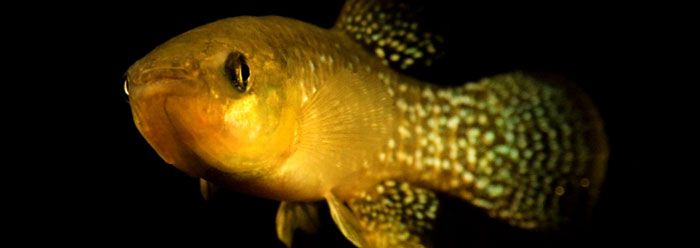
 Industrialists dumped potent pollutants into Atlantic bays in the 1950s and 1960s, killing all kinds of fish. Even today, few fish brave those waters. A team of scientists led by Andrew Whitehead of University of California, Davis recently sequenced and analyzed the genomes of almost 400 Atlantic killifish to try to find out how these fish survive the polluted waters while other kinds don’t. They found good, scientific answers but framed them in wildly unscientific terms.
The researchers discovered that killifish survive by using their elaborate array of genes, including some that help them manage poisons. Like having Swiss army knives instead of flint knives, these fishes’ genetic gizmos enable them to solve more environmental challenges than other fish can handle. UC Davis News gave this finding a strong evolutionary spin:
- “While environmental change is outpacing the rate of evolution for many other species, Atlantic killifish living in four polluted East Coast estuaries turn out to be remarkably resilient.”
- “The more genetic diversity, the faster evolution can act.”
- “Most species we care about preserving probably can’t adapt to these rapid changes because they don’t have the high levels of genetic variation that allow them to evolve quickly.”
- “At the genetic level, the tolerant populations evolved in highly similar ways.”
- “This study shows that different populations of Atlantic killifish exposed to toxic pollution evolve tolerance to that pollution through changes in one molecular pathway.”
- Finally, the genomes offered clues that suggest “these fish already carried the genetic variation that allowed them to adapt before the sites were polluted.”1
But if the fish already possessed, in the beginning, the genetic variation required for them to cope with toxic pollution, then what does their use of those pre-existing genetic tools have to do with evolution?
An evolution that supposedly transformed fish into philosophers should cause significant change.2 But these fish didn’t change. They were killifish before and after encountering pollution. They didn’t even acquire new or broken genes. These fish used absolutely no evolution to pioneer polluted waterways—they simply used their onboard genes.
If one man can build a stick hut five times faster using a Swiss army knife than another man can using his sharp-edged rock, who in their right mind would say that he “evolved” more quickly? Evolution had nothing to do with the faster hut—it was all about the tools.
Since killifish genes made the difference, the originator of those genes deserves the credit. Where did those genes come from? No scientist witnessed or measured their origins, but the genes reveal enough information for rational thinkers to clearly see that the Creator is the answer. The reasoning goes like this:
- Killifish genetic information anticipates and meets future environmental challenges.
- All information systems that can anticipate and meet future challenges arise from intelligent people who can imagine and anticipate new scenarios.
- Therefore, killifish genetic information arose from an intelligent, imaginative person.
Evolution’s unthinking natural processes invoke no intelligence and thus fail to meet this minimum requirement for genetic toolkit origins. The Creator revealed in the Bible, on the other hand, has an infinite intelligence—He warrants the most consideration. Jesus, “through whom also He made the worlds,”3 made these fish and their genes. He who can rescue humanity from spiritual pollution deserves all the credit for providing Atlantic killifish with genetic solutions to physical pollution.
References
- Kerlin, K. Against the Tide: A Fish Adapts Quickly to Lethal Levels of Pollution. UC Davis News. Posted on ucdavis.edu December 8, 2016, accessed December 11, 2016.
- “It may seem strange that humans have evolved from fish.” Mosley, M. Anatomical clues to human evolution from fish. BBC News. Posted on bbc.com May 5, 2011, accessed December 11, 2016. See also Lemonick, M. D. We Are All Fish. Time. Posted on time.com May 14, 2014, accessed December 11, 2016.
- Hebrews 1:2.
Image credit: Copyright © Andrew Whitehead/UC Davis. Adapted for use in accordance with federal copyright (fair use doctrine) law. Usage by ICR does not imply endorsement of copyright holders.
* Mr. Thomas is Science Writer at the Institute for Creation Research and earned his M.S. in biotechnology from Stephen F. Austin State University.