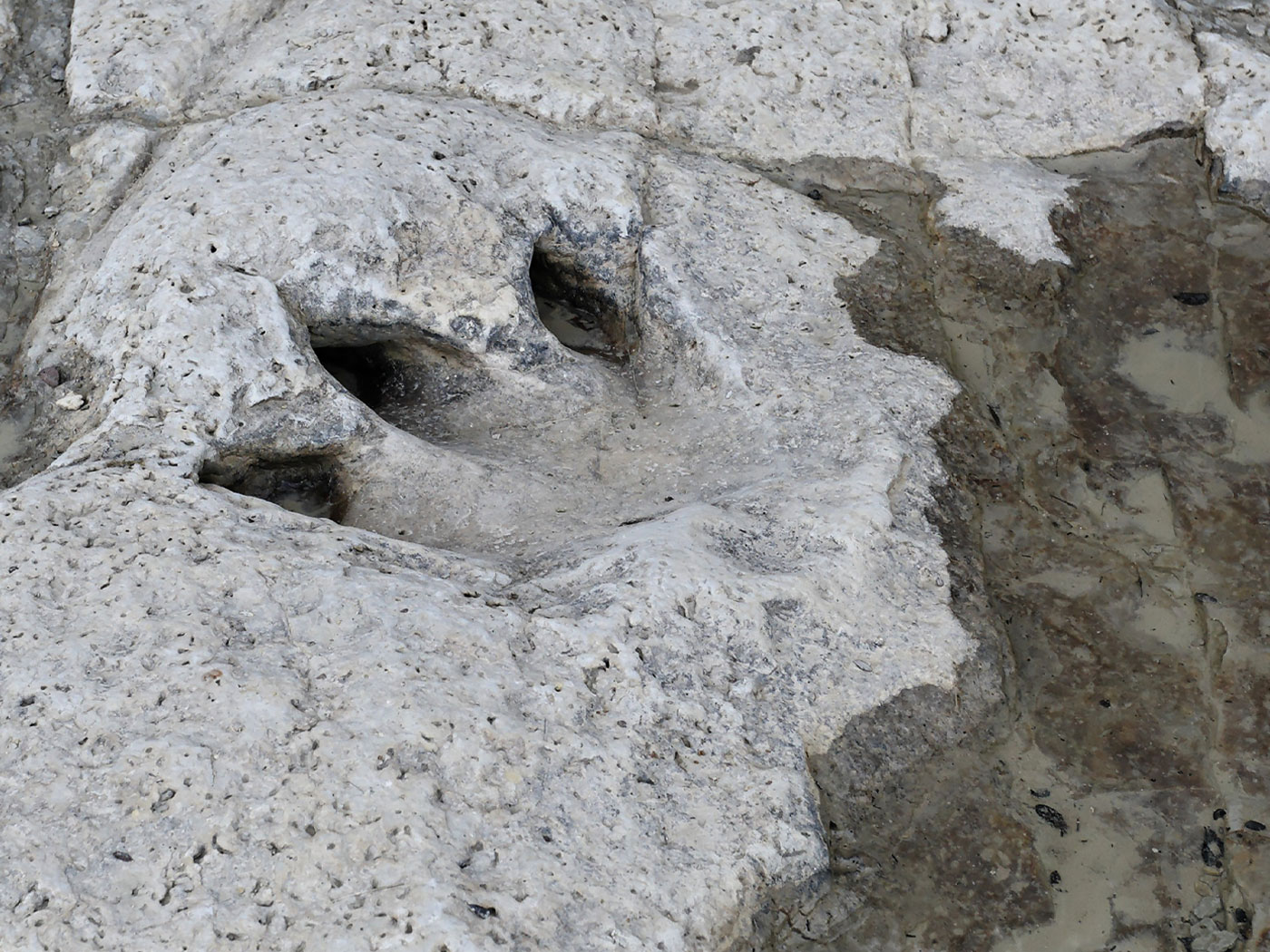
It’s tough to beat a genuine dinosaur trackway for a fascinating glimpse of ancient life. Among the frozen tracks of giant, four-footed sauropod dinosaurs like Apatosaurus now frozen in stone, most preserve both hind feet and "hands"—or in tech speak, the "pes" and "manus." But newly exposed tracks from Gansu Province in northern China have experts scrabbling to explain why they only preserve sauropod hind feet.
Perhaps the dinosaurs were wading or partly swimming, like other tracks elsewhere in the world.1 But if that were the case, the ancient animals’ hind feet might make swipe marks where only the claws touched the bottom sediments. These tracks in China look normal with no swipe marks—but contain no front footprints.
Were the dinosaurs somehow walking on their hind feet like some kind of reptilian circus bear? Lida Xing, lead author of the study published online in Scientific Reports, told University of Bristol News, "Nobody would say these huge dinosaurs could stagger along on their hind legs alone—they would fall over."2
The research team conceived a new solution. They hypothesized that these medium-sized giant dinosaurs were walking on muddy flats soft enough for their hind legs to puncture an overlying mud layer, but that mud layer was hard enough for their front feet to leave no impressions in a sandy layer just below the mud.
The study authors wrote,
This implies both a moister, more saturated substrate [bottom sediment] and an overlying layer of sediment on which the animals were walking. These conditions are easily and quite simply explained by the fact that the track-bearing sandstone layers are overlain by fine mudstones and siltstones indicating a transition to subaqueous (lacustrine [lake bottom]) deposition. Sauropods walking on a layer of soft silt and mud deposited on top of the sandstone would likely spread their pes [front] claws to grip and penetrate the substrate steeply….3
Is their creative explanation really as easy and simple as they make it sound?
Even if this scenario actually solves the hind track mystery, it introduces new questions. For example, where does sand discretely underlie a mud layer without a rapid rise in water level, whether surrounding environments are transitioning or not?
And about that supposed transition: How long would it have taken, considering dinosaurs walked right through it? It looks like hours or days. And how does thick mud so quickly cover sand without some type of flood event?
Also, where do either sandy or muddy bottoms preserve large animal tracks for perpetuity? Waves wash and worms churn tracks, erasing them in just weeks. However, flooding can preserve soft sediment footprints by quickly covering them with a layer of sediment.
These authors may have zeroed in on a helpful solution to the hind track mystery by saying that these dinosaurs were simply walking on layered sediments with differing levels of hardness, but in the process they dredged up new sedimentary mysteries that a global Flood can solve.
References
- Thomas, B. New Dinosaur Tracks Study Suggests Cataclysm. Creation Science Update. Posted on ICR.org January 25, 2013, accessed February 18, 2016.
- Sauropod swimmers or walkers? University of Bristol News. Posted on bristol.ac.uk February 18, 2016, accessed February 18, 2016.
- Xing, L. et al. 2016. Digit-only sauropod pes trackways from China—evidence of swimming or a preservational phenomenon? Scientific Reports. 6: 21138.
Image credit: © 2016 L. Xing. Scientific Reports. Adapted for use in accordance with federal copyright (fair use doctrine) law. Usage by ICR does not imply endorsement of copyright holders.
*Mr. Thomas is Science Writer at the Institute for Creation Research.
Article posted on February 25, 2016.