Critics of the Bible sometimes claim the first and second chapters of Genesis represent two different creation accounts and that these two accounts are clearly contradictory. They allege the order of events is different. Genesis 1 teaches that plants and birds were created before people. But some critics claim Genesis 2 teaches the opposite. Genesis 2 teaches that Adam was created before Eve. But doesn’t Genesis 1 indicate they were created at the same time?
As is often the case, the critics just haven’t read the text carefully. Genesis 1:1–2:4 records an overview of the cosmic events of the creation week.1 It gives the order of events and a broad summary of what happened on each day.
Genesis 2:5-25 is not a second or different account of creation; rather, it’s a more detailed report of the Adam-and-Eve-focused events of Day Six.2 This should be clear, because this chapter describes in greater detail the creation of Adam and Eve—events that Genesis 1:26-30 indicate happened on the sixth day.
But what about the alleged differences? Genesis 1 indicates plants were created on Day Three and people were created on Day Six. So, plants already existed when man was created. But regarding the early events of Day Six, Genesis 2:4-5 discusses a time “before any plant of the field was in the earth and before any herb of the field had grown. For the Lord God had not caused it to rain on the earth, and there was no man to till the ground.”
Is this contradictory? Not at all. Notice that Genesis 2:5 does not teach that there were no plants on Day Six. Rather, it states there was no plant of the field and that no herb of the field had grown. The phrase “of the field” is translated from the Hebrew word sodeh, which in this context refers to cultivated plants—those that were planted by man in ground tilled by man. So there were plants on Day Six, just no cultivated plants. And the rest of the verse gives the reason—because “there was no man to till the ground.”
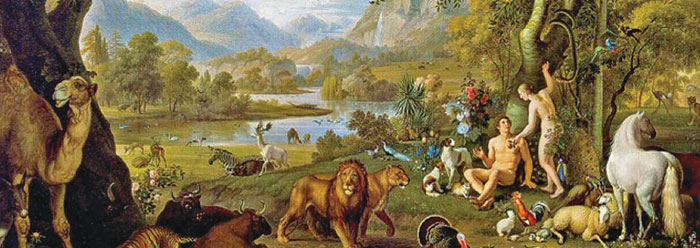
And what of the creation of animals? According to Genesis 1:23-30, land animals were made on Day Six—the same day as man and apparently just before the creation of man. Birds were made on the fifth day and therefore before man. But Genesis 2:18-20 mentions the creation of birds and land animals after describing the creation of Adam. But notice that Genesis 2 doesn’t actually state the animals were made after man—it only mentions their creation after it mentions the creation of man. The order in which events are mentioned here does not claim to be (and so it need not reflect) the order in which they happened. Moreover, Hebrew verbs focus on completeness of action, not past/present/future temporality. So, they do not have “tense” like English verbs. Instead, the past/present/future temporality of an action verb is determined by context. Thus, in context with Genesis 1, Genesis 2:19, which uses a verb that denotes completion of actions, can be translated as “Now the Lord God had formed out of the ground all the beasts of the field and all the birds of the air.”3
And what about the claim that Genesis 1:27 teaches that Adam and Eve were made at the same time? The text only states that God created both the man and the woman on Day Six. It says nothing at all about the precise timing. It is only by reading the details in Genesis 2 that we learn that some time elapsed, perhaps several hours, between the creation of Adam and the creation of Eve on the sixth day. As with most alleged Bible errors, the resolution is found by simply reading the text carefully and thinking logically.
References
- Note that Genesis 2:4 states, “This is the history of the heavens and the earth when they were created,” confirming that Genesis 1:1–2:4 is about the creation of the entire universe.
- This detailed report of Adam and Eve continues into Genesis 5:1, which states, “This is the book of the genealogy of Adam,” confirming that the focus of this section is on the creation, and subsequent fall, of man.
- The 1984 New International Version translates Genesis 2:19 in just this way.
* Dr. Lisle is Director of Physical Sciences at the Institute for Creation Research and received his Ph.D. in astrophysics from the University of Colorado.