Charles Darwin believed that selective breeding, the process he leadingly coined as “artificial selection,” illustrated how evolution in the wild could transform one animal kind into another. Have thousands of years of purposeful propagations backed up his claim?
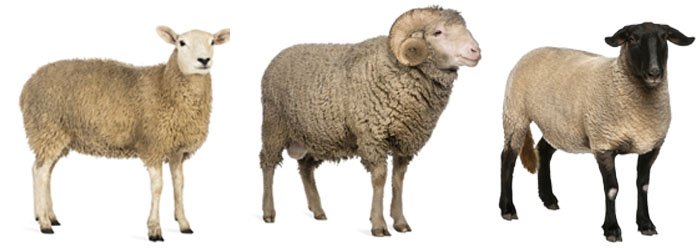
It’s true that sheep have changed over time. Variations occur in their body sizes, legs, heads, ears, tail sizes and shapes, and wool colors and quality. For example, some breeds have no horns, some have horns only in the males, some have horns in both sexes, and others have multiple sets of horns. But wouldn’t the emergence of some non-sheep traits through selective breeding best illustrate the supposed truth of evolution?
Genesis presents the first written record of selective breeding when it describes Jacob inducing specific sheep to mate and then separating the “stronger livestock” from the “feeble.”1 There is every historical indication that this practice has continued unbroken from before Jacob’s time until today. How many years has this artificial selection been going on?
For the sake of argument, one can pin an archaeological date to Jacob’s grandfather Abraham. Babylonian land and labor contracts dated back to 1950 B.C. and 1965 B.C. record dealings of “Abi-ramu” (Abram) near Ur.2 Abraham was 100 years old when his wife Sarah gave birth to Isaac, and Isaac was 60 when his wife Rebekah gave birth to Jacob (Genesis 21:5; 25:26). This puts Jacob working as a shepherd in the early 18th century B.C., roughly 38 centuries ago. Sheep gestation lasts about five months, and sheep reach sexual maturity at roughly six to eight months.3 Thus, a brand-new generation occurs every 11 to 13 months—one sheep generation per year for 38 centuries yields about 3,800 generations.
Darwin suggested that one must simply imagine trait changes that occur under domestication also occurring in the wild over eons, gradually transmuting one kind into another. But the basic kind has resisted evolution for perhaps 3,800 generations. So far, sheep keep birthing sheep, and all of their trait variations remain…well, sheepish.
Similarly, researchers spent 29 years selectively breeding 600 fruit fly generations only to find no permanent trait changes—no evolution.4
Nineteenth-century naturalist Sir Wyville Thomson wrote that sea life “refuses to give the least support to the theory which refers the evolution of species to extreme variation guided only by natural selection.”5 Darwin reacted to this comment in 1880:
I have likewise there [in The Variation of Animals and Plants under Domestication] adduced a considerable body of facts, showing the direct action of external conditions on organisms [selective breeding]....If Sir Wyville Thomson were to visit the yard of a breeder, and saw all his cattle or sheep almost absolutely true, that is, closely similar, he would exclaim: “Sir, I see here no extreme variation; nor can I find any support to the belief that you have followed the principle of selection in the breeding of your animals.” From what I formerly saw of breeders, I have no doubt that the man thus rebuked would have smiled and said not a word. If he had afterwards told the story to other breeders, I greatly fear that they would have used emphatic but irreverent language about naturalists.5
Darwin was intimating that sheep breeders know that some traits change quickly and that this change illustrated evolution. But the extremely long history of sheep breeding better fits Thomson’s beliefs than Darwin’s. While animals express variations in certain traits, their basic forms remain stable.
References
- Genesis 30:41-42.
- Cooper, B. 2012. The Authenticity of the Book of Genesis. Portsmouth, UK: Creation Science Movement, 81-82.
- Some breeds reach sexual maturity as early as three months of age and others as late as 20 months.
- See Burke, M. K. et al. 2010. Genome-wide analysis of a long-term evolution experiment with Drosophila. Nature. 467 (7315): 587-590.
- Darwin, C. 1880. Sir Wyville Thomson and Natural Selection. Nature. 23 (576): 32.
* Mr. Thomas is Science Writer at the Institute for Creation Research.