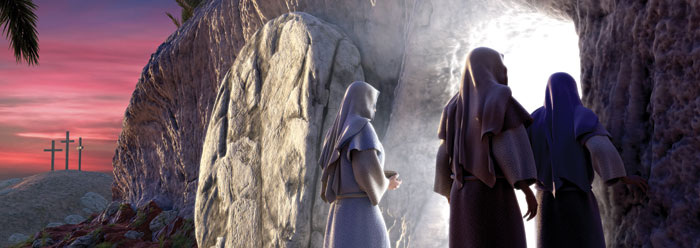
There are "many infallible proofs" of the bodily resurrection of the Lord Jesus Christ, but the testimony of the empty tomb is the most conclusive of all. Jesus had been buried, with the tomb sealed and guarded by a watch of Roman soldiers. Yet on the third day of His burial, on the morning of the first day of the week, the body was no longer there, and the empty tomb still stands today as an unanswerable proof that the Lord Jesus rose from the dead.
There are other proofs, of course. The ten or more recorded appearances of the resurrected Christ to His disciples, the amazing change of demeanor of the disciples from that of fearful hideaways to fearless evangelists, the worldwide spread of the Christian faith as founded on the resurrection, and so on. But the impact of the empty tomb was the foundation and bulwark of all the rest. As we consider its impact on the world, and on us today, it is instructively fascinating to consider first its impact on those who first encountered it.
Impact on the Soldiers
A watch (possibly a "quaternion" of four Roman soldiers…compare Acts 12:4) had been designated by the Roman Governor Pilate to guard the tomb after Jesus’ body had been buried there by Nicodemus and Joseph. The account is in Matthew 27:62-66.
Now the next day, that followed the day of the preparation, the chief priests and Pharisees came together unto Pilate, Saying, Sir, we remember that that deceiver said, while he was yet alive, After three days I will rise again. Command therefore that the sepulchre be made sure until the third day, lest his disciples come by night, and steal him away, and say unto the people, He is risen from the dead: so the last error shall be worse than the first. Pilate said unto them, Ye have a watch: go your way, make it as sure as ye can. So they went, and made the sepulchre sure, sealing the stone, and setting a watch.
The "great stone" had already been "rolled...to the door of the sepulchre" by Joseph when he and Nicodemus buried Jesus (Matthew 27:60), but now the soldiers (as directed by the chief priests) sealed it in place with the official Roman seal, which could only be broken on penalty of death. Then they took their guard positions for the rest of the three-day period. Probably they took turns at sleeping, one sleeping while three remained awake on guard. Certainly none of the hiding disciples (or anyone else) would have dared to try to invade the tomb for any reason.
The soldiers had probably been selected from that "whole band of soldiers" (Matthew 27:27) that had stripped Jesus in Pilate’s hall and scourged Him and mocked Him and then taken Him out to crucify Him. They had watched Him suffer and die, but then they had also experienced the great darkness and the great earthquake (Matthew 27:45, 51), and had heard their centurion cry out: "Truly this man was the Son of God" (Mark 15:39).
They had no reason to fear the disciples, but they must have had some concern about what God might do to them, if indeed Jesus was the Son of God, as their centurion had cried. In any case, they certainly would not be lethargic and careless about their assignment, or about to fall asleep while on duty.
They were hardly prepared for what did happen!
And, behold, there was a great earthquake: for the angel of the Lord descended from heaven, and came and rolled back the stone from the door, and sat upon it. His countenance was like lightning, and his raiment white as snow: And for fear of him the keepers did shake, and became as dead men. (Matthew 28:2-4)
As soon as they recovered and were able to move, they scattered from the site, rightly deciding that the mighty angel was more to be feared than the priests or even Pilate.
But what to do next? They realized that the happening at the tomb would soon become known, including their flight, and they realized Pilate might well have them put to death for leaving their post.
Their best hope would be the priests, who seemed to have some kind of influence with the governor, and perhaps would be able to understand their plight. Therefore, some of them (what happened to the others is not recorded) headed for the temple, to tell Caiaphas and the others that the tomb was empty, though it was not because of the disciples, who were still somewhere in hiding.
Behold, some of the watch came into the city, and shewed unto the chief priests all the things that were done. And when they were assembled with the elders, and had taken counsel, they gave large money unto the soldiers, Saying, Say ye, His disciples came by night, and stole him away while we slept. And if this come to the governor’s ears, we will persuade him, and secure you. So they took the money, and did as they were taught: and this saying is commonly reported among the Jews until this day. (Matthew 28:11-15)
Under other circumstances, the soldiers would have been afraid to say they all four had been sleeping on duty. But they were also greedy, and the "hush-money" convinced them. They were in mortal danger anyway, and they realized that Pilate might be amenable to bribery too, and they really had no other choice. Roman officials were indeed known to take bribes to render desired decisions (note the reputation of the governor Felix as implied in Acts 24:26).
The idea that the disciples had stolen the body while the soldiers slept circulated for a while, but it was so unreasonable that it could not survive very long. In the first place, if the soldiers really were all asleep (which is practically inconceivable), they could not have known what happened. Secondly, the work of moving the stone, stripping the grave clothes off the body, and carrying the body away would surely have awakened at least some of the soldiers.
Finally, the disciples could never have persisted in preaching a lie about resurrection when it began to cost them all their possessions and finally their lives to do so. Thus, the story circulated by the soldiers was basically unbelievable and could not convince people very long.
But it served the immediate purpose, presumably, of sparing the soldiers’ lives for the time being. They did know that the tomb was empty, however, and we can at least wonder whether some of them also might have eventually come to believe that Jesus was really the Son of God, and to seek His forgiveness and salvation.
To read the rest of Dr. Morris’ commentary on the impact of the empty tomb, visit icr.org/ChristEmptyTomb.
Image © James Steidl/Dreamstime.com
Adapted from Dr. Morris’ booklet "Impact of the Empty Tomb," published by ICR in 2001.
* Dr. Morris (1918-2006) was Founder of the Institute for Creation Research.
Cite this article: Morris, H. 2011. Impact of the Empty Tomb. Acts & Facts. 40 (4): 22-23.