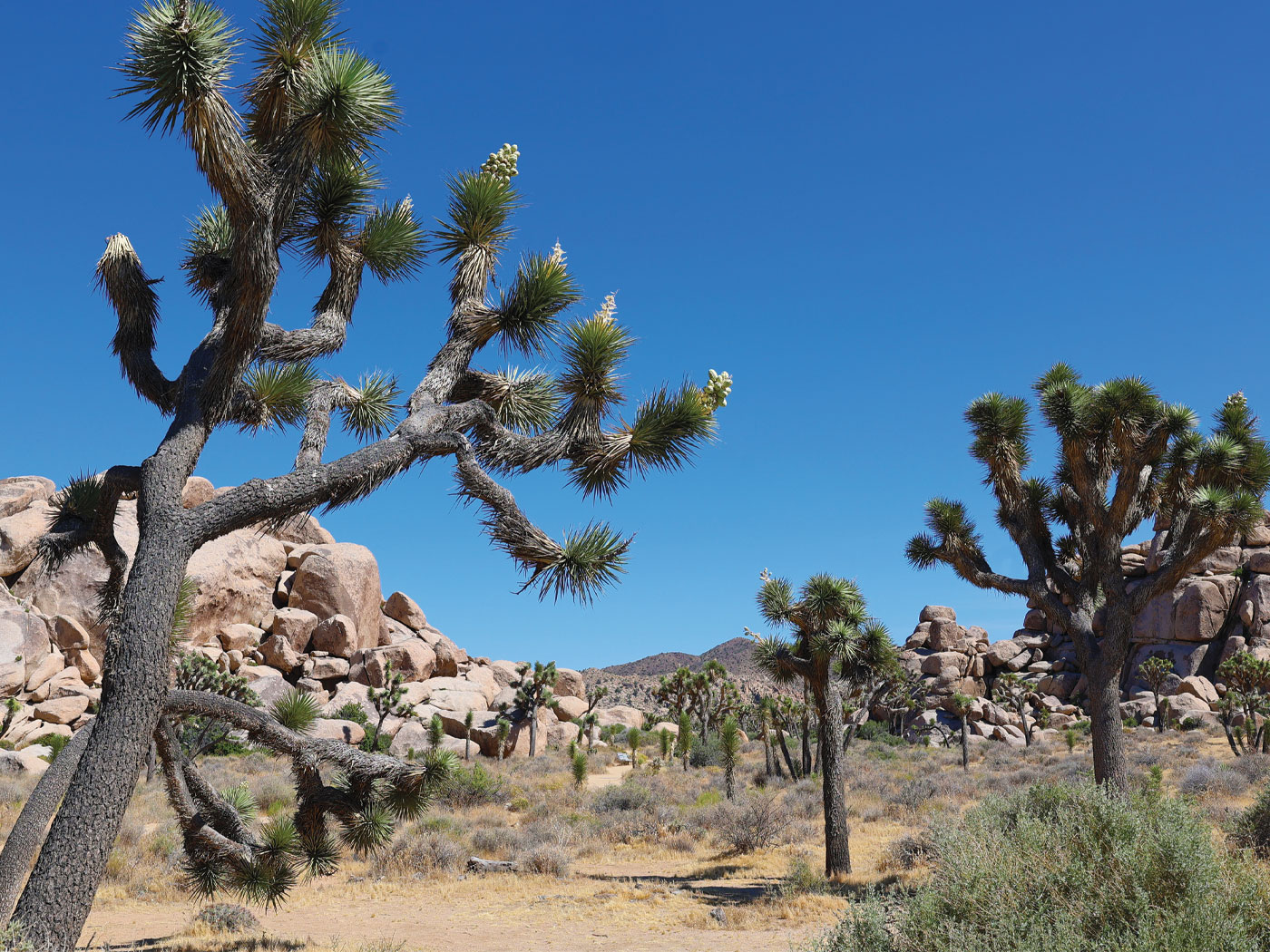
From salt grass to sassafras, flowering plants dominate earth’s landscapes, and many plant fossils are of leaves, bark, and pollen grains. The rock layers that contain them are most often found atop layers that have non-flowering plant fossils, like gymnosperms. If plant fossils are a record of an evolutionary past, then the sudden appearance of so many different flowering plants in these upper rock layers implies an “explosion” of plant forms that occurred faster than evolution can explain.
The abrupt appearance of flowering plants has long stood as evidence against evolution. Even Charles Darwin called it an “abominable mystery.” In the last 150 years, the problems in piecing together a putative evolutionary past for flowering plants have only worsened.1 A recent study applied new molecular clock calibrations to estimate how long evolution would have taken to generate new flowering plant forms. It produced evolutionary dates that ran far afoul of those assigned to flower fossil strata.
Yale professor of evolutionary biology Michael Donoghue and his fellow researchers conducted the study published in the Proceedings of the National Academy of Sciences.2 According to their results, flowering plants ought to have “emerged” 75 million years earlier than they are recognized in the fossil record! Donoghue told the Yale Daily News, “For now, the riddle of flowering plants’ origins remains unsolved.”3
Molecular clocks “tick” at an inferred speed of DNA base changes that are assumed to have taken place as nature supposedly wrote new genetic code. The clocks are typically calibrated with “known” fossil ages for plants, as this study’s were. Clashes between various molecular clock dates for the same organism, and between molecular clock and evolutionary fossil dates, are widespread, casting doubt on the whole methodology.
In addition, discoveries made since molecular clock analyses began undermine the chief attribute of using clocks: a reliable tick rate. Mutations and other causes of DNA base changes occur in different places on chromosomes at different times for different reasons. The results of Donoghue’s study presented a similar clash, as they suggest that flowering plants existed 215 million years ago, instead of the standard 140-million-year age ascribed to them.
University of Florida molecular systematics expert Pamela Soltis, who was not involved in the Yale study, attempted in 2004 to construct a phylogenetic “tree” for flowering plants. These tree diagrams display possible evolutionary paths of various forms and sometimes include estimates of when each form evolved. If the evolutionary paradigm is correct, the dates determined by various molecular clock studies ought to coincide, and should also validate evolutionary dates attached to the fossils. Soltis found agreement on several points among plants, but six glaring unknowns were presented, including uncertainty over where and when to place most flowering plants in evolutionary history.4
In 2009, Soltis summarized the status of using molecular clocks: “We know it doesn’t tick evenly, regularly, or the same in all species.”5 The Yale study sought to remedy these problems by programming flexible variables in its new molecular clock formula. But even after these painstaking gyrations, Donoghue concluded, “Either our methods are correct and the fossil record is way off, or the fossil record is good and our methods are not giving the right answers.”3
Of course, a third option is that their methods are not giving the right answers and the fossil record is way off—or at least the man-made timeline assigned to the fossil record is highly inaccurate.
“What this study highlights is that we have a serious problem that is only getting worse, which is the gap between molecular methods and the fossil record,” Donoghue said.3 It may be that the increasing problem will never be solved by adjusting fictional clock rates, but only by abandoning the evolutionary paradigm that the data do not support.
References
- The origin of angiosperms is still a mystery. Fact sheet from the University of Berkeley. Posted on berkeley.edu, accessed March 30, 2010.
- Smith, S. A., J. M. Beaulieu and M. J. Donoghue. 2010. An uncorrelated relaxed clock analysis suggests an earlier origin for flowering plants. Proceedings of the National Academy of Sciences. 107 (13): 5897-5902.
- Herz-Roiphe, Z. Flowering plants older than expected. Yale Daily News. Posted on yaledailynews.com March 24, 2010, accessed March 29, 2010.
- Soltis, P. S. and D. E. Soltis. 2004. The origin and diversification of angiosperms. American Journal of Botany. 91 (10): 1614-1626.
- Soltis, P. From “Darwin's 'Abominable Mystery,'” a lecture given February 19, 2009, as part of the University of Oklahoma’s Ecology and Evolutionary Biology Lecture Series.
Image credit: NPS
* Mr. Thomas is Science Writer at the Institute for Creation Research.
Article posted on April 9, 2010.