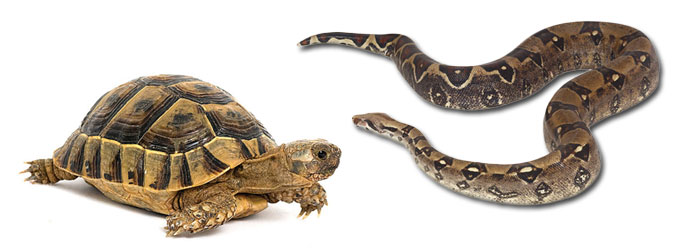
Evolution, the concept that each type of animal arose from some other sort of animal, faces many daunting challenges. Among the more difficult hurdles for evolution to clear is the formation of turtles from non-turtles, and the development of snakes from non-snakes. Darwin was fascinated by them both, and openly wondered what path they took on their evolutionary journey. Turtles and snakes are reptiles--along with lizards, plesiosaurs, crocodiles, and pterodactyls, to name a few others. The wide variety of unique design observed in reptiles argues for the purposeful design of all.
Consider the slow-moving turtle. Turtles are quite different from other creatures, yet there is no difficulty in recognizing them or their fossils, which are easily preserved. Their hard upper shell (the carapace) and their hard lower plate (the plastron) resist decay and are easily recognized even when shattered. No other reptile has anything even comparable that potentially could have been modified to produce such a dominant feature. One paleontology textbook states, "The first true turtles made their appearance by the late part of the Triassic period, by which time they were far advanced along the lines of adaptive radiation typical of modern turtles."1
Suggested transitional forms have not been found. From what other reptile could they have possibly evolved? Or did they evolve separately from an even more different amphibian? Predictably, no such proposition can be supported by any fossil evidence.
This should be an excellent test case for evolution. The signature features are so easily fossilized, so recognizable, and so different from any other earlier creature that surely transitional forms would be found if they ever existed. Such forms are, however, nowhere to be found. Evolutionary theory loses another one.
Snakes are equally mysterious. They are placed in the same order as lizards and are thought to have evolved from them, having lost their legs along the way. They are quite different from lizards, however, with a greatly extended vertebral column, sometimes with several hundred vertebrae. There are no forelimbs in any snake, and in only a few snakes are found rudimentary hind limbs, tiny features used in copulation.
Obviously, the differences between snakes and lizards are great, and if one evolved from the other we would expect to see some fossil evidence. It is not sufficient to simply tell the story, as is common, that selection pressures caused the snakes to lose their legs as they habitually burrowed underground. Where is the evidence to support such a story? Why would natural selection select for the loss of a useful structure?
Paleontologist Michael J. Benton claimed that snakes "are believed to have arisen from 'lizard' ancestors, but the nature of those ancestors is a mystery."2 There are thousands of fossils of snakes, and many thousands of fossils of lizards. "Unfortunately, the fossil history of the snakes is very fragmentary, so that it is necessary to infer much of their evolution from the comparative anatomy of modern forms."3 Once again, the assumption of evolution negates the need for evidence and ignores the lack of evidence.
It seems that the fossil record fits the idea that the God of the Bible created each basic type of animal "after their kind"4 not very long ago, just like we read when we go "Back to Genesis."
References
- Colbert, E. H. and M. Morales. 1991. Evolution of the Vertebrates. New York: John Wiley and Sons, 216, as cited in Gish, D. T. 1995. Evolution: The Fossils Still Say No! El Cajon, CA: Institute for Creation Research, 113.
- Benton, M. J. 2005. Vertebrate Palaeontology. Malden, MA: Blackwell Science, 244.
- Colbert and Morales, Evolution of the Vertebrates, 223, as cited in Gish, Evolution: The Fossils Still Say No!, 112.
- Genesis 1:25.
* Dr. Morris is President and Director of Research at the Institute for Creation Research.
Cite this article: Morris, J. 2009. Turtles and Snakes: No Evolutionary Journey. Acts & Facts. 38 (6): 15.