Plants use biological systems that harvest light energy from the sun to convert environmental water and carbon dioxide into tiny carbon/hydrogen energy units stored within them. When people eat those energy units, the extraordinary human digestive and metabolic systems convert the work of plants into energy that is useful to people and give back water and carbon dioxide to the environment that can be used by plants. How do these systems make that happen?
Journey to the Stomach
Ingested food encounters precisely-shaped teeth that cut and grind it into small pieces--which, surprisingly, is the second step of the digestion process. The first vital step involves the brain readying the digestive organs for an influx of food. When the brain's "association areas" match smells, sights, and even sounds of food with imprinted memories of eating, the nervous system signals the process to start. Glands in the mouth respond by secreting saliva, which is mostly water, but also contains digestive enzymes, antibodies, and enzymes lethal to some bacteria. Very sensitive chemical and mechanical receptors respond to even trace amounts of food by triggering a larger release of saliva--which is rarely in short supply, as salivary glands are capable of producing over a quart per day. Glands under the tongue make a sticky substance called mucin that the tongue mixes with chewed food and saliva into a sticky wet ball (a bolus) that can be easily swallowed.
After swallowing, an automated sensory-muscular system surrounding the esophagus senses the exact location of the food bolus. Simultaneous signals are sent to two different muscles: a contraction signal to a muscle closer to the mouth above the bolus, and a relaxation signal to a muscle closer to the stomach below the bolus. As the bolus moves below the relaxed muscle, it contracts and a still lower muscle relaxes in a coordinated rhythmic action that squeezes the food toward the stomach. The propelling force is strong enough to move food along the esophagus regardless of body position, even when it's upside down. A similar system is used in the intestines (with the addition of constrictive muscle zones that act as one-way valves to stop backflow of materials) to keep things moving smoothly there as well.
Breaking Food Down
The bolus arrives in the stomach, a sack-like organ with outer layers made of a huge number of elastic fibers laminated to a tri-layer of muscles: one layer with an oblique orientation of cells, one circular, and one longitudinal in the outer wall. Elastic fibers allow food to fill the stomach from the normal empty volume of about one half of a cup to hold over a gallon, if really stuffed. The orientation of the muscles allows the stomach to do the necessary churning of food to physically break it down and not just squeeze it into a tight ball.
Once inside, over a dozen important enzymes, hormones, and other factors are added to the mix to continue breaking down components, help capture nutrients, and activate other digestive organs at just the right time further down the process. "Parietal" cells secrete a very acidic concentration of hydrochloric acid (pH about 2.5) with a hydrogen ion concentration 100,000 times higher than in blood. Food is ground and dissolved into fine paste, but the stomach itself is protected from this harsh environment by an inner blanket of "goblet" cells joined very tightly to each other to contain the acid. These cells also secrete a bi-layer protective coat of sticky syrup-like mucus overlying a fluid which has a dissolved substance in it similar to antacid tablets that is capable of neutralizing any acid penetrating the top layer. The cells are programmed to be in a continuous state of renewal, resulting in a new inner lining on average every four days.
Nutrient Absorption
To optimize nutrient absorption, both the rate of stomach emptying and the type of enzymes added to the mix are initially custom-tailored to the types of food ingested by a part of the small intestine, the duodenum. Able to sense ratios of fat, protein, and sugar content, as well as the volume of food, the duodenum modulates a control valve exiting the stomach by a tandem of neurologic and hormonal networks. A regular meal is emptied in about four hours, while a high fat meal may be delayed an additional two hours or more.
The intestine is also protected from "self digestion" with a coating of the lumen similar to that of the stomach. In addition, many digestive enzymes that would destroy the digestive organs themselves if they were in direct contact are really "two-part" enzymes. Similar to many industries using hazardous chemicals, these enzymes are kept in harmless-inactive forms by the pancreas until released into the safety of the lumen. An "activator" chemical made by cells lining the lumen is secreted into the lumen and transforms the inactive enzyme into an aggressive digestive form. This activated enzyme then acts like an activator to "turn on" other inactive enzymes in a coordinated digestive cascade.
Possibly the most impressive feature of the small intestine is its incredible surface area. If all of the folds and microscopic villi were smoothed out flat, the area of an average person's small intestine would cover over 1,500 square feet. This results in a capture of nearly 100 percent of all potentially absorbable nutrients. The final products are single molecules of glucose, amino acids, and glycerol broken down from carbohydrates, proteins, and fats respectively. These are distributed by the blood and lymphatic systems to all of the cells in the body.
Generating Energy
Many of these "raw materials" will be used to build new body tissues, but about 60 percent will be metabolized or "burned" to supply energy needs. At rest the average person will need to generate the equivalent energy to continuously power a 120-watt light bulb; heavy work can drive the power demand up ten-fold. But instead of electrical energy, body cells capture the chemical energy released when one molecule of adenosine triphosphate (ATP) is broken down to adenosine diphosphate (ADP). ATP is the universal energy currency of the body that special organelles of cells called mitochondria are constantly making from ADP. How?
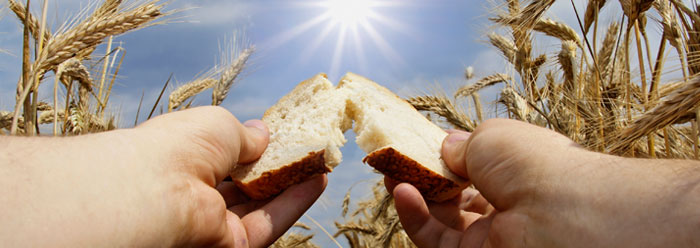
Take a glucose sugar molecule that once existed as some of the starches in wheat bread before digestion. Glucose is composed of carbon, hydrogen, and oxygen atoms. Through three extraordinary processes involving dozens of enzymes, coenzymes, electron carrier proteins, and intermediate products, the atoms are stripped off the molecule.
One process uses the carbon portion to make ATP. The electron transport process uses the hydrogen atoms. Special proteins pump these atoms to one side of a hydrogen-impermeable membrane, while at the same time splitting the hydrogen into a positively-charged proton and an electron. The flow is controlled in a step-wise fashion so that ATP is generated at several steps. Just like water behind a dam is released slowly through turbine generators, so the electron pairs are released slowly rather than all at once--which would only generate heat. But instead of gravity being the driving force to add energy, oxygen, which has been breathed in and carried by red blood cells to the mitochondria, is the driving force.
The attractive energy of one negatively-charged oxygen atom strongly pulls two proton-electron pairs to eventually make one molecule of water and simultaneously pumps a high concentration of hydrogen ions across the membrane. Now an electric potential of energy has been established across the membrane. A current of hydrogen ions flows from "high" side to "low" side back across the membrane, but only through special channels called "ATP synthases." ATP synthases are actually tiny three-part rotary motors consisting of a rotor, a connecting rod, and an enzyme-embedded knob. In a process that converts electrical energy to chemical energy, these motors combine ADP and phosphate molecules by running them through gear-like structures to make ATP.
ATP is now available to power the needs of everything from muscle cells to neurons in the brain. ATP is not stored but continuously made and utilized. In one day, a person will make the equivalent of half their body weight in ATP.
From Sunlight to Body Power
In this amazing process that powers the human body, nuclear fusion energy in the sun is converted and conveyed as light energy to the earth, where it is captured and converted by plants to foodstuffs, then digested by a person and metabolized to universal energy packets that can be converted to chemical, mechanical, and electrical energy as needed. The information content behind all of this is truly staggering. The conversion of sunlight to body energy involves all systems of the body, plus a few plant systems, which must be totally functional. Credit belongs to the Lord Jesus Christ--the creative genius! The Lord is gracious to all people by freely giving the sun's light energy, the vital biological systems of plants, and humans' incredible digestive and metabolic systems.
* Dr. Guliuzza is ICR's National Representative.
Cite this article: Guliuzza, R. 2009. Made in His Image: From Solar Energy to Human Energy. Acts & Facts. 38 (3): 16.