Where Can We See Young-Earth Evidence? | The Institute for Creation Research

Where Can We See Young-Earth Evidence?

Download PDFDownload Where Can We See Young-Earth Evidence? PDF

Rocks and fossils do not come with labels informing us of their age. They must be understood in light of their geologic context, and interpreted within a worldview. Unfortunately, my evolutionary colleagues are often so dominated by uniformitarian brainwashing they can't objectively understand young-Earth evidence. Nevertheless, some of the evidence is clear and open for all to see.

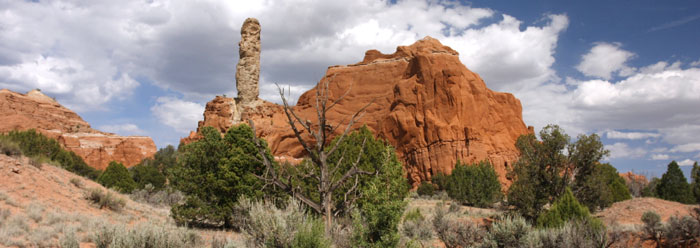
One such clear piece of evidence is in Kodachrome Basin State Park in Utah. Named by a former director of National Geographic magazine for its photographic beauty, it can be found near the better-known Bryce Canyon National Park. Here one can see numerous clastic "pipes" rising many feet into the air.

A clastic rock consists of eroded fragments of a previous rock. For instance, sandstone consists of sand grains, usually derived from a previously existing granitic source. When sand grains are deposited and cemented together it becomes a sandstone. These clastic pipes are sandstone, nearly identical with a deeply buried sandstone source.

Evidently a tectonic event fluidized an unconsolidated sand deposit, and squeezed it up like toothpaste into piercements in the overlying rock. Once emplaced as a liner "dike," or in this case a vertical "pipe," it hardened into resistant rock. Eventually the surrounding, more easily erodable rock was washed away, leaving only a vertical pipe.

The timing of the deposition, squeezing, and erosion provides the young-Earth argument. According to conventional dating methods, the pipes squeezed up some 150 million years ago, but the source sandstone bed is 175 million years old. Thus, the mother bed remained soft and unconsolidated for 25 million years before it squeezed up.

In the presence of a cementing agent to bind the grains together, which both the source and daughter pipes have, loose sand can harden into a sandstone in a short time, perhaps just years. The fact that the pipes exist at all is evidence that little time passed between deposition and squeezing. Thus, the millions of years postulated by old-Earth advocates never happened.


Cite this article: John D. Morris, Ph.D. 2006. Where Can We See Young-Earth Evidence?. Acts & Facts. 35 (7).

The Latest
NEWS
Insect Eyes Reflect Creation
Research into insect eyes continues to reveal amazing structure and function. For example, although fruit flies’ eyes are attached firmly to their...

NEWS
February 2026 ICR Wallpaper
"Be strong and of good courage, do not fear nor be afraid of them; for the LORD you God, He is the One who goes with you. He will not leave you...

NEWS
Microgravity's Effect on Bacteriophages Is Not Evolution
The word evolution is often used imprecisely, leading the public to believe that any biological change is evolution, and, therefore, it’s a fact.1...

NEWS
Engineered for Extremes: The Hidden Precision of a Salt Lake...
Water that is nearly five times saltier than the ocean is deadly to most animals. But in Utah’s Great Salt Lake, scientists have found a tiny...

CREATION PODCAST
Giant Sequoias: Too Complex to Be Accidental | The Creation Podcast:...
What living thing grows taller than a 25-story building, survives raging wildfires, and actually depends on those fires to reproduce? Giant sequoias...

NEWS
Bound by Design: How a Universal Temperature Law Reveals Life’s...
What if every living creature—from coral reefs and cold-water fish to mountain flowers and desert reptiles—followed the same hidden temperature...

NEWS
The Flood Explains 18,000 Dinosaur Tracks in Bolivia
A new discovery of 18,000 individual dinosaur tracks in the Bolivian El Molino Formation contains the highest number of theropod dinosaur tracks in...

NEWS
Prolonged 40-Year Growth in T. Rex: Evidence for Pre-Flood Longevity?
An open access 2026 PeerJ research paper claims that T. rex took 40 years to reach its full adult body size, in contrast to a much shorter previous...

NEWS
Recent Discovery of a Strange Microbe Gives No Clues to Evolution
Research into God’s living creation is dynamic and always surprising. This is true whether one peers into the deepest reaches of space or dives...

NEWS
Built to Adapt: What Microbial Flexibility Reveals about Biological...
Imagine a machine that keeps working even when its parts change slightly or its surroundings shift. Most human-made machines would fail under that kind...