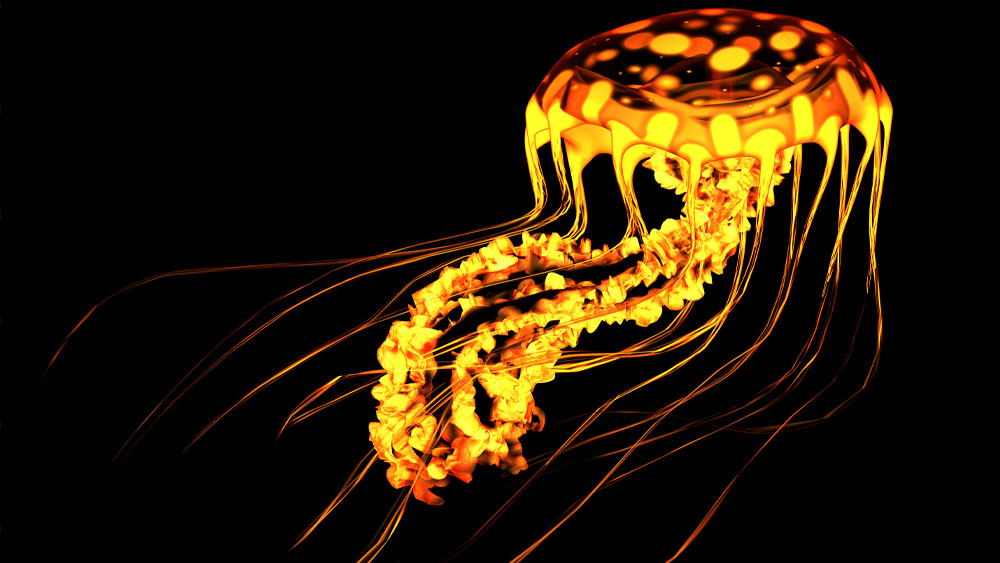
There is nothing so beautiful (and sometimes breathtaking) than observing creatures designed with the ability to undergo fluorescence, the biological emission of light (also called bioluminescence).1 Five scientists defined bioluminescence as “the chemical reaction between a substrate (luciferin) and an enzyme (luciferase) resulting in light emission in a living organism.”2 What was the origin of such an amazing biochemical process?
A recent Smithsonian news release stated that bioluminescence supposedly evolved in animals well over a half-billion years ago.3 Smithsonian’s National Museum of Natural History curator Andrea Quattrini said, “Nobody quite knows why [bioluminescence] first evolved in animals.”3 The article went on to say the “study focuses on an ancient group of marine invertebrates that includes soft corals, push[ing] back the previous oldest dated example of trait [bioluminescence] by nearly 300 million years.”3
This fascinating procedure is only pushed back by hundreds of millions of years according to evolution, but it is still exceedingly complex, and its evolutionary origins still remain unknown. Indeed, scientists at the University of California San Diego stated, “Probably bioluminescence originated in the oceans; based on the chemical structures of luciferins and luciferases, bioluminescence may have independently evolved several dozen times [emphasis added].”4
In 2012, ICR’s Brian Thomas, Ph.D., reported the pattern of bioluminescence in basic forms of creatures was erratic at best.
Evolutionary researchers organize all of these basic forms onto a preconceived “tree of life” that supposedly shows how closely related each form might be to another, assuming all creatures share common ancestry. Evolutionists expect one creature to have evolved bioluminescence and then to have passed that trait along to its descendants. However, the researchers do not find this or any other evolutionary pattern. Instead, bioluminescence is scattered willy-nilly among dozens of totally different life forms.5
Almost a decade later, evolutionists still do not know the evolutionary origin of bioluminescence, so they rely upon vague and questionable processes.
The luminescent systems have different origins, resulting in highly diverse systems involving different molecular actors, different associated morphological and anatomical structures, and different types of control mechanisms. It is strongly suggested that the multi-convergent evolution of bioluminescence demonstrates the existence of intense selective pressures in support of the emergence of bioluminescence mechanisms during organism evolution.6
“Multi-convergent evolution” and “the existence of intense selective pressures” are obscure just-so phrases that virtually guarantee the evolutionary origins of bioluminescence will always be shrouded in darkness.7,8
Delroisse and his fellow authors appeal to homology, “a controversial term,”9 and parallel evolution, which presupposes an unknown common ancestor, even though the terms do nothing to explain how bioluminescence evolved. The evolution of the key enzyme luciferase is also cryptic.
While some phylogenetically related organisms may use non-homologous luciferases (e.g., at least four convergent luciferases are found in Pancrustacea), it has also been observed that phylogenetically distant organisms may use homologous luciferases (e.g., parallel evolution observed in some cnidarians, tunicates and echinoderms that are sharing a homologous luciferase-based system). The evolution of luciferases then appears puzzling.6
This biological emission of light is wondrous, since it is forever mysterious in its alleged evolutionary origin. The Bible states that God’s creation—even though it is corrupted by sin—is still clearly seen.10
References
- Sherwin, F. 2003. Living Light. Acts & Facts. 32 (1).
- DeLeo, D. et al. 2024. Evolution of Bioluminescence in Anthozoa with Emphasis on Octocorallia. Proceedings of the Royal Society B Biological Sciences. 291 (2021).
- Bioluminescence First Evolved in Animals at Least 540 Million Years Ago. Smithsonian Institution. Posted on si.edu April 23, 2024, accessed May 20, 2024.
- “Why Are So Many Animals in the Ocean Bioluminescent?” Bioluminescence Questions and Answers. Latz Laboratory. Posted on latzlab.ucsd.edu, accessed May 20, 2024.
- Thomas, B. 2013. The Unpredictable Pattern of Bioluminescence. Acts & Facts. 42 (4): 17.
- Delroisse, J. et al. 2021. Leaving the Dark Side? Insights Into the Evolution of Luciferases. Frontiers in Marine Science. 8, article 673620.
- Guliuzza, R. 2017. Major Evolutionary Blunders: Convergent Evolution Is a Seductive Intellectual Swindle. Acts & Facts. 46 (3): 17–19.
- Guliuzza, R. 2010. Natural Selection is Not ‘Nature’s Design Process.’ Acts & Facts. 39 (4) 10–11; Thomas, B. Lizard Study Questions Natural Selection. Creation Science Update. Posted on ICR.org June 4, 2010.
- Thain, M. and M. Hickman, 2004. Dictionary of Biology. London, UK: Penguin Books, 353.
- Romans 1:20.
* Dr. Sherwin is a science news writer at the Institute for Creation Research. He earned an M.A. in invertebrate zoology from the University of Northern Colorado and received an honorary doctorate of science from Pensacola Christian College.