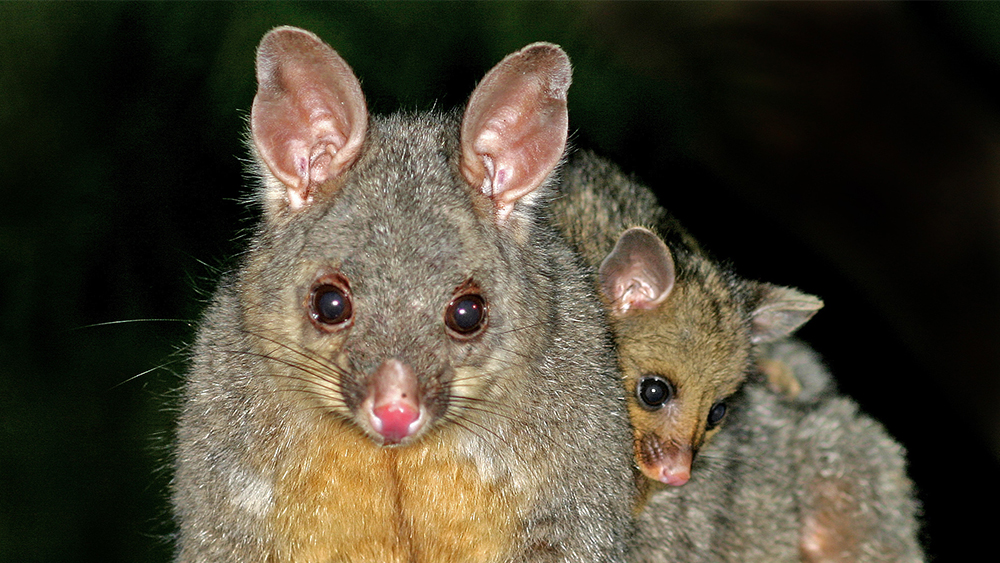
Recently, University of Kansas paleontologists discovered a fossil of what they think is a “near-marsupial.”1 It is called Swaindelphys and was found in Big Bend National Park, Texas. Conventional scientists interpret Swaindelphys as a large extinct possum.
The two researchers involved in this discovery stated in the Journal of Vertebrate Paleontology,
Here, we describe a new species of metatherian [marsupial], Swaindelphys solastella sp. nov., from the Tiffanian Ray’s Bonebed locality. The new taxon is the largest species of metatherian yet discovered from the Paleocene, being comparable in size to the Wasatchian peradectid [small metatherian mammal] Mimoperadectes.2
What was the origin of the metatherians? “Metatherians are a clade of boreosphendian mammals that must have originated by the Late Jurassic [emphasis added].”3 Evolutionists are not sure of their evolutionary history but believe they may have originated in the northern area (Amazonia) of South America.4
However, the fossil record shows that possums (which are marsupials and not near-marsupials) have always been possums. In fact, possums have been called living fossils, and for good reason: how they look today matches what’s in the fossil record.
Sometimes called “Lazarus taxa,” living fossils are organisms that were thought to be extinct, only to turn up alive in modern populations. Ranging from magnolia flowers to gar fish, and from single-cell algal filaments to lobsters, the living counterpart looks so much like its fossilized predecessors that identification down to the species level is often possible.5
So what should have been just a straightforward, interesting story about a new species of a fossil marsupial has instead been poorly assumed to have been an evolutionary transition for marsupials. Going even further, some unscientifically hope this creature could be part of ancient human ancestry.
The research into Swaindelphys solastella — including analysis of specimens from the LSU and University of Texas at Austin collections — and new fieldwork in Big Bend National Park was supported by The Leakey Foundation, a donor-supported nonprofit organization with a mission “to uncover the story of human evolution and share this knowledge with the world.”6
This is because the evolutionists believe this supposedly 60-million-year-old fossil could have been like an early primate. Paleontologists see the distribution and even the behavior of Swaindelphys as a way to understand primate history.
The coauthor of the Journal of Vertebrate Paleontology paper, Chris Beard, senior curator with the University of Kansas Biodiversity Institute, stated,
“The Leakey Foundation funded work in Big Bend National Park as we knew there were fossil primates and also fossil primate-like creatures there...I call them ‘primatomorphans.’ They’re not, technically speaking, primates, but they're very close to the ancestry of living and fossil primates. These marsupials are probably ecological analogues of early primates.”6
But like possums, the research shows primates have always been primates, and people have always been people.7–10 The discovery of Swaindelphys solastella shows it is of the opossum kind and that it lived in the pre-Flood world thousands of years ago.
References
- Researchers Unearth Big Possum that Lived Around 60 Million Years Ago in Texas’ Big Bend National Park. University of Kansas. Posted on news.ku.edu June 23, 2025, accessed July 16, 2025.
- Miller, K. and K. Beard. Biogeographic and Biostratigraphic Implications of a New Species of Swaindelphys (Mammalia, Metatheria) from the Paleocene (Tiffanian) Black Peaks Formation, Big Bend National Park, Texas. Journal of Vertebrate Paleontology.
- Williamson, T. et al. 2014. The Origin and Early Evolution of Metatherian Mammals: The Cretaceous Record. Zookeys. 465: 1–76.
- Castro, M. C. et al. 2021. Amazonia as the Origin and Diversification Area of Didelphidae (Mammalia: Metatheria). Journal of Mammalian Evolution. 28 (3): 583–598.
- Living Fossils Display No Signs of Evolution's Long Ages. Institute for Creation Research. Posted on ICR.org, accessed July 16, 2025.
- Researchers Unearth Big Possum that Lived Around 60 Million Years Ago in Texas’ Big Bend National Park. University of Kansas. Posted on eurekalert.org June 23, 2025, accessed July 16, 2025.
- Tomkins, J. 2020. Out of Babel; Not Africa: Genetic Evidence for a Biblical Model of Human Origins. Journal of Creation. 34 (1): 79–85.
- Tomkins, J. New DNA Sequences of the Y Chromosome Refute Human-Ape Evolution. Creation Science Update. Posted on ICR.org January 4, 2024, accessed July 16, 2025.
- Tomkins, J. et al. 2022. Human Origins. Dallas, Texas: Institute for Creation Research.
- Sherwin, F. Do People and Wild Apes Share a Common Language? Creation Science Update. Posted on ICR.org February 9, 2023. .
* Dr. Sherwin is a science news writer at the Institute for Creation Research. He earned an M.A. in invertebrate zoology from the University of Northern Colorado and received an honorary doctorate of science from Pensacola Christian College.