''Blood Worm Moon'' Total Lunar Eclipse 2025 | The Institute for Creation Research


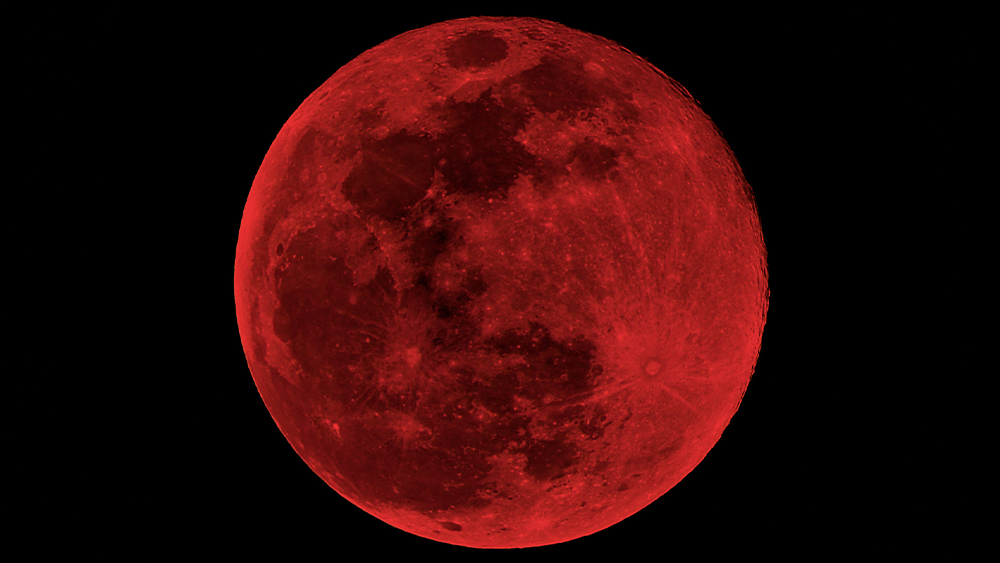
''Blood Worm Moon'' Total Lunar Eclipse 2025

Barring cloud cover, about 75% of the country saw the total lunar eclipse, aka the “Blood Worm Moon.” Texas had good weather conditions for last night’s display, as did the lower Great Lakes, Ohio Valley, and a portion of the Central Plains.

In a lunar eclipse, the shadow of Earth blocks most of the light that illuminates the surface of our moon. This eclipse began at 11:26 p.m. (PST) on Thursday, March 13, or at 2:26 a.m. (EST) Friday, March 14, and lasted over an hour (compared to last year’s total solar eclipse of just a few minutes).

The strange title “Blood Worm Moon” comes from the moon’s red appearance when the moon moves through Earth’s umbra (the darkest, innermost part of its shadow). It looks red because the sunlight that still reaches the moon is filtered through Earth’s atmosphere. This filtered light, especially the orange and red wavelengths, covers the moon in an orange/red hue—the “blood moon.” It was thought earthworms appear at about this time because the ground thaws from winter, ergo the title “Blood Worm Moon.”

This was the first total lunar eclipse visible anywhere in the world since November 2022.

Creationists see God’s hand in this fascinating celestial display. He designed the moon in such a way that the earth-moon pair has unique proportions not found anywhere else in our solar system. The moon also has a unique orbit around the earth, allowing us to view both solar and lunar eclipses. For example, the moon is 400 times smaller and 400 times closer than the sun. Coincidence? Hardly. Such a ratio is why we have spectacular total lunar eclipses given to us by the Creator, the Lord Jesus Christ.

We hope you enjoyed the "Blood Worm Moon" and remember who put it there for our enjoyment.

* Dr. Sherwin is a news writer at the Institute for Creation Research. He earned an M.A. in invertebrate zoology from the University of Northern Colorado and received an honorary doctorate of science from Pensacola Christian College.

The Latest
NEWS
Alive with Christ
“Now if we be dead with Christ, we believe that we shall also live with him: knowing that Christ being raised from the dead dieth no more; death...

NEWS
April 2026 Wallpaper
"Ask the Lord for rain in the time of the latter rain. The Lord will make flashing clouds; He will give them showers of rain, Grass in the field...

NEWS
Does Earth Have a Twin?
A possible Earth-like planet 146 light-years away has recently been discovered by citizen scientists.1 The evolutionary community is cautiously...

NEWS
Giant Virus, Big Claims: Does Ushikuvirus Explain Complex Life?
A newly discovered giant virus called ushikuvirus has been described by conventional scientists as a possible clue to how complex cells evolved. But...

NEWS
Conventional Science Still Struggling to Exhume the Great Unconformity
The book of Genesis tells us about a global flood that occurred about 4,500 years ago, an event that began with the bursting of the fountains of the...

NEWS
Designed to Handle Oxygen: Lessons from Asgard Archaea
Oxygen gives cells energy. But oxygen can also harm cells. Any organism that uses oxygen must both harness the power and protect itself against being...

NEWS
New Species of Spinosaurus Supports Flood Catastrophe
Many people are fascinated with dinosaur discoveries—a new fossil, a new species, and the impressive size. But whenever we read a news article,...

NEWS
Adaptation Without Innovation: Rethinking Mutations and Design
What if mutations that seem helpful today become harmful tomorrow? That question sits at the center of a new genetics study published in Nature Ecology...

NEWS
More Soft Tissue in Archaeopteryx
Was the famous extinct fossil named Archaeopteryx a bird or an evolutionary link that led to birds? And how confident should scientists and others feel...

NEWS
The Lipstick Vine: Evidence of Designed Adaption
In their desire to validate the questionable case for evolution, conventional biologists will appeal to local adaptation, variation, and ecological...