Creation scientists maintain that if something is living, then it’s automatically complex. This applies to organisms ranging from a single bacterium (a prokaryote, such as E. coli) to a blue whale (a mammal composed of untold trillions of sophisticated eukaryotic cells).
Recently, a report was published regarding unique microfossils from Western Australia.1 It is significant to conventional scientists that the microfossils resemble a type of photosynthetic algae (eukaryotic cells) more than they do bacteria.
This is because of the theoretical Great Oxidation Event (GOE) that supposedly occurred roughly 2.4 billion years ago during what’s called the Early Earth’s Paleoproterozoic Era. The event allegedly caused a rise in the concentration of oxygen. Because of this, it is reasoned there was a jump in the complexity of life that fundamentally changed Earth’s surface. Erica Barlow of the Department of Geosciences at Penn State said, “What we show is the first direct evidence linking the changing environment during the Great Oxidation Event with an increase in the complexity of life.”1
The Penn State report went on to say:
More work is required to determine if the microfossils were left behind by eukaryotic organisms, but the possibility would have significant implications, the scientists said.
It would push back the known eukaryotic microfossil record by 750 million years.
“The microfossils have a remarkable similarity to a modern family called Volvocaceae,” Barlow said.1 (emphasis added)
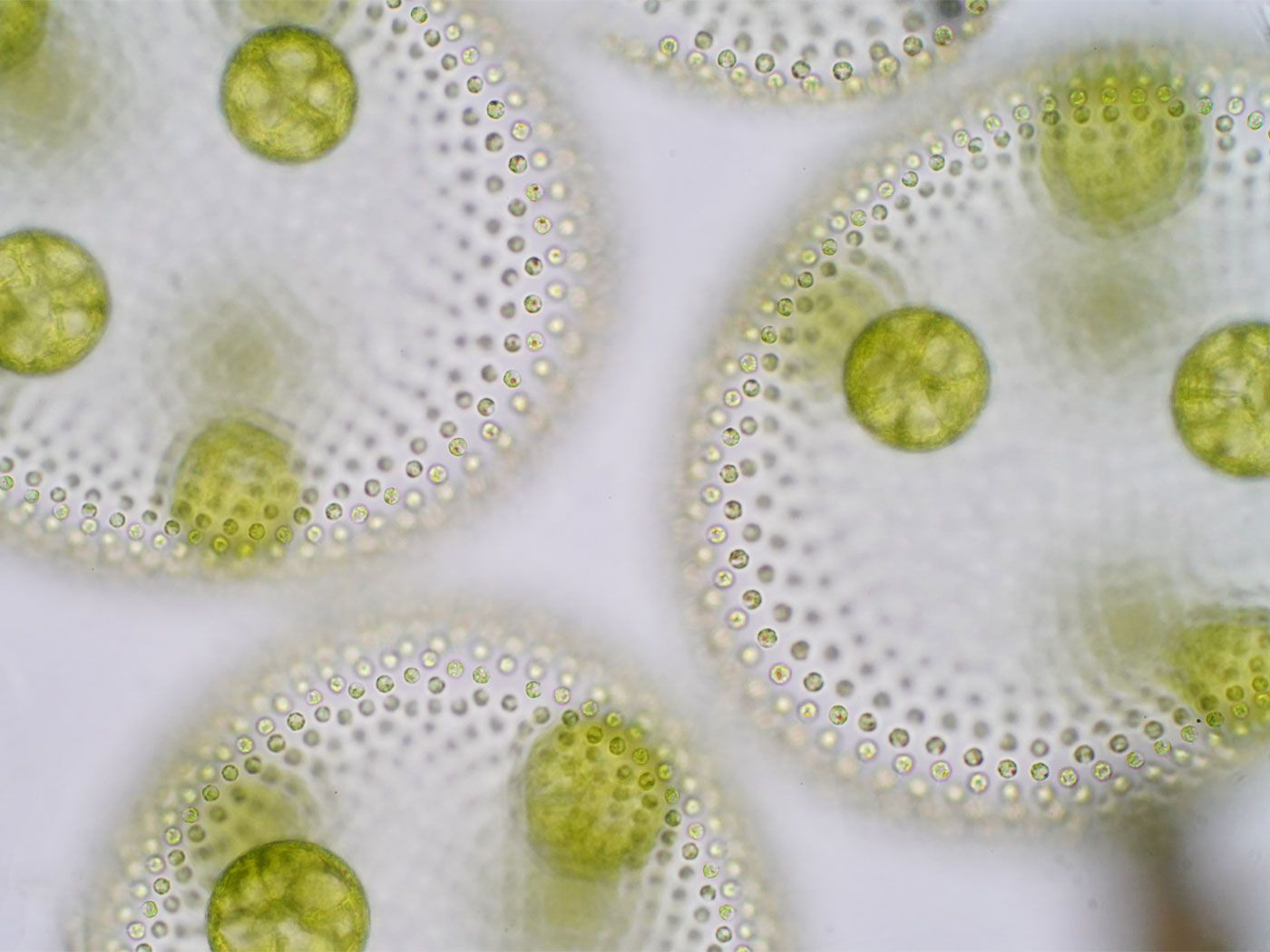
As stated above, the fossil evidence indicates that these were eukaryotic, photosynthesizing algal cells like Volvox, which is commonly studied by high school and college biology students.
Volvox is complex, and evolutionists can only hypothesize about their evolution.
Since its divergence from unicellular ancestors, Volvox has evolved into a highly integrated multicellular organism with cellular specialization, a complex developmental program, and a high degree of coordination among cells.2
There is no evidence that Volvox diverged from unicellular ancestors3 or that it randomly evolved its cellular specializations. In addition, these algae undergo photosynthesis, which is an incredibly complex process. This biochemical method could never arise naturalistically via chance and time.4,5
There are other problems with this “GOE jump in the complexity of life” theory. For example, the onset of the GOE is not really known. Evolutionists have narrowed it down to a paltry half-billion years.6,7,8
Additionally, the researchers never mentioned the critical transition from prokaryotic cells to eukaryotic cells, which is an ongoing evolutionary problem. The Penn State scientists stated, “Algae, along with all other plants and animals, are eukaryotes, more complex life whose cells have a membrane-bound nucleus.”1 How did the nuclear region of a bacterium evolve the very complex nuclear envelope (NE) of the eukaryotic cell? Such an envelope consists of an underlying nuclear lamina and nuclear pore complexes (NPCs), which have been described as “efficient chemical nanomachine[s].”9 The complexes are huge and embedded in the NE. There must be nucleocytoplasmic transport between the nucleus and cytoplasm of the cell via the NPCs for signaling pathways, gene expression, and cell cycle progression. So how did the NE and NPCs evolve?
It used to be thought that the nuclear region (nucleoid) of prokaryotes containing the cell’s DNA was relatively simple. Not anymore. The challenge for evolutionists is to explain how the negatively supercoiled DNA of a bacterium evolved into the chromosomes of eukaryotic cells. Many biologists see this supercoiled DNA with all of its associated enzymes to be every bit as complex as chromosomes, if not more so.
In a Geobiology paper, Erica Barlow et al. stated the Australian microfossils are not only relatively complex and large, but they also appear relatively early in Earth’s history. She also described the fossil’s “unusual form, whose distinctive, SA [spherical aggregate] morphology has no known counterpart in the fossil record.”10 The fossil is unique. Algae have always been algae.11
Finally, “These specific fossils are remarkably well preserved, which allowed for the combined study of their morphology, composition, and complexity [emphasis added],” said Christopher House, professor of geosciences at Penn State and a co-author of the study.1 Could this remarkable preservation have something to do with a massive, catastrophic flood just thousands of years ago?
Life has always been complex; it didn’t need a jump start via the ethereal Great Oxygenation Event. Furthermore, the Volvox cells alive today are the same kind of cells as the preserved microfossils—they show no change. Algae, animals, and angiosperms were all created by the Lord Jesus in the beginning.
References
- Window to the past: New microfossils suggest earlier rise in complex life. Penn State. Posted on sciencedaily.com November 7, 2023, accessed January 28, 2024.
- Herron, M. et al. 2009. Triassic origin and early radiation of multicellular volvocine algae. Proceeding of the National Academy of Sciences. 106 (9): 3254–3258.
- Tomkins, J. Algae Multicellular Evolution Study Debunked. Creation Science Update. Posted on ICR.org March 21, 2019, accessed January 27, 2024.
- Sherwin, F. Photosynthesis Continues to Amaze. Creation Science Update. Posted on ICR.org March 14, 2019, accessed January 28, 2024.
- Thomas, B. Photosynthesis uses quantum mechanics. Creation Science Update. Posted on ICR.org June 25, 2012, accessed January 28, 2024.
- Ross, L. et al. 2022. Evidence that the GOE was a prolonged event with a peak around 1900 Ma. Geosystems and Geoenvironment. 1 (2): 100036.
- Luo, G., S. Ono et al. 2016. Rapid oxygenation of Earth's atmosphere 2.33 billion years ago. Science Advances. 2 (5).
- Gumsley, A. et al. 2017. Timing and tempo of the Great Oxidation Event. Proceedings of the National Academy of Sciences of the United States of America. 114 (8): 1811–1816.
- Jamali, T. et al. 2011. Nuclear Pore Complex: Biochemistry and Biophysics of Nucleocytoplasmic Transport in Health and Disease. International Review of Cell and Molecular Biology. 287: 233–286.
- Barlow, E. et al. 2023. Distinctive microfossil supports early Paleoproterozoic rise in complex cellular organization. Geobiology. 22 (1).
- Thomas, B. Dinosaur Algae Alive and Well Today. Creation Science Update. Posted on ICR.org September 14, 2017, accessed January 28, 2024.
Stage image: Volvox
Stage image credit: Copyright © Frank Fox, 2011 (Creative Commons license). Used in accordance with federal copyright (fair use doctrine) law. Usage by ICR does not imply endorsement of copyright holder.
* Dr. Sherwin is science news writer at the Institute for Creation Research. He earned an M.A. in zoology from the University of Northern Colorado and received an Honorary Doctorate of Science from Pensacola Christian College.