 Defining where the global Flood of Genesis terminated in the rock record is of great importance in developing an accurate and cohesive story for the Flood. If the end of the Flood is placed too low, as is the case with proposing a Cretaceous-Paleogene (K-Pg, formerly K-T) boundary, it becomes necessary to speculate about implausible biological adaptations to explain many of the Cenozoic fossils.
For example, some K-Pg boundary advocates claim that legged proto-whales walked off Noah’s Ark and then somehow morphed through saltation into the diversity of whales we see today.1 This claim is very similar to the secular narrative. This interpretation becomes even more untenable because it forces all of the globally distributed whale fossils to be products of small local post-Flood catastrophes within a few hundred years after the Flood.
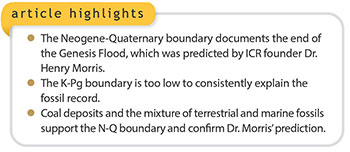
Despite this whale of a tale regarding an early Flood boundary, the global rock record provides a clear picture of the Flood sediments extending nearly to the top of the geologic column in the Upper Cenozoic—providing a Neogene-Quaternary (N-Q) Flood boundary.2 In fact, the latest stratigraphic data from North America, South America, Africa, and Europe indicate that at least 30% of all Flood sediments representing the geologic column are Cenozoic (late Flood), a group of strata also known as the Tejas Megasequence.2
But it’s not just the rock record that points to an N-Q boundary for the end of the Flood. Global paleontology pertaining to the Cenozoic layers contains extensive plant and animal fossils representing life that lived at higher elevations in the pre-Flood world. Two newly published papers by ICR scientists document this data in regard to global Cenozoic coal layers and South American paleontology.3,4
The first paper was published by ICR researchers Tim Clarey, Davis J. Werner, and Jeffrey P. Tomkins and shows how massive Cenozoic coal deposits are located on nearly every major continent, and in many cases are so vast they account for over half of that continent’s coal production.3
These huge Cenozoic coal beds are typically found in large basins and contain plant material ripped off higher elevations in the global Flood. The plant material was transported and caught and buried in basins as the floodwaters were pouring off the continents in the final phase of the Flood at the same time most mountain ranges were being uplifted. In addition, many offshore regions in the oceans also contain Cenozoic coals from plant material washed off the continents late in the Flood.
The second paper, published by Drs. Tomkins and Clarey, documents how the Cenozoic basin paleontology of South America also supports an N-Q boundary.4 The Andes in Western South America is the longest continental mountain range in the world and was uplifted and formed late in the Flood. This massive uplift caused the floodwaters to pour off east of the Andes, dumping huge amounts of plants and animals into the deep basins that formed next to the newly uplifted mountains. Not only do these Cenozoic deposits contain land animals and plants but also marine creatures, typical of Flood sediments at all levels in the geologic column. A progressive flood burying animals and plants by ecological zonation, combined with mixing of marine fossils, are the two primary rules for interpreting the paleontology of the global Flood.
In his classic book The Genesis Flood, ICR founder Dr. Henry Morris originally proposed that the record of the Flood extended nearly to the top of the geologic column (the N-Q), which included what was formerly called the Tertiary.5 Now his prediction has been fully vindicated, not only by ICR’s extensive global geological Column Project but also by paleontology.
References
- Tomkins, J. P. and T. Clarey. 2019. Whale Fossils Confirm Post-Flood Boundary. Acts & Facts. 48 (12): 9.
- Clarey, T. 2020. Carved in Stone: Geological Evidence of the Worldwide Flood. Dallas, TX: Institute for Creation Research, 312–353.
- Clarey, T. L., D. J. Werner, and J. P. Tomkins. 2021. Globally Extensive Cenozoic Coals Indicate High Post-Flood Boundary. Journal of Creation. 36 (1): 7-9.
- Tomkins, J. P. and T. L. Clarey. 2021. South American Paleontology Supports a Neogene-Quaternary (N-Q) Flood Boundary. Journal of Creation. 36 (1): 17-20.
- Whitcomb, J. C. and H. M. Morris. 1961. The Genesis Flood: The Biblical Record and Its Scientific Implication. Phillipsburg, NJ: P&R Publishing.
* Dr. Tomkins is Director of Research and Dr. Clarey is Research Scientist at the Institute for Creation Research. Dr. Tomkins earned his Ph.D. in genetics from Clemson University, and Dr. Clarey earned his Ph.D. in geology from Western Michigan University.