The scientific literature contains over 100 examples of original biomaterials in fossils.1 These include a few decades’ worth of reports, using at least a few dozen independent techniques to target specific vertebrate biochemicals—such as the hardy protein collagen.
One team of skeptics recently published a report trying to disprove the existence of collagen in supposedly ancient bone. They made the case that they found no collagen in their one dinosaur bone, and because they found microbes in it, therefore all the other claims of Cretaceous collagen are false. All that published work from hundreds of expert researchers around the world supposedly mistook modern microbes for ancient proteins.2 Three shortcomings in this report leave short-lived collagen perfectly intact inside dinosaur bones. It also leaves intact the enormous weight that fossil proteins force evolutionary time to shoulder.
The first shortcoming is lousy logic. Even non-specialists can see that just because one fossil bone has no collagen, it doesn’t mean others have none. Logicians call this the “hasty generalization fallacy.” It happens when we assume that just a few particulars in one instance describe the whole field in general. Even if their fossil bone had no collagen, so what? That could just mean that all the collagen in their bone decayed or degraded over the thousands of years it has been sitting underground since the Flood. Possibly most fossils have no collagen—but that doesn’t mean all do not, or cannot, have it.
Second, the study group used evolutionary logic in place of observational science. The eLife study authors wrote, “Reports of dinosaur protein and complex organic structure preservation are problematic for several reasons. Firstly, it remains unclear how such organics would be preserved for tens of millions of years.”2
Their circular logic looks like this:
2. Collagen cannot last millions of years.
3. Therefore, dinosaur fossils cannot contain collagen.
Next,
2. Reports show collagen in dinosaur fossils.
3. Therefore, reports must show contamination, not collagen.
The conclusions follow those premises, but what if the first premise is the very question at stake? The team merely assumed that dinosaur fossils cannot contain collagen by assuming that the bones are tens of millions of year old. They did not demonstrate those millions of years. Ultimately, they conclude contamination not because they found any evidence of contamination in the dozens of published reports, but merely on the basis of a time assumption.
Better logic follows this flow:
2. Numerous reports show collagen in dinosaur fossils.
3. Therefore, reports show that dinosaur fossils did not last millions of years.
Last, the eLife study concluded that tissues in fossils actually come from microbe-made biofilms (flimsy films that bacteria make) and not from the original animals. This conclusion addressed none of the experiments and arguments set forth in the definitive 2016 refutation of the biofilm idea, published in the free online journal PLOS ONE.3 Stunningly, the eLife study authors cited six PLOS ONE papers, but not the most relevant one from 2016! Possibly the only way they could get away with their biofilm claim is to simply ignore all the evidence against it—the report’s third shortcoming.4
The team found no collagen in one dinosaur bone by using none of the techniques that specifically target collagen. Does this mean that no other fossils can have collagen? Not at all. Total reliance on lousy logic like hasty generalization, begging the question, and cherry picking clearly disqualifies the conclusions in this eLife report. In fact, if one must resort to scholarship this poor to defend the biofilm claim, then the microbial contamination story looks more ridiculous now than before this eLife report got published.
References
1. List of Biomaterial Fossil Papers (maintained). Online document, accessed June 20, 2019.
2. Saitta, E. T. et al. 2019. Cretaceous dinosaur bone contains recent organic material and provides an environment conducive to microbial communities. eLife. 8: e46205.
3. Schweitzer, M., H., A. E. Moyer, and W. Zheng. 2016. Testing the Hypothesis of Biofilm as a Source for Soft Tissue and Cell-Like Structures Preserved in Dinosaur Bone. PLOS ONE. 11(2): e0150238.
4. This represents a shameful case of cherry-picking, or the incomplete evidence fallacy.
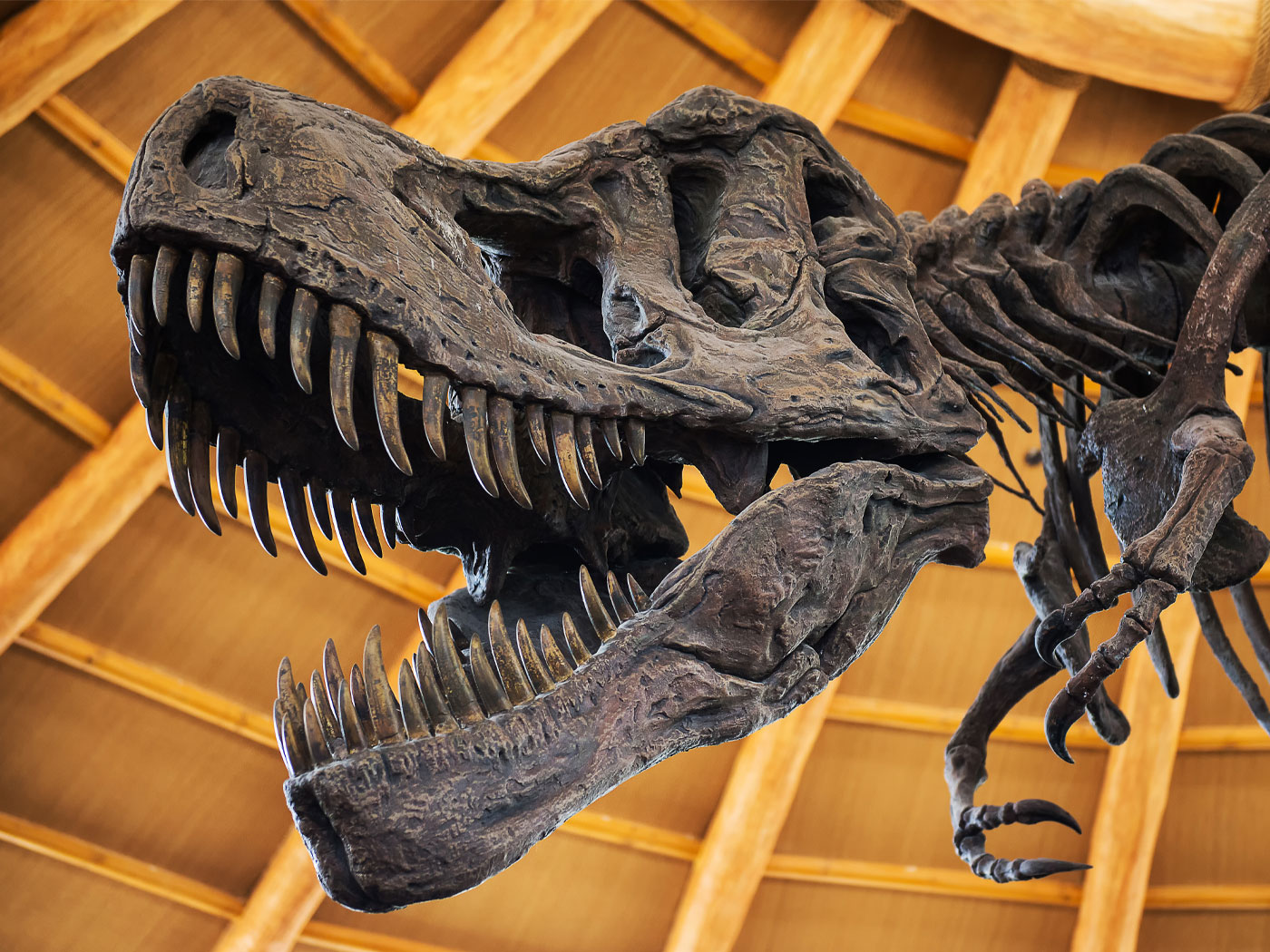
Image: T. rex (Cretaceous dinosaur) in Osaka, Japan.
*Brian Thomas is a Research Associate at the Institute for Creation Research.