Homo naledi is the most recent claim of a human evolutionary ancestor.1 Exactly what the bones represent remains unclear, but they are certainly not human.2 An additional mystery is how the bones ended up in the hard-to-reach chamber where they were found. My recent paper sheds light on this topic and offers a new emplacement method that fits the creation model for the post-Flood world.3
The original 1,550 H. naledi bone fragments were discovered in South Africa in 2013 in a remote cave called Dinaledi Chamber.1 Recently published age estimates indicate they are from the Pleistocene or Ice Age.4 An additional 131 fragments of H. naledi bones were found in a nearby cave site called the Lesedi Chamber in the same system.5 This cave is about 200 feet from the Dinaledi Chamber, and they share a common entrance chamber.
Lead researcher Lee Berger and his team proposed that the bones were deliberately placed there by living H. naledi in a burial ritual.6,7 As National Geographic reported, “Disposal of the dead brings closure for the living and confers respect on the departed, or abets their transition to the next life. Such sentiments are a hallmark of humanity.”8 It was further suggested that the disposal took place over an extended period of time.9
Exactly what the bones represent remains unclear, but they are certainly not human. 
The second discovery of H. naledi specimens in the nearby chamber adds to the mystery.5 Two separate discoveries make it less likely that the H. naledi remains in the Dinaledi Chamber were deliberately cached. Why place bodies in the Dinaledi Chamber, with its tortuous and narrow passages that can take an hour to traverse,10 if other H. naledi were being disposed of nearly simultaneously and in the same system in a chamber much easier to reach?
At least two of the geologic units found in the cave could have been deposited as one event—units 2 and 3b, as described by Paul Dirks.3,4 If these units were deposited simultaneously, as the physical geology indicates, then all the H. naledi bones could have been emplaced in a single flooding episode (or possibly closely spaced episodes) of the cave system that caused the spill of suspended clays and H. naledi remains to drain into both the Dinaledi and Lesedi Chambers (Figure 1).
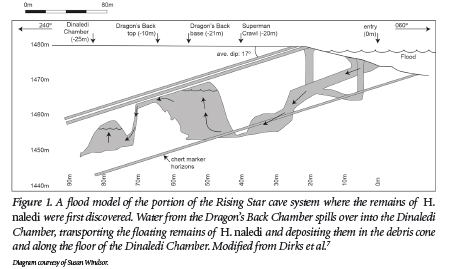 The emplacement of H. naledi in the Dinaledi and Lesedi Chambers may be nothing more than a consequence of extreme Ice Age climate fluctuations when Africa was experiencing more rainfall from the effects of the recent global Flood. Flash-flooding may have transported either previously deceased bodies or H. naledi taking refuge in the cave entrance and floated the partial remains to the chambers of the cave system. As the flood subsided, the bones simply lowered into place in the observed random orientations in which they were found.
References
- Berger, L. R. et al. 2015. Homo naledi, a new species of the genus Homo from the Dinaledi Chamber, South Africa. eLife. 4: e09560.
- The latest analysis of H. naledi bones indicates they are most similar to an australopith, like the famous Lucy. See O’Micks, J. 2017. Further Evidence That Homo naledi Is Not a Member of the Human Holobaramin Based on Measurements of Vertebrae and Ribs. Answers Research Journal. 10: 103-113.
- Clarey, T. L. 2017. Disposal of Homo naledi in a possible deathtrap or mass mortality scenario. Journal of Creation. 31 (2): 61-70.
- Dirks, P. H. G. M. et al. 2017. The age of Homo naledi and associated sediments in the Rising Star Cave, South Africa. eLife. 6:e24231.
- Hawks, J. et al. 2017. New fossil remains of Homo naledi from the Lesedi Chamber, South Africa. eLife. 6: e24232.
- Dirks, P. H. G. M. et al. 2016. Comment on “Deliberate body disposal by hominins in the Dinaledi Chamber, Cradle of Humankind, South Africa?” Journal of Human Evolution. 96: 149-153.
- Dirks, P. H. G. M. et al. 2015. Geological and taphonomic context for the hominin species Homo naledi from the Dinaledi Chamber, South Africa. eLife. 4: e09561.
- Shreeve, J. 2015. Mystery man: A trove of fossils found deep in a South African cave adds a baffling new branch to the human family tree. National Geographic. 228 (4): 30-57.
- Val, A. 2016. Deliberate body disposal by hominins in the Dinaledi Chamber, Cradle of Humankind, South Africa? Journal of Human Evolution. 96: 145-148.
- Berger, L. and J. Hawks. 2017. Almost Human: The Astonishing Tale of Homo naledi and the Discovery That Changed Our Human Story. Washington, D.C.: National Geographic.
* Dr. Clarey is Research Associate at the Institute for Creation Research and earned his Ph.D. in geology from Western Michigan University.