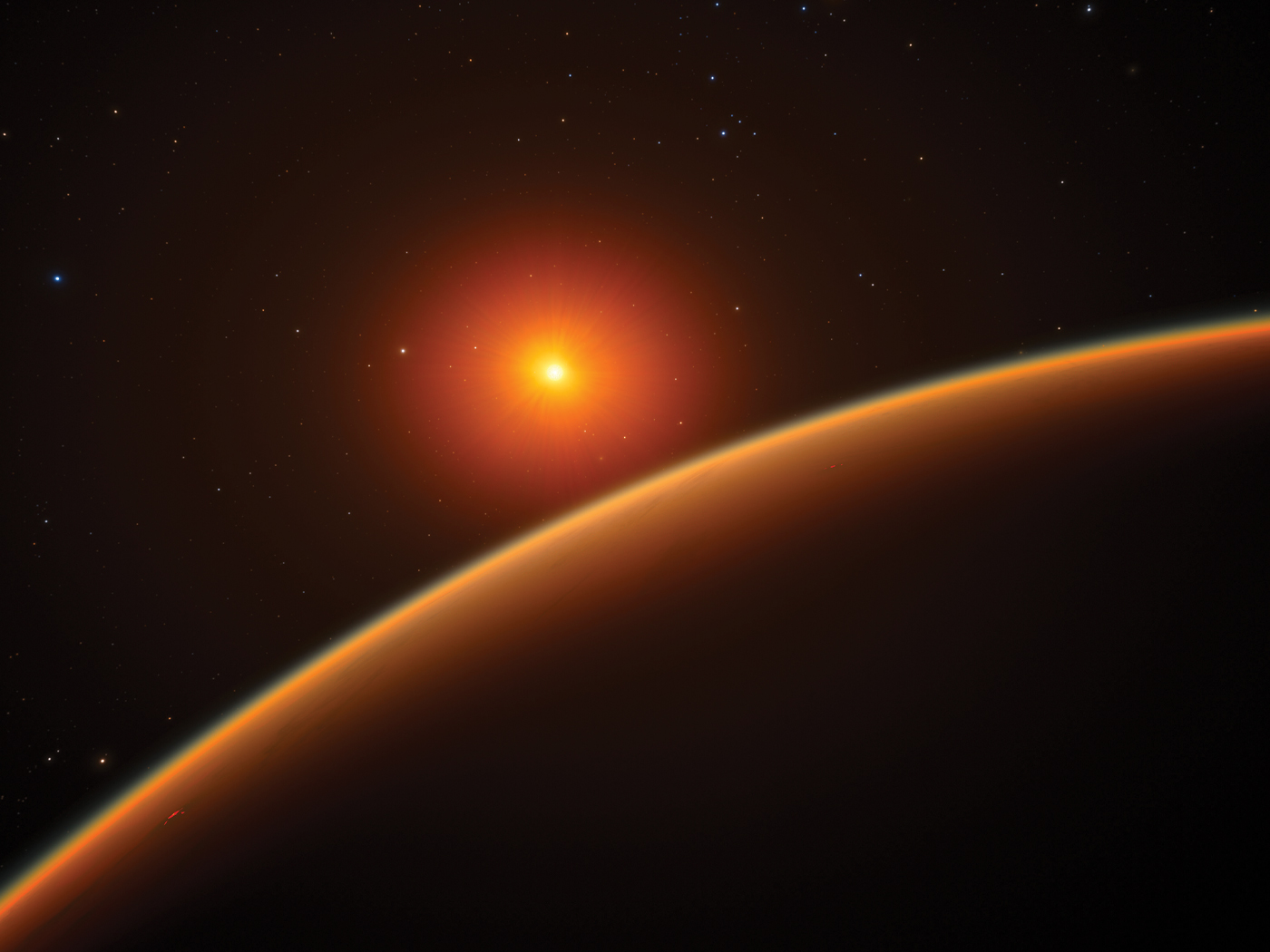
The system itself is around half the age of the Sun, at 2 billion years old, and given the intense radiation, a Neptune-like planet would not be expected to keep its atmosphere for so long, providing an intriguing puzzle to solve; how such an improbable system came to be.1
Secular scientists have offered hypotheses to explain LTT 9779b’s atmosphere.1 They suggest it started out as a much larger gas giant and most of its atmosphere was siphoned off by the gravity of its star, leaving behind a much smaller gas planet but one that still retains a significant atmosphere. Or perhaps LTT 9779b did not start out so close to its host star but was nudged relatively recently into its current position via collisions with other bodies. The first option sounds a little more plausible than the second and is predicted (or at least allowed) by models, but these models “require some fine tuning.”1 It’s not clear from the news article whether or not the models themselves need additional tuning, or whether the first scenario is so unlikely that it can only happen if very special conditions are met (probably the latter). In any case, secular astronomers were very surprised that a planet this close to a star would have a substantial atmosphere.
There’s a very simple solution to this mystery, but it’s one that secular astronomers are loath to consider: What if the true age of LTT 9779b is far, far less than 2 billion years? What if its age is only about 6,000 years, as the Bible implies? In that case, the planet could still retain a substantial atmosphere despite its nearness to the host star.
Make no mistake about it, the assumption of “deep time” is at the heart of this mystery. Astronomer James Jenkins from the University of Chile stated, “We believe these planets get stripped of their atmospheres over cosmic time, ending up as so-called Ultra Short Period planets.”3 Another news report said, “The age of this system is 2 billion years. At this high temperature, the planet’s atmosphere should have evaporated long ago, early in the system’s life.”4
Secular astronomers think stars and planets form naturally from spinning clouds of gas and dust. If this were the case, one would expect all planets to orbit their host stars in planes that coincide, or nearly coincide, with the host star’s equator. And they should orbit their stars in the same sense that the stars themselves are rotating. But many exoplanets have highly inclined orbits, and some orbit in the opposite sense as their host stars (i.e., counterclockwise when the host star rotates clockwise, or vice versa). As Scientific American said in 2011, “Observers in any field of science take a peculiar pleasure in seeing their theorist colleagues collapse into sobbing heaps, but it happens with unnerving regularity with exoplanets. Modelers have consistently failed to predict the diversity of planetary systems out there.”5
At ICR.org we’ve documented many such exoplanet “surprises.”6-8 And some of these exoplanets, such as LTT 9779b, call into question the idea of “billions of years.”9
Naturalistic theories are inadequate to explain the origin of planets, both those in and those beyond our solar system. Rather, these planets were created by the Lord Jesus Christ on Day 4 of the creation week just a few thousand years ago.10
References
1. Thorley, P. The first ultra-hot Neptune, LTT 9779b, is one of nature’s improbable planets. Phys.org. Posted on phys.org September 22, 2020, accessed October 23, 2020.
2. New study details atmosphere on ‘hot Neptune’ 260 light years away that ‘shouldn’t exist.’ Phys.org. Posted on phys.org October 23, 2020, accessed October 23, 2020.
3. Reference 1, emphasis added.
4. Carr, S. Data reveals evidence of molecular absorption in the atmosphere of a hot Neptune. University of New Mexico news release. Posted on news.unm.edu October 26, 2020, accessed October 26, 2020.
5. Musser, G. Why don’t exoplanets match astronomers’ expectations? A dispatch from the American Astronomical Society meeting. Scientific American. Posted on scientificamerican.com January 13, 2011, accessed October 23, 2020.
6. Thomas, B. Exoplanet Discoveries Demolish Planet Formation Theories. Creation Science Update. Posted on ICR.org January 24, 2011, accessed October 23, 2020.
7. Thomas, B. Planet’s Reverse Orbit a New Twist in Old Evolutionary Story. Creation Science Update. Posted on ICR.org September 18, 2009, accessed October 23, 2020.
8. Hebert, J. Intermediate Gas Giants Challenge Planet Formation Theory. Creation Science Update. Posted on ICR.org January 24, 2019, accessed October 23, 2020.
9. Hebert, J. “Hot Jupiter” on the Verge of Destruction. Creation Science Update. Posted on ICR.org March 19, 2020, accessed October 23, 2020.
10. Genesis 1:14-19; John 1:1-3; Colossians 1:16.
*Dr. Jake Hebert is Research Associate at the Institute for Creation Research and earned his Ph.D. in physics from the University of Texas at Dallas.