




Can Cosmic Collisions Create?
From setting orbits straight and creating moons, to manufacturing magnetic fields, secular science has consistently used chance cosmic collisions and near-misses to explain the origins of a host of fine-tuned attributes. This strong reliance on lucky coincidences reveals a bias toward “methodological naturalism.”
Inflation Hypothesis Doesn't Measure Up to New Data
Since the Big Bang story of the origin of the universe has been refuted by a host of external observations and internal contradictions,1 secular science has been forced to postulate additional, exceedingly improbable events to keep it afloat.
Methane on Mars: The Stuff of Life?
On January 15, 2009, NASA scientists announced what they believed could be evidence of life on the planet Mars. What they had actually found was methane in the atmosphere, a gas that can be produced by either living organisms or non-living geological processes. The origin of the methane is currently unknown, so speculation that Mars is a “living” planet is somewhat premature.
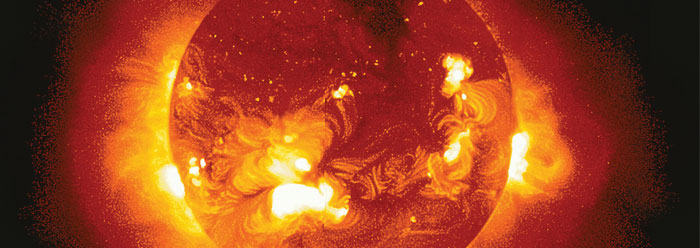
More Than a Rising Star
On his widely popular Cosmos science program in 1980, Carl Sagan described our paltry existence in pathetic terms: "We live on an insignificant planet of a humdrum star, lost in a galaxy, tucked away in some forgotten corner of universe in which there are far more galaxies than people." Several developments since then have altered this perception dramatically.
.gif)
Pages
