



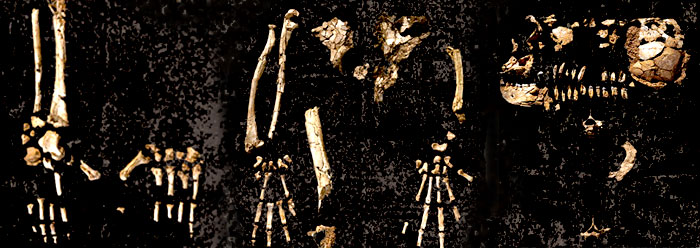
Did Humans Evolve from 'Ardi'?
Ardipithecus ramidus is an extinct primate whose fossilized remains were first found along the Awash River in Ethiopia about fifteen years ago. Many fragments were collected, including shattered bones from a four-foot-tall female nicknamed "Ardi." She was chosen to represent her kind, apparently because of the comparative completeness of her remains.

Preadaptation: A Blow to Irreducible Complexity?
Molecular biologist Michael Behe described a system made of several interacting parts, whereby the removal of one part would disrupt the functioning of the whole, as irreducibly complex. Both creation scientists and intelligent design proponents highlight examples of irreducible complexity in their studies.

Rainforest Fossils Demonstrate Dramatic Climate Change
Researchers are recovering beautiful fossils from the Cerrejón Formation of Colombia. One was a giant snake, called the “Titanoboa.” Most recently, a study examined the formation’s fossilized flora, which looked the same as modern plants, and the rainforest environment in which they lived.1 This research dovetails nicely with other studies on ancient earth’s turbulent climate.
New Fossil Cache Shows Plants Haven't Changed
A coal mine in the Cerrejón Formation of Colombia has yielded a gold mine of fossils. This particular cache preserved a time in earth history when the tropical climate was quite different from today’s. Evidence indicates that it was warmer and wetter. But despite the different climate, the fossilized tropical plants were the same as today’s, albeit less diverse.
Does Altered Fish Vision Exhibit Evolution?
Biologists recently analyzed special proteins in fish eyes that capture light photons, making vision possible. By comparing the sequences of a critical protein from different fish, they identified a particular alteration that likely occurred somewhere along the line of this fish’s ancestry. The altered protein resulted in the fish seeing visible light instead of ultraviolet rays, or UV.
Pages
