An organization named Noah’s Ark Scans is investigating a site called Durupinar, almost 20 miles from Mount Ararat in Turkey. Could it contain some remains of Noah’s Ark? The group’s founder, Andrew Jones, said in a press release, “I believe this is Noah’s Ark, that’s why I’m putting the Durupinar site through the most rigorous testing possible.”1
The same release announced that as part of this “rigorous testing,” they are drilling at the site. The team is looking to see if any features might fit the interpretation that Noah’s Ark is at this location. Several major news sources have picked up this story, and folks are asking ICR for our take.2,3 ICR and others have investigated Durupinar and found compelling reasons to cross it off the list of possible ark sites.
First, there are mismatches between the size and shape of the phenomenon at Durupinar and the Bible’s description of the Ark. The lenslike shape in the ground there has sharply pointed ends—supposedly the front and back of a boat now turned to stone. But Genesis 6:14 uses the Hebrew word tebah, meaning “box.” Boxes do not have curved sides with pointy ends, nor would that lenslike shape have had the stability required to survive the rigors of a worldwide flood, as studies on ark models with biblical dimensions have shown it had.4,5
Second, ICR geoscientist Dr. John Baumgardner studied the Durupinar site in 1987 and 1988, noted by Noah’s Ark Scans on their website.6 He concluded that the in-ground shape was natural. An ancient lava flow hit some resistant material and flowed around it to soon harden into its lens shape. Solid rock is not a good candidate for an ark’s wooden walls.
Finally, current ark researcher Dr. Don Patton has likewise felt long convinced that the Durupinar site has nothing to do with the landing place of the Ark. He told ICR, “I have personally examined the Durupinar site many times. This is a natural feldspar formation.” He further described how at one point dynamite was used to probe more deeply. “It demonstrated weathered feldspar all the way.” No ark to see here.
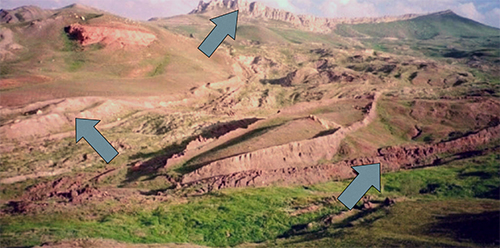 Patton also provided an aerial photograph of the site that shows at least three nearby outcrops of similar shape and material. If one of these shapes was a boat, shouldn’t the other shapes represent boats as well? Patton said, “Noah was not an admiral of a fleet.”
These and other observations refute claims that the Durupinar site is the real Ark.7 It is not. However, the fact that any ark research—accurate or not—can make international news shows that fascination with the Ark persists even millennia after it carried our ancestors through a worldwide, watery judgment (1 Peter 3:20).
References
- Core Drilling Begins at Durupinar Noah’s Ark Site, Drill Bit Shatters on Possible Layer of Petrified Wood. GlobeNewswire. Posted on globenewswire.com September 23, 2026, accessed September 28, 2026.
- See for example, Mashuga, J. Researchers Ignite Noah’s Ark Debate After Saying Boat-Shaped Mound near Mount Ararat ‘100%’ Man-Made. Yahoo! News. Posted on yahoo.com September 25, 2026, accessed September 25, 2026.
- See also Liberatore, S. Noah’s Ark Resting Place ‘100% Confirmed’ After 4,300 Years as Astonishing ‘Man-Made’ Structure Is Detected Buried Deep Underground. Daily Mail. Posted on dailymail.com September 22, 2026, accessed September 24, 2026.
- Hong, S. W. et al. 1994. Safety Investigation of Noah’s Ark in a Seaway. Journal of Creation. 8 (1): 26–36.
- Lovett, T. 2024. Noah’s Ark: Proportions of a Real Vessel. Answers in Depth. 19.
- Noah’s Ark Project Details. Noah’s Ark Scans. Posted on noahsarkscans.com, accessed September 28, 2026.
- Hale, T. No, Researchers Haven’t Found “Noah’s Ark” near Mount Ararat in Eastern Turkey. IFL Science. Posted on iflscience.com September 25, 2026, accessed September 28, 2026.
Image with arrows: Dr. Don Patton
Stage image: Durupinar site
Stage image credit: Mfikretyilmaz, CC BY 3.0 Unported. Used in accordance with federal copyright (fair use doctrine) law. Usage by ICR does not imply endorsement of copyright holder.
* Dr. Brian Thomas is a research scientist at the Institute for Creation Research and earned his Ph.D. in paleobiochemistry from the University of Liverpool.