



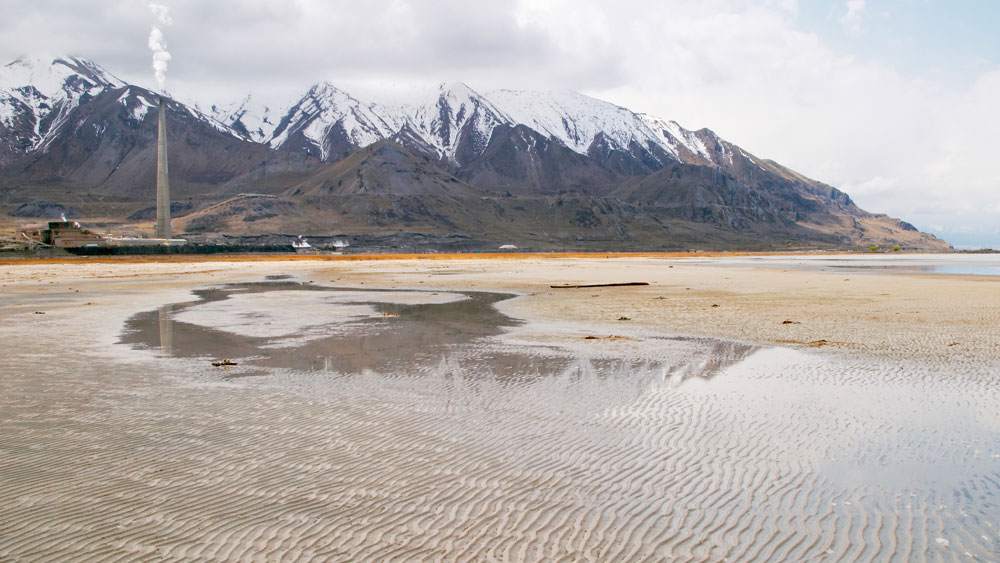
Water that is nearly five times saltier than the ocean is deadly to most animals. But in Utah’s Great Salt Lake, scientists have found a tiny roundworm living in these harsh waters. The organism, called Diplolaimelloides woaabi, was recently described in the Journal of Nematology.1 Its discovery gives a clear example of how life can function at the edge of what is possible. More than adding a new species name, this worm shows features that precisely fit its environment.
Researchers found the worm living inside microbialites. These are layered, rock-like structures built by microbes on the lakebed.1 Microbialites are difficult places to live. Salt levels are extremely high, oxygen levels can change fast, and food is not consistently available. For a multicellular animal to survive there, it must keep careful control of its internal chemistry. Scientists identified D. woaabi as a free-living (rather than parasitic) nematode with clear physical traits. These include special sensory organs and a small, compact body that fits into tight, mineral-filled spaces.1 These traits allow the worm to move, feed, and reproduce where most animals could not survive.
One key trait is the worm’s ability to handle osmotic stress. In very salty water, cells lose water and proteins can stop working as they should. Even so, D. woaabi keeps its internal balance. While the study does not explain every molecular detail, similar nematodes use controlled ion transport systems, protective membrane compounds, and stress-response proteins to keep cells stable.2 These systems do not work alone. They sense changes in the environment and respond together. This kind of coordination—where multiple systems work toward a single function—is a hallmark of biological design rather than an independent, unguided processes.2,3
The worm also plays a role in its ecosystem. Nematodes are important recyclers in many environments, including extreme ones. They feed on microbes and help move nutrients through food webs.1,4 Inside the microbialites, D. woaabi likely helps control microbial growth and supports balance in the lake’s ecosystem. Its body design and behavior fit well with this role, showing a strong link between structure and function.
The setting of this discovery adds to its significance. The Great Salt Lake is changing and under stress. Rising salinity and lower water levels are threatening the lake’s biological balance.5 Organisms like D. woaabi can survive only within narrow limits. Because of this, their presence can reflect the health of the environment.1,5 Even small changes in water chemistry could affect their survival. This shows how closely life is matched to its surroundings.
Taken together, the features seen in Diplolaimelloides woaabi—salt control, compact body design, sensory ability, and ecological role—form a clear picture. Each trait supports the others. The worm is not only able to survive extreme conditions but functions well within them. Discoveries like this remind us that even the smallest living things show careful biological order. Their balance and precision invite wonder at how life is put together.
Observations like these echo a truth recorded long ago. Scripture says, “But now ask the beasts, and they will teach you; and the birds of the air, and they will tell you . . . . Who among all these does not know that the hand of the Lord has done this, in whose hand is the life of every living thing” (Job 12:7, 9–10). When even a tiny worm shows such precise fit and careful balance, it points beyond chance. Nature itself bears witness to the Creator through the lives it sustains.
References
- Jung, J. et al. 2025. Diplolaimelloides woaabi sp. n. (Nematoda: Monhysteridae): A Novel Species of Free-Living Nematode from the Great Salt Lake, Utah. Journal of Nematology. 57 (1): 20250048.
- Wharton, D. A., A. J. Marshall, and K. R. Viney. 2010. Osmoregulation in the Antarctic Nematode Panagrolaimus davidi. Journal of Experimental Biology. 213 (12): 2025–2032.
- Guliuzza, R. 2024. Why Biology Needs A Theory of Biological Design—Part 1. Acts & Facts. 53 (3): 4–7.
- Sapir, A. 2021. Why Are Nematodes So Successful Extremophiles? Communicative & Integrative Biology. 14 (1): 24–36.
- Williams, C. Great Salt Lake’s Latest Species Discovery Gets a Name Fit for the Lake’s Native History. KSL News. Posted on ksl.com December 13, 2025.
* Dr. Corrado earned a Ph.D. in systems engineering from Colorado State University and a Th.M. from Liberty University. He is a freelance contributor to ICR’s Creation Science Update, works in the nuclear industry, and is a Captain in the U.S. Naval Reserve.

