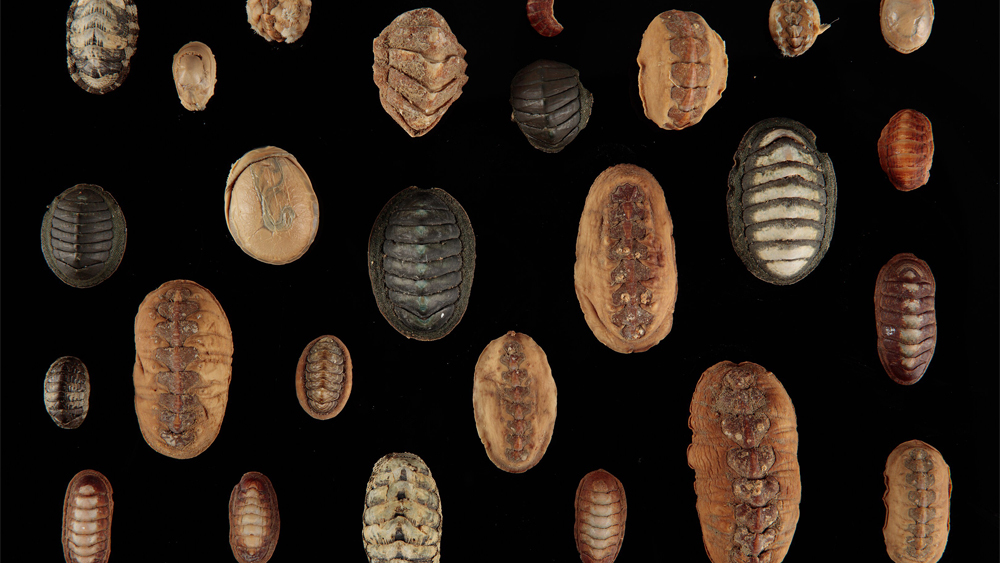
Mollusks consist of a wide range of invertebrates that include the intelligent octopus, pulmonated snails (gastropods), and bivalves (clams). They appear suddenly in the early Cambrian about 514 million years ago according to evolution theory. In 2020, evolutionists said there is “no good record of molluscs before they had shells, and there can be some doubt that certain early fossil shells are really remains of molluscs.”1 Five years later, evolutionists writing in Nature said, “Mollusca is the second most species-rich animal phylum, but the pathways of early molluscan evolution have long been controversial.”2
Indeed, the story of mollusk evolution has been rewritten again in light of the discovery of spiky fossils called Punk ferox and Emo vorticaudum. They belong to the molluscan group Aculifera (e.g., chitons). Evolutionists have long seen this group of mollusks as primitive and rudimentary. But science writer Sanjana Gajbhiye stated, “this discovery paints a different picture, revealing their complexity and evolutionary ingenuity.”3 Additionally, Sutton et al. reported in Nature that the two species had a mode of locomotion that was “novel” and “unusual.”
The intricacy of these creatures is no surprise to creationists, who expect these “primitive” aculiferan species to be very complex. But notice that credit is given not to the Creator but to evolution for being clever, resourceful, and imaginative. Is there anything this mindless, random process can’t do?
Sutton et al. also describe these “two new three-dimensionally preserved aculiferan species from the Silurian Herefordshire Lagerstätte [sedimentary layer with unique, well-preserved organic remains].”2 The sediments “preserve a diverse open marine biota in remarkable detail”2 that are “exceptionally well preserved and reveal details of the soft tissues [that] is extremely rare,” according to a lead researcher, Mark Sutton of Imperial College London.3 Again, the creation model expects this, predicting well-preserved fossils due to their rapid and catastrophic burial about 4,500 years ago.4
The “early” mollusks (aculiferans) were sophisticated, show no evidence of evolution, and were well-preserved in sediments, which is contrary to evolution and consistent with the creation model.
References
- Hickman, C. et al. 2020. Integrated Principles of Zoology. New York, NY: McGraw Hill, 366.
- Sutton, M. et al. 2025. New Silurian Aculiferan Fossils Reveal Complex Early History of Mollusca. Nature. 637: 631–636.
- Gajbhiye, S. Fossils Called Punk and Emo Rewrite the Story of Mollusk Evolution. Earth.com. Posted on earth.com January 13, 2025.
- Morris, J. and F. Sherwin. 2017. The Fossil Record. Dallas, TX: Institute for Creation Research.
Stage image: Chiton fossils
Stage image credit: Copyright © CC BY 2.0, Auckland Museum Collections. Used in accordance with federal copyright (fair use doctrine) law. Usage by ICR does not imply endorsement of copyright holder.
* Dr. Sherwin is a news writer at the Institute for Creation Research. He earned an M.A. in invertebrate zoology from the University of Northern Colorado and received an honorary doctorate of science from Pensacola Christian College.