Purpose
The Coconino Sandstone is one of the most well-known formations in Grand Canyon. The blond-colored sandstone, just three layers down from the rim, forms a distinctive cliff that can be traced as far as the eye can see. It is noted for its large, angled cross-beds that many scientists believe represent ancient desert sand dunes. In fact, some have said that this formation alone is sufficient to prove the Bible is wrong about Noah’s Flood. Arthur Strahler claims, “In itself it [the windblown origin of the Coconino] is sufficiently weighty to totally discredit the biblical story of the Flood of Noah as a naturalistic phenomenon occurring in one year.”1 Strahler correctly reasoned that you cannot have a desert during Noah’s Flood.
Methods
As part of ICR’s FAST (Flood Activated Sedimentation and Tectonics) project, Paul Garner, Ray Strom, and I sought to overturn the reigning conventional desert paradigm for the Coconino. The project was funded by ICR, Cedarville University, Calgary Rock and Materials Services Inc., and some private individuals. It involved many years of field work, sample collection, library study, and laboratory work. The results were presented to both the conventional and creation science communities as abstracts and papers.
When we first started this project, the task was daunting. How could we ever find evidence to overturn a paradigm that had been well-established for over 75 years? What we found was surprising— the rocks had not been carefully studied in outcrop or under the microscope, and no significant work on the formation had been completed in decades.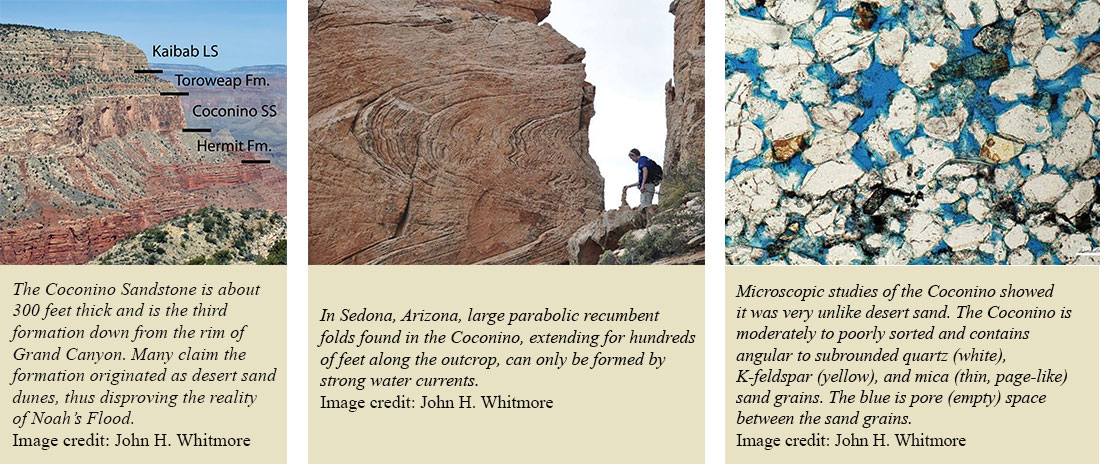 Results
Here is a summary of our most significant findings.2
- Cross-bed angles. Modern dunes contain a wide range of angled beds, from a few degrees to about 40°. Our hundreds of Coconino crossbed measurements cluster around 20°, with both high and low angles conspicuously missing. This is contrary to what many have claimed (“steep cross-bed dips”) but have never documented with actual measurements.
- Rounding and sorting. Wind causes desert sand grains to become round and sorts the sand grains so that they are all about the same size. For decades, claims have been made that this is what the Coconino was like, too—but no one looked at its sand grains under the microscope until we did. The Coconino has subangular grains and is moderately sorted (like sand found in the ocean), contrary to conventional expectations. Dolomite. The mineral dolomite occurs as clasts, rhombs, ooids, beds, and cement widely throughout the Coconino.
- Dolomite is a marine mineral and would not be expected to form in arid conditions.
- Mica. The mineral muscovite is a soft type of mica that we observed in almost every rock thin section under the microscope. Muscovite is normally destroyed by the abrasive action of the wind in deserts but is an abundant mineral in all kinds of aqueous settings.
- Extent. It was found that the Coconino forms a thin but continuous sheet extending from California to the Dakotas.
- Parabolic recumbent folds. Guy Forsythe found these unusual types of folds in Sedona, Arizona. They can only be formed by strong water currents.
Impact
Much more can be said about the sedimentology, paleontology, and stratigraphy of the formation that all conclusively point to an underwater origin. The project demonstrates that creationists should not be afraid to scientifically investigate well-established paradigms that challenge biblical views. Many surprises await!
References
- Strahler, A. N. 1999. Science and Earth History: The Evolution/Creation Controversy. Amherst, NY: Prometheus Books, 217.
- Whitmore, J. H. and P. A. Garner. 2018. The Coconino Sandstone (Permian, Arizona, USA): Implications for the Origin of Ancient Cross-bedded Sandstones. In Proceedings of the Eighth International Conference on Creationism. J. H. Whitmore, ed., Pittsburgh, PA: Creation Science Fellowship, 581–627. This summary paper includes a list of our extensive publications. Work on the formation by Whitmore and others is ongoing.
* Dr. Whitmore earned his Ph.D. in biology with an emphasis in paleontology from Loma Linda University. He is Senior Professor of Geology at Cedarville University and a 1991 graduate of ICR.